
Technical Information
Latest


The Porsche 914-6 GT was a race car built by Porsche, based on the 914 model with a 6-cylinder engine and GT package. The 914-6 GT was a race configured version of the 914-6. The factory offered the GT option, which was distinguishable by its box-like steel fender flares. It quickly became known as the 914-6 GT and was raced employing different engine configurations. This included the 'T' specification, which was a basic 911 engine. Another popular configuration was to use a converted Carrera 6 engine.

Porsche only built 2 914/8s. The first was a development mule that Piëch used to prove the concept of a 914/8. The second was built for Ferry Porsche as a birthday present. Both are very unique 914s still owned by Porsche and regularly shown at the museum in Stuttgart. They had a 300 HP 3.0L 908 engine and a 916 transmission, and was never registered for the street. This was a test bed and a prototype.

For 1974 a 1.8-liter engine replaced the 1.7 and had a new type of electronic fuel injection called AFC (air flow control), or ‘L’ Jetronic. This same basic injection was used on 911s in the late-’80s. Unfortunately, due to emissions regulations, the 1.8 made just 76 hp, less than the smaller engine it replaced. The standard steel wheels were changed to 5.5-inch wide VW units. Rubber bumper guards now adorned the rear and the headlight surrounds were changed from white to black plastic. US cars got the infamous ignition seat-belt interlock buzzer. This was also the year of the limited edition series.


Porsche produced two limited edition 914 models: the Creamsicle and Bumblebee, the latter created to celebrate the Porsche's domination of the Can-Am series with the Type 917. The Bumblebee was finished in black with contrasting Summer Yellow lower sections. Many otherwise optional items were standard on these limited edition models, including driving lights, dual horns, a leather covered steering wheel, and a centre console with clock etc. 500 of each type were manufactured.


Porsche 914 Model Numbers Standard Equipment = Basic Equipment (no appearance or performance group) Appearance Group = Comfort Equipment...

Porsche 914 Paint Color Options & Samples This post outlines all the color options for the Porsche 914 over its...

Porsche 914/4 Vehicle Type Codes Year Model Engine Code Displ (cc) HP DIN @rpm Bore (mm) Stroke (mm) Compression Fuel...

Porsche 914 Tune Up Specifications Valve Clearance with engine cold Description 1700cc 4-Cylinder 1800cc 4-Cylinder 2000cc 4-Cylinder 2000cc 6-Cylinder Intake...

Porsche 914 Torque Specifications Engine Description lb f ft. kg f m Oil Drain Plug 16 2.2 Retaining nut for...

Porsche 914 Lubricants & Fuel Specifications Description Temperature Range Recommended Type Capacity Engine Oil Below 5F (-15C) SAE 10W, 10W-30...

Porsche 914/4 Vehicle Type Codes Year Model Liters Engine Code Displacement (cc) HP DIN @rpm Bore (mm) Stroke (mm) Compression...

Porsche 914 VIN, Engine, Transmission & Chassis Numbers Our reader already know we have an in-depth VIN decoder for Porsche...


1973 – 1976 Porsche 914 2.0L Specifications ...


German pricelist for 1974 model year Porsche 914 1.8-litre, 63 kW 2.0-litre, 74 kW VW-Porsche 914-4 DM 13.990 DM 14.990...

Some great work by one of our colleagues who managed to put together the chassis numbers for all the Porsche...



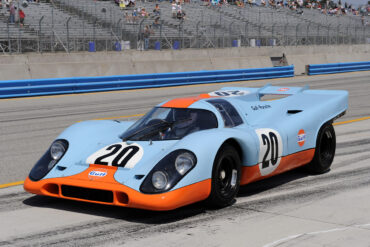


Porsche 935/77 “Baby” Specifications ...

Porsche 935/77 Specifications This is the spec sheet for the Porsche 935/77. Note there was also a 1.4 Liter “Baby” Porsche...


Porsche 935 Tribute Specifications Concept: Single-seater near-standard non-homologated race car. Basis: Porsche 911 GT2 RS (991.2) Weight/dimensions:...




The 992 Porsche Targa 4 GTS adds more grunt, packs less weight, has sharper handling, and packages it up in the sexiest bodystyle that Porsche sells. The Targa 4 GTS gives us the best of all worlds, providing all-wheel-drive traction, an open-top experience, and a fixed-roof feeling in the same car. Its automatic transmission and adaptive suspension completed the image of a daily-driver sports car. This may be the perfect car.

Porsche has also decided to gift the GTS a more distinct and dynamic personality that can’t be duplicated via the Carrera S’s options list (even if you could get the engine, which you cannot). The downside is that the price has gone up too and ticking a few more options boxes can get the Carrera 4 GTS Cabriolet into 911 Turbo territory price-wise. In the engine department, the 3-litre twin turbo flat six develop 473 bhp and 420 ft lbs.


The engine is the same 3.0-litre, twin-turbocharged flat-six petrol engine as in the 911 Carrera S, but it has been fettled to produce 473 bhp. The GTS also has a bespoke suspension set-up that sits 10mm lower than the standard 911, and that's true no matter whether you choose two- or four-wheel drive. Most of the time, there's absolutely no difference between the standard GTS and the all-wheel-drive version. But when you need it, the AWD Carrera 4 GTS will save you.

The 992.1 Porsche 911 Carrera GTS Cabriolet arrives with 473 horsepower and 420 ft lbs of torque. Porsche's ultimate Carrera cabriolet model is brilliant, and flexible. Sure, you can go faster in a 992 911 Turbo, but we guarantee it won't be as much fun or as engaging as the GTS Cabriolet. This is just a great car, an all-round sports car that combines effortless performance with open top fun. It gets a 3.0-liter twin-turbocharged flat-six engine producing 473 horsepower.

The reality was that in the past you could basically build your own GTS. In the past, Porsche offered an optional factory "power kit" for 911 Carreras, but things are different now. That isn't an option for the 992. The 992 Porsche 911 Carrera GTS is therefore your only pass for accessing a version of the 3.0-liter twin-turbo flat-six tuned up to 473 hp and 420 ft lbs of torque. Those figures are achieved via an approximately 14.5 percent increase in turbo boost pressure.


Porsche 550 Spyder Production Porsche assigned build numbers to each of the 550/1500RS cars built (RS short of rennsport which...

Porsche 550 Spyder Chassis Numbers & Stories Chassis #550-0016 to #550-0090 One year before Porsche started production of the legendary...


When the German Army tender was lost to DKW, Porsche decided to market the product for civilian use, supposedly for hunting. This provided the 597 with a nickname “Jagdwagen”. In addition to the military prototypes around 50 Jagdwagens were produced, but there was no need for such a product in large numbers and the project was terminated.

Buchmann took a Porsche 928, removed all of the "unwanted" crap behind the doors and parts of the roof and created the stunning Buchmann Targa. This is a Targa convertible with an open roof above the seats but still with the B-pillar in tact. This opening is bridged by a Targa-bar which gives the car extra stiffness to compensate for the loss of it by removing the roof. The concept was a stunner.

In the 1980s and 90s, the Munich-based tuning company Koenig Specials GmbH was known for its conversions of top-class sports cars, especially Ferraris. They also turned their attention to the Porsche 928 with a number of cool 928 kits. Popular in the Middle East, these "widebody" kits made the 928 look like a totally different car. It is unknown how many were made and most of the cars were pretty unique in terms of the kit and updates.

When it comes to land speed records speed is measured to the fifth decimal place (hundred thousandths). So when Carl Fausett’s Porsche 928 hit 216.63537 MPH, that was more than enough to capture the title of World’s Fastest Porsche 928 (previously set at 206 MPH). It happend on August 7, 1986 with Al Holbert behind the wheel.

Porsche shipped one of its experimental 'All-aluminum' 928S to the Brumos Racing Team for the 1984 24 hours of Daytona with the instructions not to modify the car in any way. Porsche desired to promote the performance of the 928 in the U.S. The drivers were given specific instructions to just 'drive the car'.

In collaboration with tuning company AMG, in 1986 Porsche created several long-wheelbase 928 specials. These models had normal 928 headlights until the Porsche 942. One was given as a gift to American Sunroof Corporation founder and CEO Heinz Prechter. The ASC was eventually part responsible for making Porsche 944 S2 cabriolets.

Porsche's Racing Department never officially entered or prepared a racing 928 for a pure works entry. In order not to offend sensibilities of their traditional 911 customers by openly challenging them with a Works 928GTR offering, Porsche asked Max Moritz Racing, their longtime private racing partner from next door Reutlingen to enter a 928GTR Cup as a 'semi-works' car.


Porsche 928 Reliability Issues If properly maintained by someone who understood the car, second-hand 928s should have no significant issues....


Porsche 928 Engines & Transmissions Chart Below is a graphic overview of Porsche 928 engines and transmissions compared to manufacturing...

Porsche 928 Mechanical Cutout Drawings 1977/1979 Porsche 928 Drawings 1980 Porsche 928 S Drawing 1985 Porsche 928 S Drawing 1986...

1986 Porsche 928 S Technical Specifications By 1985, the V-8 received another update. For the first time, the V-8 received...

1985 Porsche 928 S Technical Specifications By 1985, the V-8 received another update. For the first time, the V-8 received...

1984 Porsche 928 S Technical Specifications Originally displacing 4.5 L and featuring a single overhead camshaft design, Porsche enlarged and...

1983 Porsche 928 S Technical Specifications Originally displacing 4.5 L and featuring a single overhead camshaft design, Porsche enlarged and...

1982 Porsche 928 S Technical Specifications Originally displacing 4.5 L and featuring a single overhead camshaft design, Porsche enlarged and...

1981 Porsche 928 S Technical Specifications Originally displacing 4.5 L and featuring a single overhead camshaft design, Porsche enlarged and...

1980 Porsche 928 S Technical Specifications Originally displacing 4.5 L and featuring a single overhead camshaft design, Porsche enlarged and...

1982 Porsche 928 Technical Specifications The Porsche Model 928 was launched in 1977 and was powered by a water-cooled V-8...

1981 Porsche 928 Technical Specifications The Porsche Model 928 was launched in 1977 and was powered by a water-cooled V-8...

1980 Porsche 928 Technical Specifications The Porsche Model 928 was launched in 1977 and was powered by a water-cooled V-8...

1979 Porsche 928 Technical Specifications The Porsche Model 928 was launched in 1977 and was powered by a water-cooled V-8...

Porsche 928 Final Drive Ratios Below is a table that outlines all the final drive ratios for the Porsche 928...

1978 Porsche 928 Technical Specifications The Porsche Model 928 was launched in 1977 and was powered by a water-cooled V-8...

Porsche 928 Wheels Below are all the Porsche 928 wheel options. Click on the table to see the full information,...

Porsche 928 Production & Sales Units By going through VIN numbers we were able to figure out the production numbers...

Porsche 928 VIN Range Our reader already know we have an in-depth VIN decoder for Porsche models, so this post...

Porsche 928 Dimensions Porsche 928 S4 Dimensions Wheelbase: 2500 mm Track front: 1551 mm Track rear: 1546 mm Length: 4520...

Porsche 928 Transmission Codes We have already gone into depth on Porsche 928 option codes and 968 parts catalogs, but...

Download Porsche 928 Diagnostics Manual This is a cool project by Paul Moers Theo Jenniskens. It is a pdf diagnostic...


Porsche 928 Paint Color Options & Samples This post outlines all the color options for the Porsche 928 over its...

With the engineering might (and budget) of Porsche behind it, and drawing upon the company’s experience of racing hybrids in endurance racing, the 918 Spyder managed to undercut its rivals on price, while providing arguably the most complete road car package of the holy trinity. Appropriately, 918 examples of the Spyder were promised, with Porsche digging deep into its motorsport knowledge to produce technology that provided world-beating performance.