

2021 – 2025 Porsche 911 Turbo (992.1) – Reviews, Pricing, Specs & Buyers Guide
The 992.1 Porsche 911 Turbo is the modern sweet spot of the “everyday supercar” brief: volcanic speed you can deploy on any road, in any weather, with near-bulletproof usability. Slotting below the Turbo S but sharing most of its engineering DNA, the 992-series Turbo arrived for the 2021 model year and ran unchanged in its fundamentals through 2025, right up to the 992.2 refresh. With 572 hp, 553 lb-ft, PTM all-wheel drive, 8-speed PDK, active aero, and brake hardware sized like a race car’s, it’s the quietly devastating 911 that humbles exotica yet commutes like a Carrera. This guide covers the story, specs, tech, how it drives, model-year updates, press reception, options, buying tips, and ownership notes.
Porsche launched the 992 generation in 2019 (Carrera/S first), then unveiled the range-topping Turbo S in spring 2020; the Turbo followed as the accessible flagship for MY2021. The Turbo kept the same 3.745-liter twin-turbo flat-six but in a lower state of tune: 572 hp at 6,500 rpm and 553 lb-ft from 2,250–4,500 rpm, driving all four wheels via PDK. Porsche quoted 0–60 mph in 2.7 seconds (Coupe) with Sport Chrono launch control and a 199-mph top track speed.
The brief didn’t change: build a 911 that’s supercar-fast without supercar compromises. The 992 platform added a wider body, revised aero, more tire, and a deeply integrated Porsche Active Aerodynamics (PAA) concept—variable front spoiler and multi-position rear wing—to maximize stability at speed with minimal drag day to day. (Porsche’s technical notes peg max downforce in the most aggressive PAA setting at ~375 lb, a 15% gain vs the previous gen.)
Powertrain, Chassis & Brakes
Engine
- 3.745-liter twin-turbo flat-six (VTG turbos)
- 572 hp @ 6,500 rpm | 553 lb-ft @ 2,250–4,500 rpm
- 7,200 rpm max engine speed; 8.7:1 compression; integrated dry-sump
- 8-speed PDK dual-clutch (Turbo is PDK-only)
Driveline & aero
- PTM active AWD with electronically controlled, water-cooled front clutch pack
- PAA with variable front spoiler and multi-position rear wing for stability/drag optimization at speed
Chassis & wheels
- PASM adaptive damping; optional PASM Sport (-10 mm) and PDCC active anti-roll system
- Staggered 20/21-in wheels with 255/35 ZR20 (front) and 315/30 ZR21 (rear) tires (Coupe and Cabriolet)
Brakes (iron, Turbo)
- Front: 6-piston monobloc calipers, 408 × 36 mm rotors
- Rear: 4-piston calipers, 380 × 30 mm rotors
- PCCB ceramics optional (Turbo S has PCCB standard with 420/390 mm rotors)
Performance: Claims vs. Reality
On paper, the 992.1 Turbo Coupe with launch control does 0–60 in 2.7 sec and runs to 199 mph. In practice, independent testing shows Porsche remains Porsche: Car and Driver measured 0–60 in 2.4 sec and a 10.3-sec quarter-mile at 133 mph, just 0.2 sec adrift of the Turbo S in both metrics. Translation: the “non-S” Turbo is blisteringly, absurdly quick. The repeatability is the point. PTM shuffles torque before slip arrives, PAA trims lift, and PDK does the thinking. It’s apex-to-apex composure any driver can access.
Tech & Infotainment
Two tech pillars round out the 992.1 Turbo experience:
- Wet Mode (range-wide): uses acoustic sensors in the front wheel housings to detect spray at the tires, then pre-conditions stability, throttle mapping, wing positions, and AWD logic. It’s proactive, not reactive—and perfectly aligned with the Turbo’s all-weather mission.
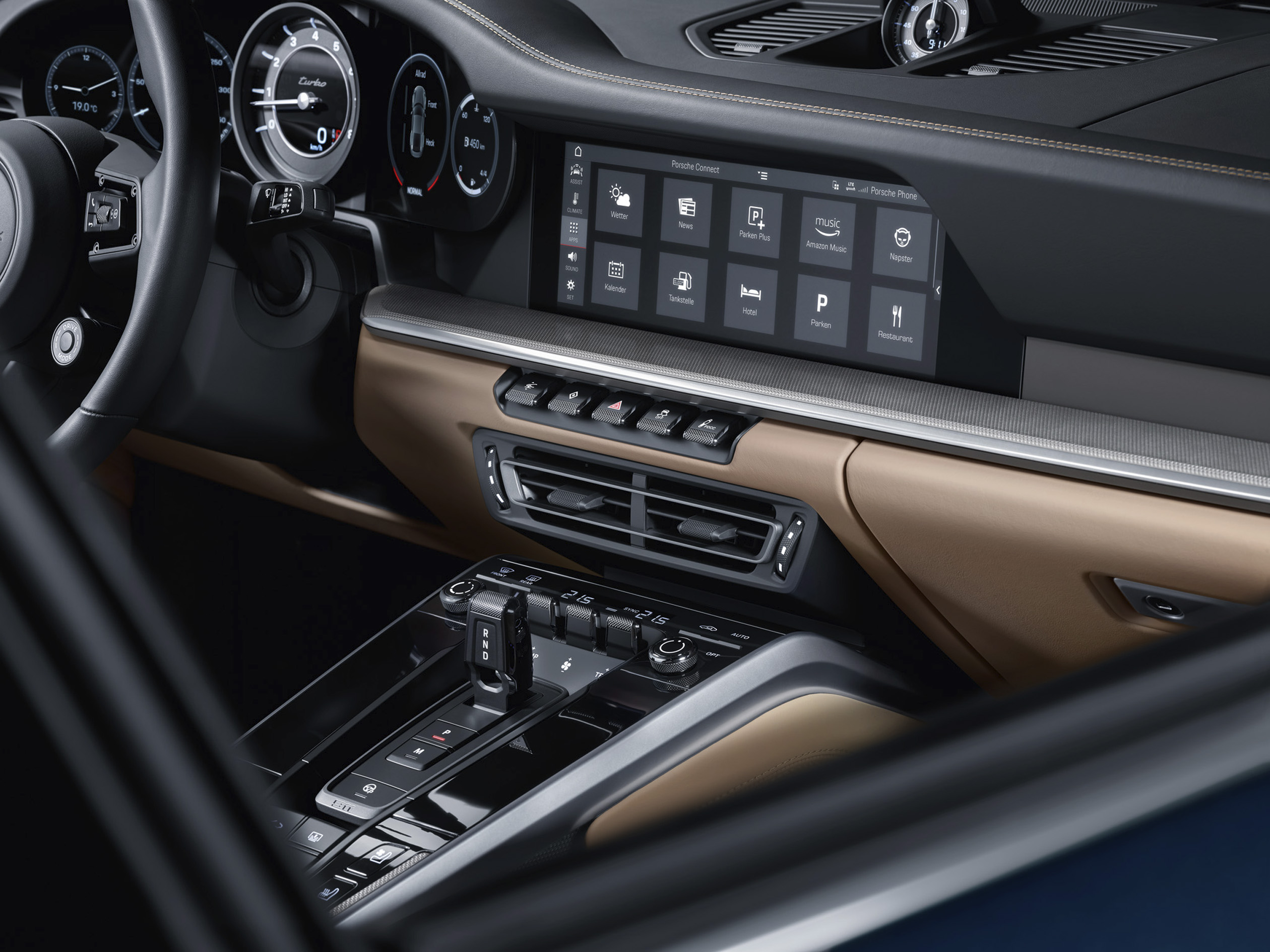
- PCM 6.0 (Jan 2022 update): Porsche added a refreshed UI and Android Auto to compatible 911s, complementing CarPlay. If smartphone integration matters, MY2022+ cars are the easiest path.
How it Drives
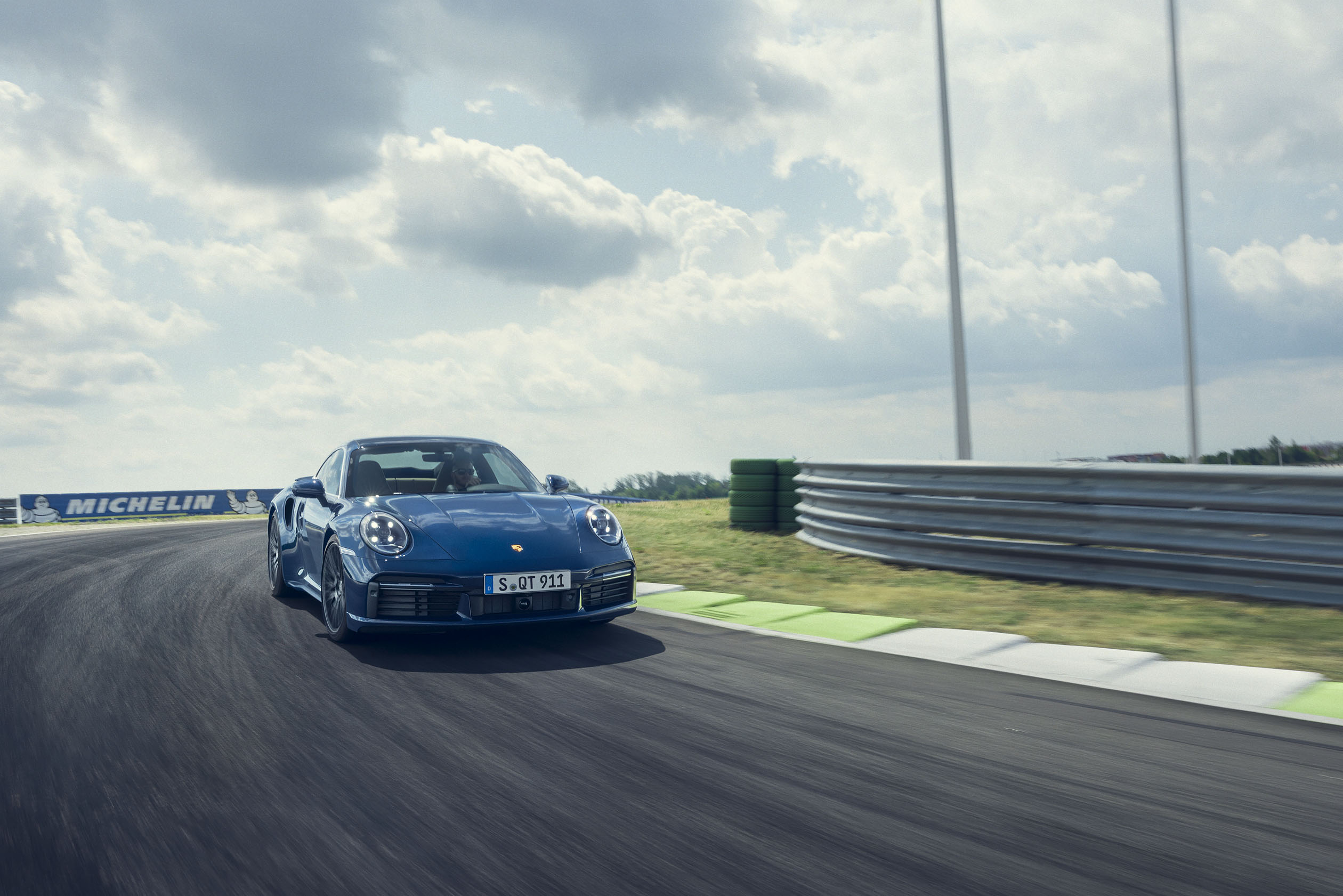
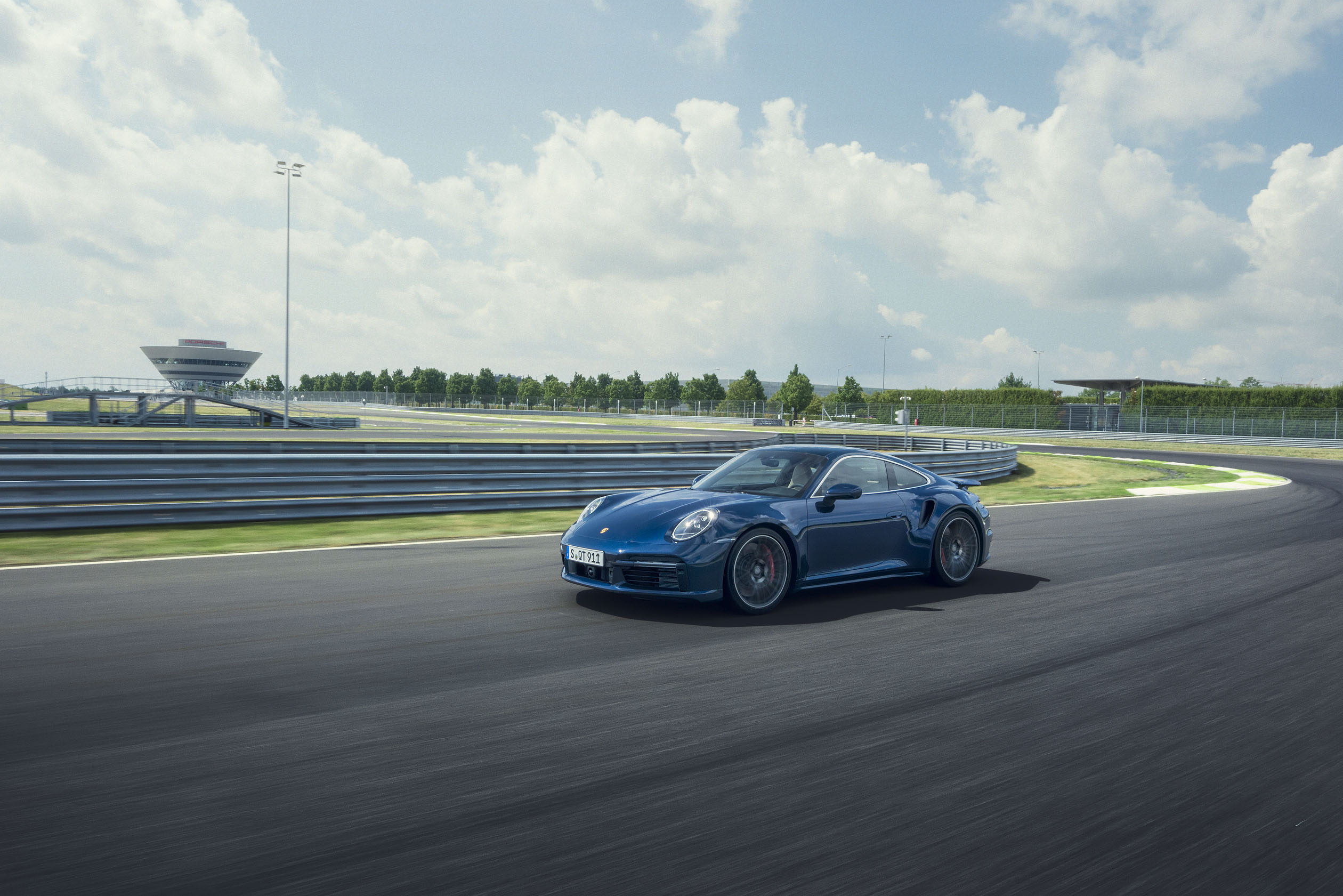
Calm brutality. The 992 Turbo’s character isn’t the GT3’s scalpel or the Turbo S’s trophy run; it’s relentless, controlled shove wrapped in uncanny civility. There’s negligible lag thanks to small, variable-geometry turbochargers and a PDK that’s always in the right ratio. The steering stays clean despite the work happening underfoot, and the chassis—especially with PASM Sport and rear-axle steering—shrinks around you. Optional PDCC further flattens roll without killing ride quality; it’s the “ice-on-glass” composure that makes this car devastating on a bumpy, fast road. Brakes are stupendous on either iron or PCCB; the standard 408/380 mm iron setup already dwarfs many supercars, and the ceramic option adds fade resistance and cuts unsprung mass (the Turbo S’s 420/390 mm PCCB is the yardstick).
Model-Year Updates
- 2021 (U.S. launch year): 911 Turbo Coupe & Cabriolet arrive with 572 hp, 553 lb-ft, PDK, PTM AWD, PASM, PAA active aero, and Sport Chrono standard (Launch Control). Factory times: 0–60 in 2.7 s (Coupe), top track 199 mph. Standard iron brakes 408/380 mm; PCCB optional. Porsche also introduces a Turbo Sport exhaust option for the first time.
- 2022: PCM 6.0 infotainment update adds Android Auto and UI improvements on applicable cars. No powertrain changes.
- 2023: Running refinements and package reshuffles (availability of items like PASM Sport, rear-axle steering, PDCC, front-axle lift, and Sport exhaust varies by market/trim).
- 2024–2025: Pre-refresh continuity. The 992.2 generation was teased mid-2025, and the 2026 Turbo S debuts is a hybridized evolution (context for end-of-run shoppers).
Note: Porsche’s Lightweight Package—fixed carbon buckets, rear-seat delete, thinner glass, reduced sound deadening, PASM Sport—is widely documented on the Turbo S (weight savings ~65–80 lb depending on spec). It is rare and market-dependent on the Turbo itself; if you want it, verify availability and equipment on the specific VIN.
Detailed Specifications (Quick Reference)
- Engine: 3.745-L twin-turbo flat-six (VTG) — 572 hp / 553 lb-ft
- Transmission: 8-speed PDK (PDK-only)
- Drivetrain: AWD (PTM) with water-cooled multi-plate front clutch
- 0–60 mph (factory): 2.7 s (Coupe) with Sport Chrono; Cabriolet 2.8 s
- Top speed: 199 mph
- Aero: PAA variable front spoiler + multi-position rear wing
- Suspension: PASM std; PASM Sport (-10 mm) & PDCC optional
- Wheels/Tires: 20/21 in; 255/35 ZR20 (F), 315/30 ZR21 (R)
- Brakes (iron): 408 × 36 mm (F, 6-piston), 380 × 30 mm (R, 4-piston)
- Ceramics (PCCB, optional): 420/390 mm (10-/4-piston)
- (Independent testing: 0–60 in 2.4 s, ¼-mile 10.3 @ 133 mph.)
Options & Packages That Matter
- Sport Chrono (standard on Turbo): brings Launch Control, the steering-wheel mode switch, and performance timers—key to the quoted 0–60 times.
- PASM Sport (-10 mm): lowers ride height, adds body control; ideal for smooth fast roads or track days.
- PDCC: active anti-roll stabilization that enhances flatness without murdering ride quality—great on back-road surfaces.
- PCCB ceramics: heroic fade resistance and reduced unsprung mass; expensive to replace if damaged but incredibly durable for street use.
- Rear-axle steering: shrinks the car in tight bends and stabilizes at speed; highly recommended if you live on technical roads.
- Sport exhaust (Turbo-specific): first time offered on 911 Turbo; adds voice without drone.
- Front-axle lift: driveway and ramp insurance.
- Aerokit (factory accessory): revised bumper/spoiler pieces that retain full PAA functionality while trimming lift and upping the look.
Reception & Reviews: What The Press Said
- Car and Driver, “By the Numbers” (2021 Turbo): 2.4-sec 0–60 and 10.3 @ 133—“torque slams through all four wheels,” and the gap to the Turbo S is nearly academic in a straight line.
- Porsche technical comms (PAA): the variable front spoiler and rear wing increase stability, with roughly 375 lb downforce in max-attack settings—key to the car’s composed feel at speed.
- Infotainment update (2022): Android Auto arrives with PCM 6.0, a quality-of-life upgrade that owners actually notice.
The consensus across outlets: the 992 Turbo is ridiculously fast, improbably easy, and nearly as devastating as the S—without demanding S-level spend.
Buying Guide (Used)
- Options hierarchy. All Turbos have Sport Chrono and PDK. Decide whether you want PASM Sport, rear-steer, PDCC, PCCB, Sport exhaust, and front-axle lift. These materially affect character and resale.
- Brakes & wheels. The standard 408/380 mm iron setup is stout; check for lip ridges and pedal pulsation. PCCB rotors are long-lived on the road but expensive—inspect carefully. 20/21-inch wheels are curb-rash magnets; inspect inner barrels, and check for inner-shoulder tire wear (315-section rears).
- Aero & underbody. Examine the front splitter elements (part of PAA) and the rear wing actuation. PAA faults are rare, but repairs aren’t cheap.
- Electronics/infotainment. If Android Auto matters, target MY2022+ or confirm PCM 6.0 on earlier cars.
- Cabriolet specifics. Cycle the top several times; listen for even operation and check seals after a wash. (Mechanically, Turbo Coupe/Cab are otherwise aligned.)
- Lightweight-leaning builds. If you’re seeking a “Lite” experience, verify PASM Sport, buckets, thinner glass, and sound deadening deletes. The full Lightweight Package is widely documented on Turbo S; for Turbos, verify equipment on the build sheet rather than assuming.
- Maintenance & provenance. The 992 Turbo is robust. Prioritize clean service history, unmodified ECU (for warranty), and careful tire/brake documentation. Track use isn’t a red flag if consumables were managed.
Where it Sits Now & Our Verdict
Live with it and the Turbo feels almost ordinary—until you ask. The ride is compliant in PASM Normal, the cabin is quiet (even on 315-section rears), and visibility is classic 911. The frunk + rear shelf carry real luggage; fuel economy is reasonable given the pace. In poor weather, Wet Mode + PTM make the car faster, more often than rear-drive exotics. And because it’s a 911, dealer support and parts flow are better than most six-figure missiles.
The 992.1 Turbo finished its run as the ultimate “do-everything” 911 short of the S. In late 2025, Porsche previewed the 992.2 family; by 2026, the Turbo S debuted with a hybridized powertrain and staggering numbers (context only—the 992.1 Turbo remains a distinct, non-hybrid car). If you want the last pure-ICE 911 Turbo in its modern form, the 2021–2025 cars are it. If your ideal 911 is the one that never feels out of place, the 992.1 911 Turbo is it. It’s nearly as rapid as the S, costs less to buy, and is easier to live with than any comparable supercar. Look for a car with rear-steer, PASM Sport (if your roads are smooth), Sport exhaust, and—if you drive hard in the mountains—PCCB. Verify PCM 6.0 if Android Auto matters, and make sure the PAA bits are healthy. Do that, and you’ll own the rare machine that can demolish a runway, shrug off a snowstorm, idle in traffic, and be faultlessly civil doing all three.
What We Said At Launch
The Porsche 911 Turbo has long been the king of all-weather sports cars, pairing exceptional performance with the surefootedness of all-wheel drive, and that is no different for the current 911 Turbo. In fact, Porsche has upped the ante, because the current 911 Turbo matches the output of last year’s 911 Turbo S and added a sport-tuned version of Porsche Active Suspension Management for the first time.
It would be a disservice to call this new Turbo a “lesser” car than the Turbo S, but it does have less in most departments. Less power at 573 hp and less torque at 55 ft lbs. That is right, we are complaining about 572 bhp @ 6500 rpm and 553 ft lbs @ 2250 rpm. This is an absurd world. There are also less features compared to the jam-packed Turbo S.
Most importantly, less money required to put one in your garage, starting at US$172,150 in 2022 compared to US$20,850 for the Turbo S. This also is not to say that the new Turbo isn’t anything short of a monster. It will still go 0 to 60 in 2.7 seconds, will corner like it was on rails with Porsche Torque Management (PTM) all-wheel-drive, and it will still hit a 198 MPH top speed.
Porsche themselves, in their press release, points out another important fact about the new Turbo: It matches, or exceeds, the packaging, performance, and technology of the Type 991 911 Turbo S and it is pretty darn close to the 992 Turbo S.
An 8-speed PDK dual-clutch transmission is the only available option for the Turbo. However, almost all of the technology packages that are built into the Turbo S are available as options for the Turbo, so you can pick and choose the specific items you want.
Motor1: ..it takes your breath away with a crush of G forces, the relaxed throttle response belying the urgent way the revs build and the speed climbs. Turbo lag is present, but considering the specific output, the increase in boost from the bigger turbos (19.6 psi max, up from 16.0 in the C4S), and the sheer urgency in how the flat-six revs, you’ll struggle to spot it.
Many argue that the Carrera 4S is good enough so why go for a 911 Turbo? First of all, the Turbo has 572 hp and 553 pound-feet of torque, which is up 129 hp and 163 lb-ft over the current Carrera 4S. Unsurprisingly, this Porsche’s straight-line performance is staggering compared to the 4S. The sprint to 60 miles per hour takes an insanely fast 2.7 seconds with the help of launch control, while the quarter mile happens in just 10.8 seconds. If you are brave enough, the top speed is 199 mph.
All-wheel drive is standard and shifts are handled by an eight-speed dual-clutch automatic transmission as the only option. This is a great all-rounder. Lots of power. Lots of luxury and fast enough to scare you when you need a little thrill.
To complement the tremendous power, the 992 Turbo packs a heap of speed-wrangling hardware and goodies, like standard rear-wheel steering and a similar aero setup as the one found on the Turbo S. There’s a heap of optional extras too, including the Turbo S’ carbon-ceramic brakes, a new Porsche Active Suspension Management (PASM) Sport suspension, offering more aggressive damping and tuning and a 0.39-inch drop over the standard PASM setup—which, we once again must stress, is still absurdly capable. Porsche Dynamic Chassis Control (PDCC) with active anti-roll stabilization is also available.
Videos & Reviews
Pictures
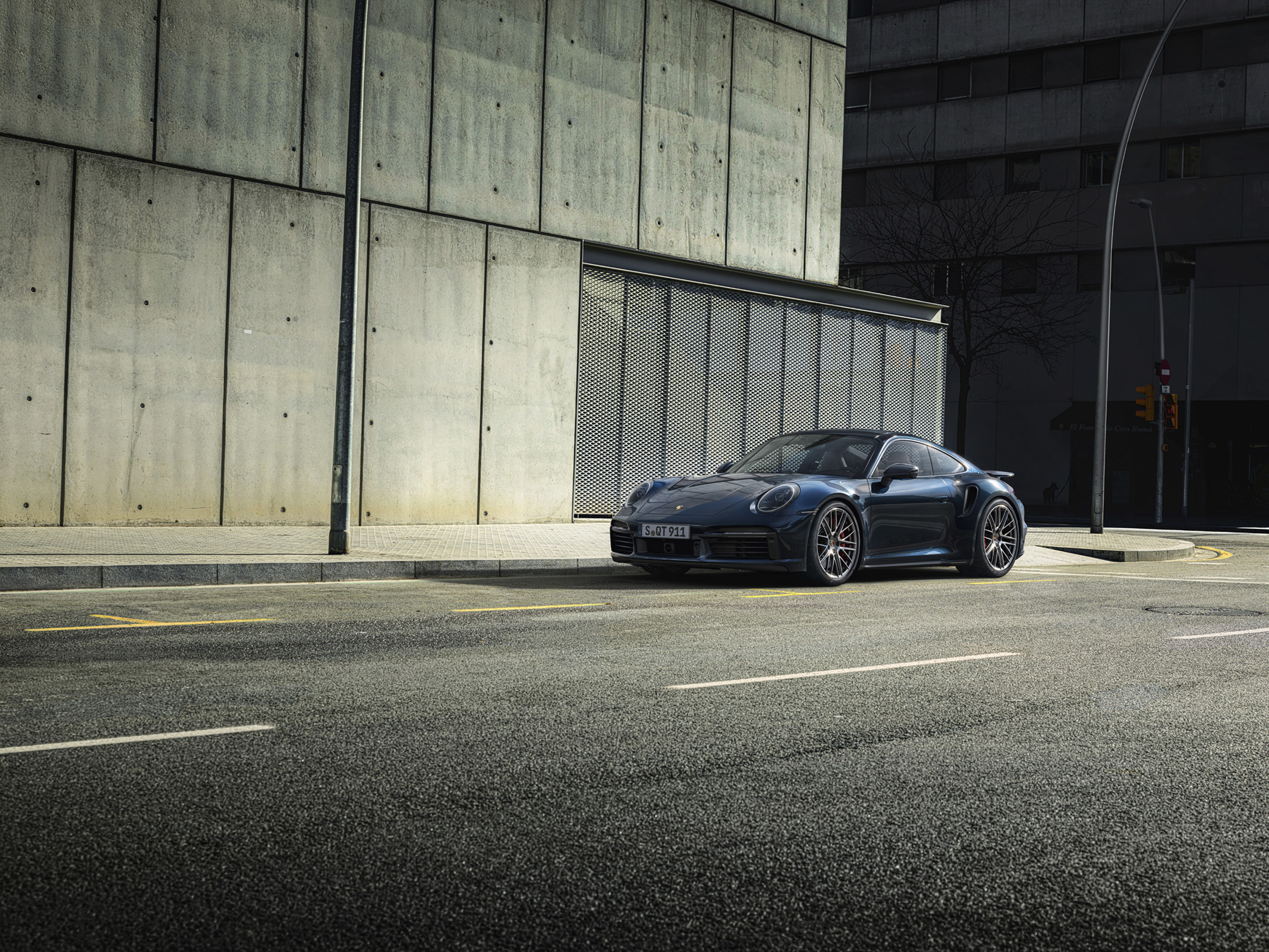
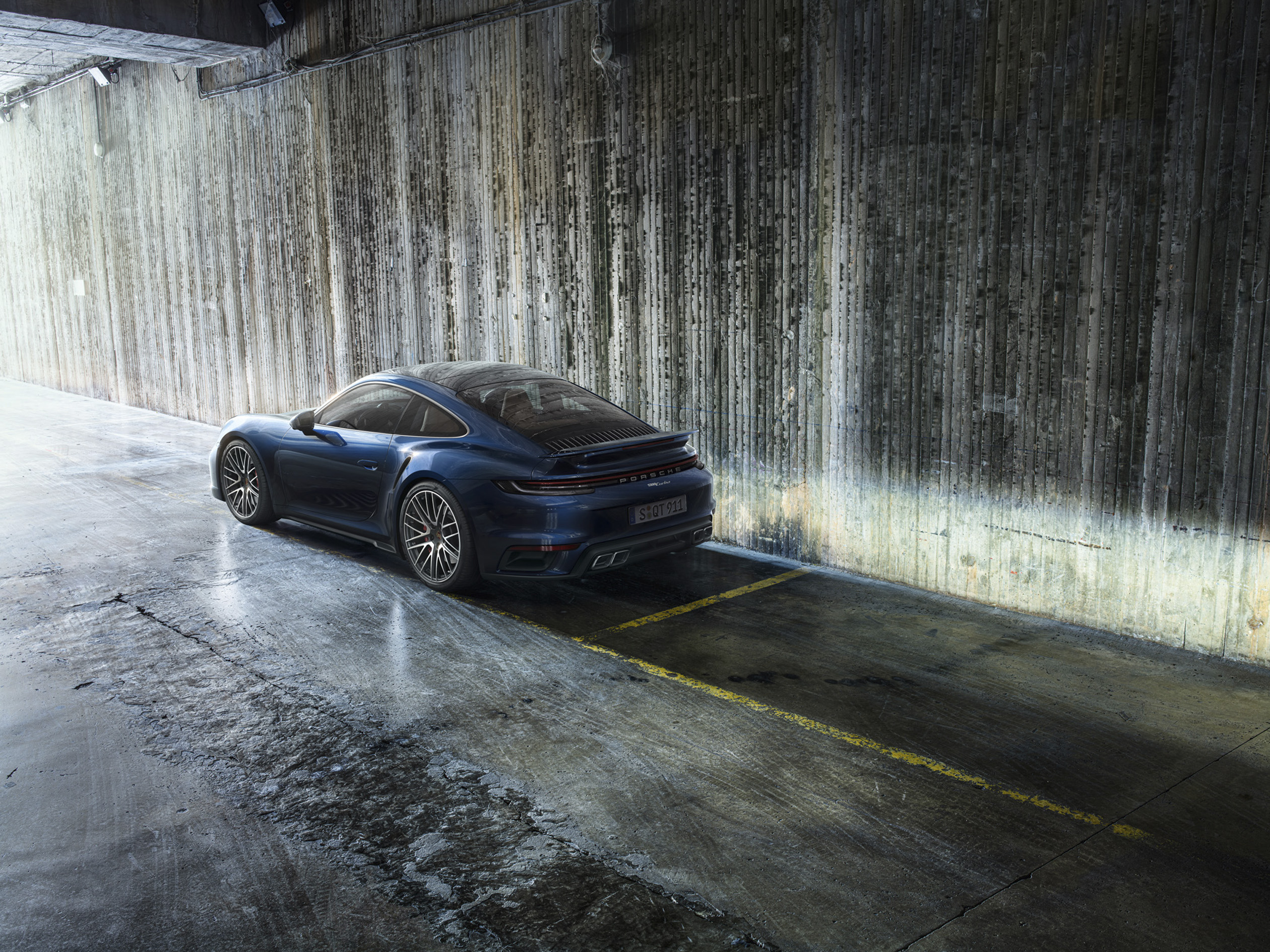
Press Release
Atlanta, Georgia. Since its introduction over 45 years ago, the Porsche 911 Turbo has balanced everyday usability with exhilarating performance. Following the recent introduction of the 2021 911 Turbo S, the 2021 911 Turbo Coupe and Cabriolet are now making their debut.
Thanks to an output of 572 hp (427 kW), marking an increase of 32 hp over the predecessor, the new 911 Turbo accelerates from 0 to 60 mph in 2.7 seconds (0.2 seconds faster than before) while the new 911 Turbo Cabriolet takes 2.8 seconds (also 0.2 seconds faster) The acceleration, power output and torque (553 lb.-ft.) of the new 911 Turbo are on the level of the previous 2019 911 Turbo S.
Like the 2021 911 Turbo S, the twin-turbo boxer engine in the 911 Turbo models is mated to a standard eight-speed PDK transmission with Turbo-specific internals and calibration. The top track speed of the new 911 Turbo models is 198 mph. New options such as a Sport and Lightweight package, Sport Suspension with a lower ride height and Sport Exhaust system, first introduced for the 911 Turbo S, are also available for the 911 Turbo for the first time, providing an even higher degree of customization than ever before.
The 2021 911 Turbo models follow in prestigious footsteps: the 911 Turbo has been the ultimate intersection of performance and luxury within the 911 model line since 1975. The latest generation of 911 Turbo is more than twice as powerful as the original 930 Turbo, which featured a three-liter, six-cylinder boxer engine, single turbocharger and an output of up to 260 PS, depending on the market.
Like the recently introduced 2021 911 Turbo S, the six-cylinder boxer engine in the new 911 Turbo has a displacement of 3,745 cc and now features symmetrical VTG turbochargers with electrically controlled bypass valves. In conjunction with the redesigned charge air cooling system and the use of piezo fuel injectors, this improves throttle response, performance, torque delivery and the free revving nature of the engine. In the Turbo models, this engine makes 572 hp. Complementing the increase in power, the chassis has been tuned to offer an even greater level of performance. Adopting the changes implemented on the new 911 Turbo S earlier this year, steering response and precision on the new 911 Turbo models have been further improved thanks to an additional 1.65 inches of front track width and the new 20-inch 255/35 tires (up from 245/35 previously). Also shared with the 2021 911 Turbo S, the Porsche Traction Management (PTM) active all-wheel drive system in the 911 Turbo is able to transfer even more power to the front wheels than before. Traction at the rear axle, which is equipped with rear-axle steering as standard, is increased even further by 0.39 inches of added track width compared to the last 911 Turbo, as well as 315/30 tires on 21-inch wheels (305/30 R 20 previously). The revamped brake system is even larger than on the last 911 Turbo and can be recognized by the red fixed calipers. The front cast iron brake rotors now measure 408 millimeters in diameter (28 mm larger than the previous 911 Turbo) and are 36 millimeters thick (plus 2 mm). The rear axle features 380-millimeter brake rotors that are 30 millimeters thick. Porsche Ceramic Composite Brakes (PCCB), standard on the 911 Turbo S, with 10-piston front calipers, are available as an option.
A Sport Exhaust system that was introduced on the 2021 911 Turbo S is also optionally available for the 911 Turbo for the very first time. Two different suspension options are also new: while the standard PASM suspension offers a greater spread between agility and ride comfort than before, the particularly performance oriented, electronically controlled PASM Sport Suspension with a 0.39 inch (10 mm) lower ride height compared to the standard suspension benefits the agility of the new 911 Turbo even further with a set-up aimed at further enhancing driving dynamics. Porsche Dynamic Chassis Control (PDCC), which uses active anti-roll stabilization, is available as an option for the 911 Turbo models.
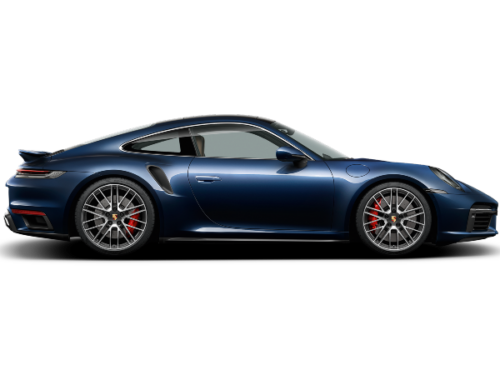
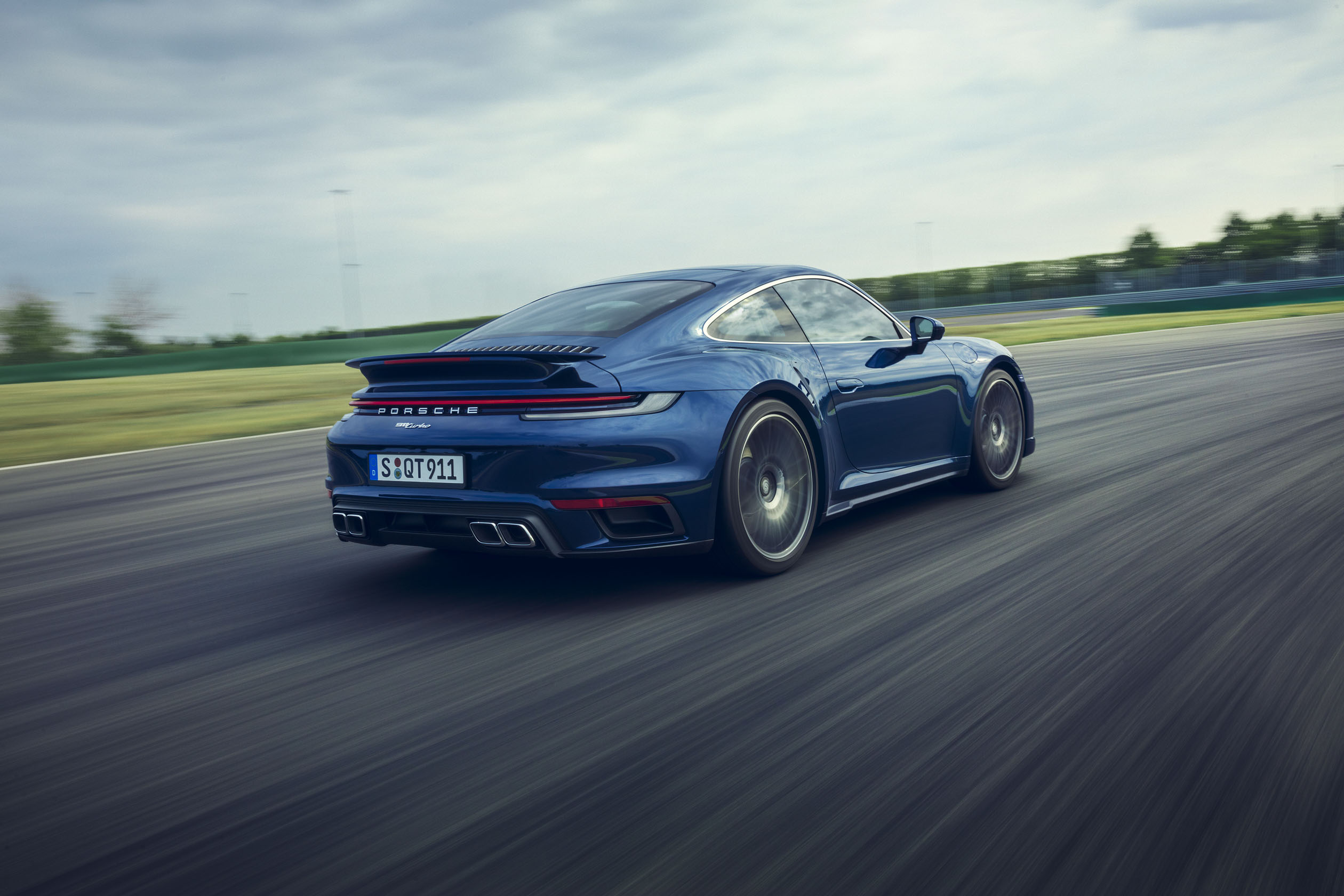
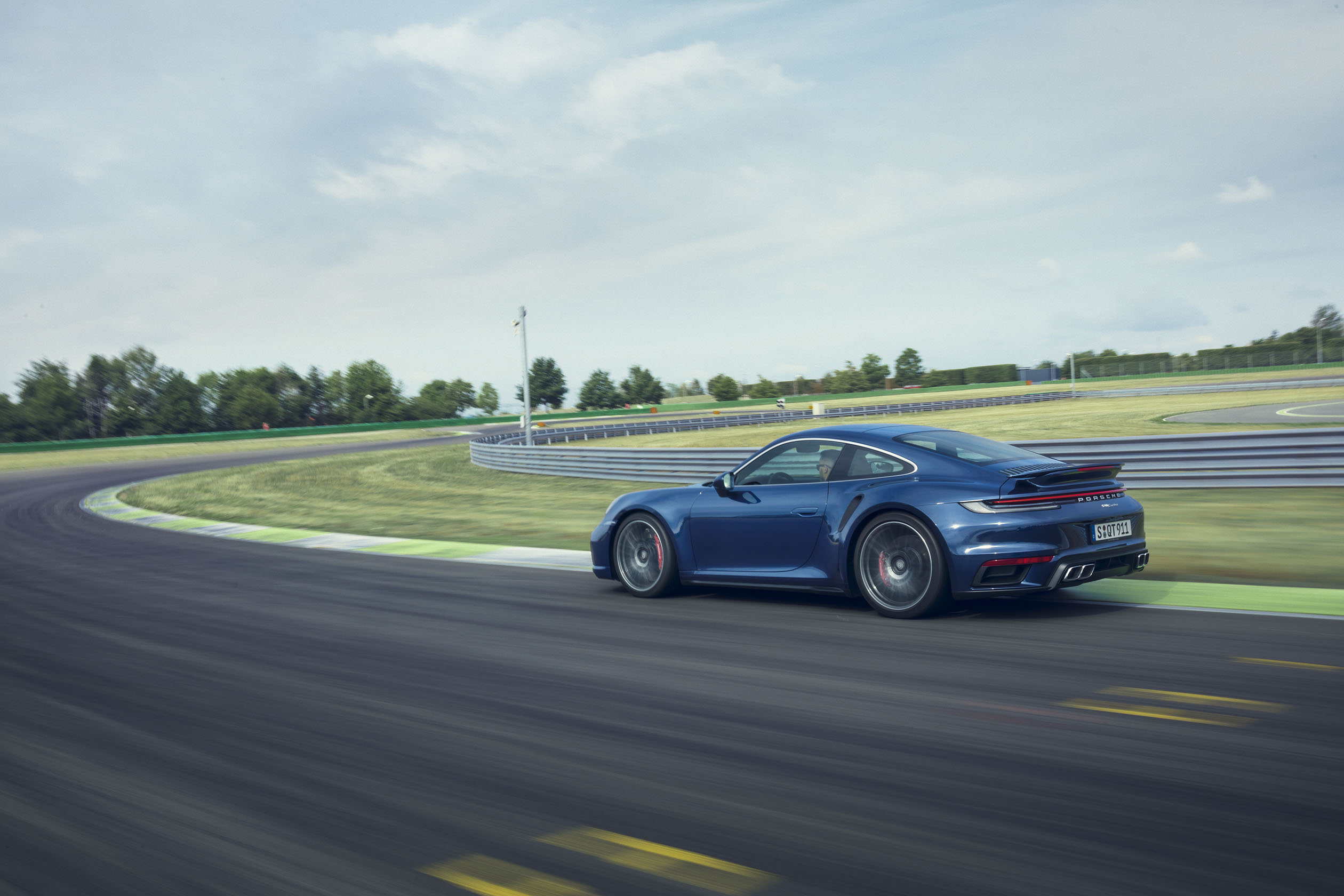
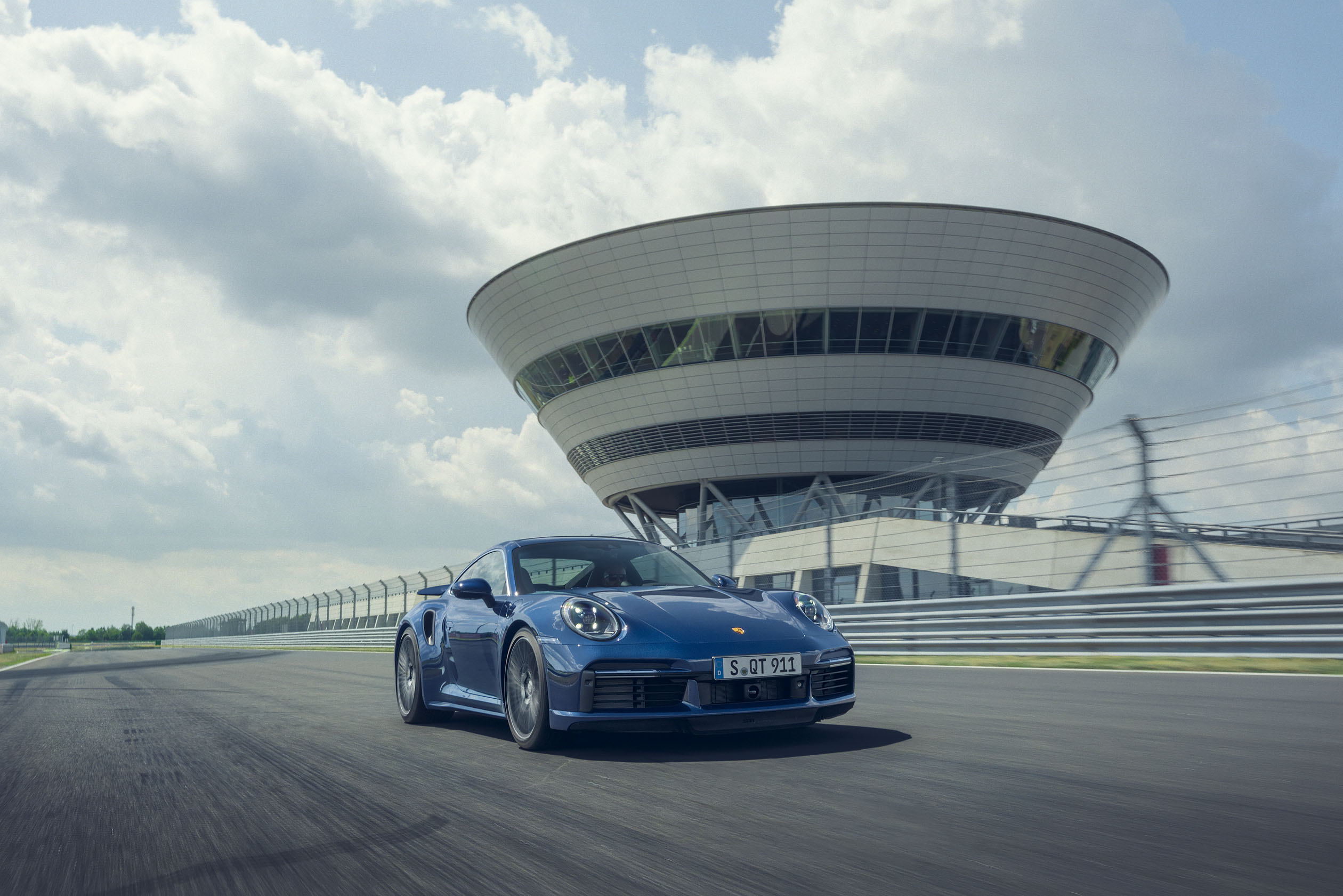
The muscular design of the 911 Turbo reflects the significant increase in power and performance of the new generation. Shared with the 2021 911 Turbo S, the body of the new 911 Turbo models is 1.8 inches wider than the predecessor at the front fenders to accommodate the increase in track width and tire size compared to the previous model. The new front luggage compartment lid featuring a striking recess in the center underlines the performance-focused character. LED headlights with PDLS Plus are fitted as standard. At the rear axle, the body is now 0.78 inches wider than the previous generation 911 Turbo (991), also to accommodate wider track and tires. Other distinguishing features of the new 911 Turbo are the enhanced adaptive aerodynamics with controlled cooling air flaps at the front, a larger active front spoiler and the significantly increased size of the active rear spoiler. The air intakes on the rear side panels, characteristic for the 911 Turbo, now draw in process air rather than cooling air. The charge air coolers are now positioned directly in the air stream under the rear decklid. The continuous light bar with LED tail lights as well as the new louvered rear decklid grille with silver trim strips round off the design of the rear end.
The appearance and performance-focused character of the vehicle can be additionally enhanced by the optional Lightweight package and Sport package. The Lightweight package for the coupe reduces the vehicle’s weight by about 66 pounds. Full Bucket seats, the deletion of the rear seats and reduced sound insulation contribute to the weight savings and allow the exhaust note to enter the cabin more intensely. The Sport package encompasses all the elements of the SportDesign package as well as additional applications in Black, carbon fiber elements and Exclusive Design clear taillights.
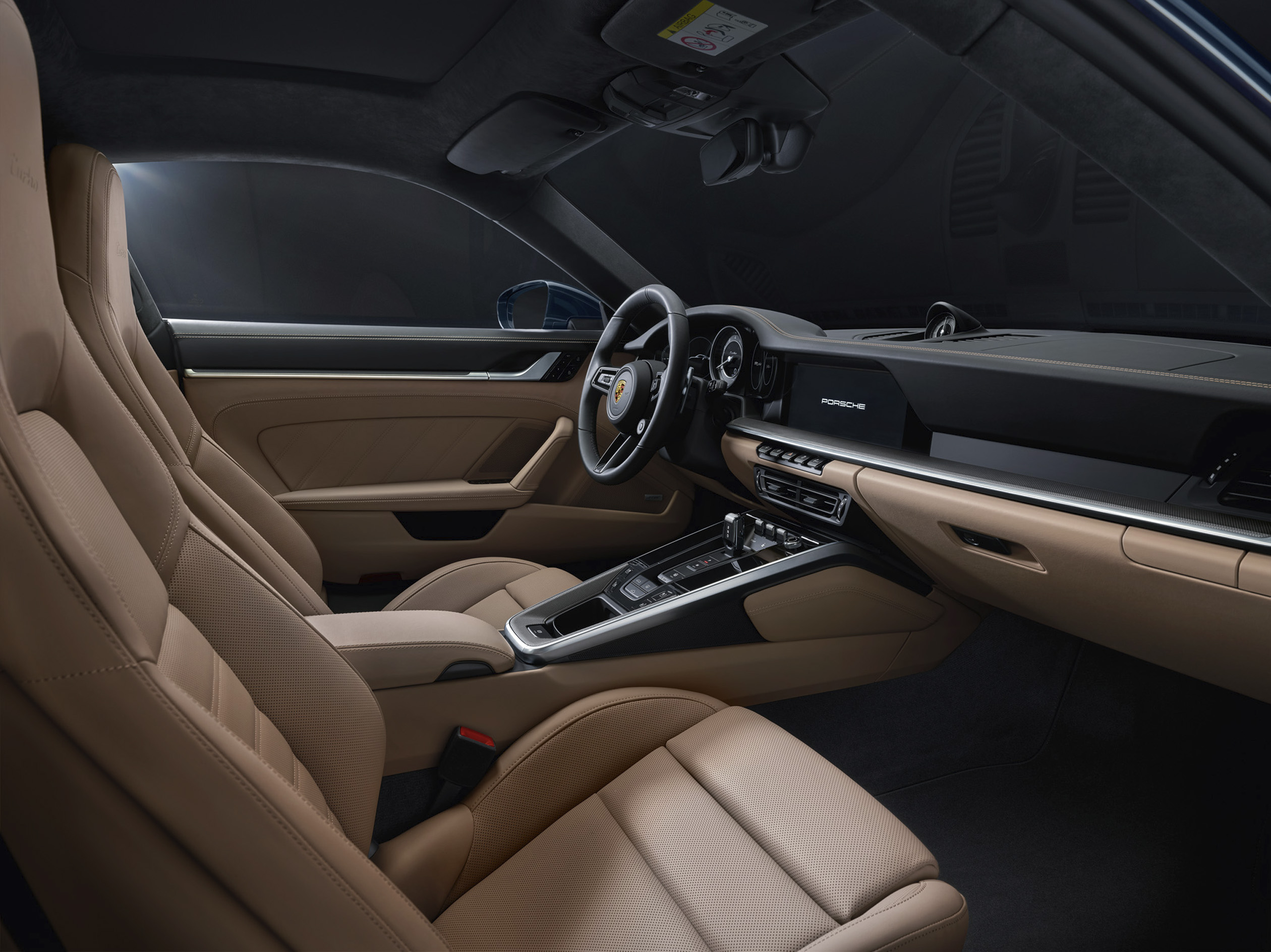
The basic elements of the 911 Turbo interior correspond to those of the current 911 Carrera models with Porsche Advanced Cockpit and Direct Touch Control. The 10.9-inch Porsche Communication Management (PCM) center screen can be operated quickly. The extensive list of standard equipment includes electrically adjustable 14-way Sport seats, the Sport Chrono package, a GT Sport steering wheel with shift paddles and mode switch as well as the BOSE® Surround Sound System. Numerous options are available, including Porsche InnoDrive with adaptive cruise control, Lane Keep Assist with traffic sign recognition, Night Vision Assist, Surround View and a Burmester® High-End Surround Sound System.
The 2021 911 Turbo models are available to order now and are expected to reach U.S. dealers by early 2021. MSRP is $170,800 for the 911 Turbo Coupe and $183,600 for the 911 Turbo Cabriolet, both not including the $1,350 delivery, processing and handling fee.