The Porsche 911 R Wasn’t Supposed to Win

Credit: Porsche

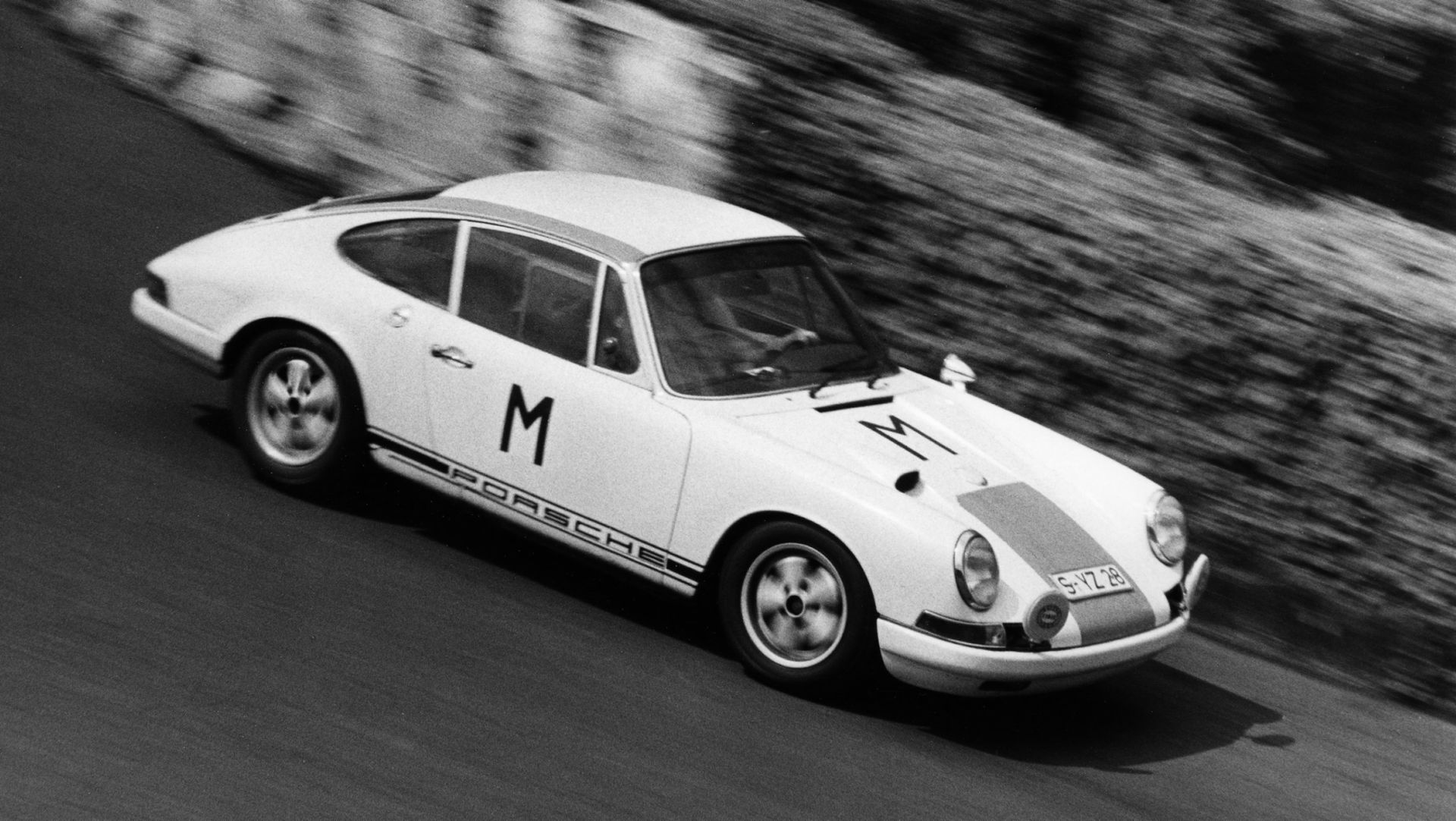
It was the fall of 1966. Somewhere in Germany, Porsche’s racing expert Rolf Wütherich was doing the math for the 911 R (R is for racing) project. He was running the numbers on weight and power as the Stuttgart-based carmaker wanted a vehicle superior to the current competition in its power-to-weight ratio. He concluded that what Porsche needed was a 911 that barely resembled one.

This purebred race car version of the 911 had the potential to dominate in GT racing while speeding up the progress of the nameplate in motorsport, which to that point had been rather slow. Rolf’s new 911 R concept made Porsche’s leadership in Zuffenhausen consider GT homologation, not winning races outright. However, Porsche built only 23 cars instead of the 500 required, so GT homologation was no longer on the table, only racing as a prototype against purpose-built machines. On paper, the 911 R had no business competing there, let alone winning. It did anyway.

A Memo and a Mission

James Dean driving his 1955 Porsche 550 Spyder aka "Little Bastard" with Rolf Wutherich in the passenger seat
Credit: Karl Weber

Rolf Wütherich wasn’t just any Porsche employee. Eleven years before he sat down to calculate the power-to-weight ratio of what would become the 911 R, he was in the passenger seat of James Dean’s Porsche 550 Spyder when it collided with another car on a California highway in September 1955. Dean died at the scene. Wütherich survived with serious injuries and eventually made his way back to Zuffenhausen, where by 1966 he was working as a technician in Porsche’s experimental department. The memo he wrote that fall was straightforward. A vehicle needed to be built with a power-to-weight ratio under 4 kg (8.8 lbs) per horsepower, about 1.5 kg (3.3 lbs) better than anything the competition had. That gap, on paper, was enough to do in GT sport what the 356 Carrera had done a decade earlier.

3/4 front view of a 1967 Porsche 911 R prototype
Credit: Porsche

The idea had been building for a while. Private racer Eberhard Mahle had been running a standard 911 in the European Hill Climb Championship and winning enough to make people in Zuffenhausen wonder what a proper racing version could do. In October 1966, Porsche finished the first lightweight test car and sent it to the skid pad at Weissach and then to Hockenheim. The lap time came back at 2 minutes and 17.5 seconds, 12 seconds off the record held by the Porsche 906 Carrera 6. The 906 was a full Group 4 prototype built for one purpose. The 911 R was supposed to be a GT car. The gap between them was 12 seconds.

Stripping It to the Bones

1967 Porsche 911 R prototype
Credit: Porsche

In 1967 Porsche built four prototypes, and the thinking behind every single one was the same. Take out what wasn’t needed and replace what stayed with something lighter. Karl Baur, a Stuttgart coachbuilder, refabricated the front lid, front wings, doors and bumpers in fiberglass. The windscreen came down to 4mm glass. Side windows went to 2mm plexiglas. Window cranks were pulled and replaced with leather straps. Two of the five instruments came out, so did the ashtrays, cigarette lighter and  front passenger sun visor. None of it was dramatic on its own. Together it added up to something significant.

The engine went the other way. Porsche put the Type 901/22 unit from the Carrera 906 into the 911 R, a flat-six with dual ignition and titanium connecting rods making 210 horsepower at 8,000 rpm. The finished car weighed 800 kg (1,764 lbs). A standard 911 S weighed 1,030 kg (2,271 lbs). The difference was 230 kg (507 lbs). Zero to 100 km/h took 5.9 seconds. A standing kilometer in 24.2 seconds, a full second quicker than a Porsche 904 Carrera GTS and five seconds ahead of an Alfa Romeo GTA. Those numbers didn’t need much explaining.

The Homologation Problem

Rear view of a 1967 Porsche 911 R on a test track
Credit: Porsche

The hard part was never making the car fast but getting it into the right class. GT homologation required 500 road-legal examples, and in the mid-1960s that wasn’t a realistic number. Europe was in the middle of an economic downturn and a 911 R carried a price tag of 45,000 Deutsche Marks, nearly twice what a standard 911 S cost. In May 1967 Porsche management settled on 19 cars. Fifteen would go to customers whilst four would stay with the factory. Combined with the four prototypes already built, that brought the total production run to 23 cars.

The decision made GT homologation impossible before the car had taken a single competitive lap. Without homologation, the 911 R couldn’t race where it was built to race. It got moved into the 2-litre GT prototype class instead, which meant competing against purpose-built race cars rather than the production-based GT machinery it had been designed to beat. That wasn’t the plan but the car went racing anyway.

What It Did Instead

Pit stop, Autodromo Nazionale di Monza, 1967,
Credit: Porsche

The 911 R showed up at the Circuito del Mugello in Italy in July 1967, that year still a round of the World Championship. Vic Elford and Gijs van Lennep finished third overall behind two Porsche 910 factory cars. They cleared the entire Alfa Romeo fleet and left a Ford GT40 Mk III in fourth. For a car that had no business being in that class it was a reasonable first impression.

The Marathon de la Route came later that year, 84 hours on the Nürburgring. Hans Herrmann, Vic Elford and Jochen Neerpasch won overall in a 911 R running a Sportomatic semi-automatic transmission. The car had leather straps for window controls and a gutted interior. It won an 84-hour race with a semi-automatic gearbox.

Front view of a 1967 Porsche 911 R driving through the Alps
Credit: Porsche

November 1967 produced the strangest result of all and it wasn’t even a race. Four Swiss drivers, Jo Siffert, Dieter Spoerry, Rico Steinemann and Charles Vögele, had planned an endurance world record attempt at Monza in a Porsche 906 Carrera 6. The 906 couldn’t handle the steep banking. The factory sent a 911 R instead. It drove from Zuffenhausen to Monza under its own power with 100 hours already on the engine from dynamometer testing. The only change was a gear ratio adjustment, fourth and fifth gears set to the same high-speed ratio to protect the transmission.

Three days and three nights at full throttle. When it was done the car had covered 20,000 km (12,427 miles) at an average of over 200 km/h (124 mph). Five world records. Fourteen international class records. The engine that started was the engine that finished. Gérard Larrousse took a factory 911 R to the Tour de France Automobile in 1969, a multi-stage French motorsport rally combining circuit races, hillclimbs and road stages. He won overall. It was the biggest result the 911 R ever produced.

Why It Still Matters

Rear view of a 2016 Porsche 911 R (991)
Credit: Porsche

Twenty-three cars is the full count. Four prototypes and nineteen customer examples, not one of them enough to reach the 500 required for GT homologation. The program missed its original target by a wide margin and Porsche knew it. The 911 2.0 T/R came shortly after, a more practical GT-class car built from the start with homologation numbers in mind.

What the T/R never had to do was prove the platform could take sustained punishment at race pace. Nobody had seriously tested that before the 911 R. The Monza run settled the question in the most direct way possible. A car that drove itself to the track with a well-used engine and no special preparation held 200 km/h (124 mph) for three days without issue. That wasn’t a race result. It was a data point about what the 911 was built from.

Porsche brought the name 911 R back in 2016. Naturally aspirated, manual gearbox, no rear wing. It sold out immediately and set off one of the louder arguments in recent Porsche collecting. That a name attached to a 23-car production run from 1967 could do that fifty years later says something. Although the original 911 R wasn’t supposed to qualify or win races, it did both anyway, with a handful of cars that fell well short of the goal and somehow did more than enough.