Porsche at Daimler, the War, and the Road to Independence

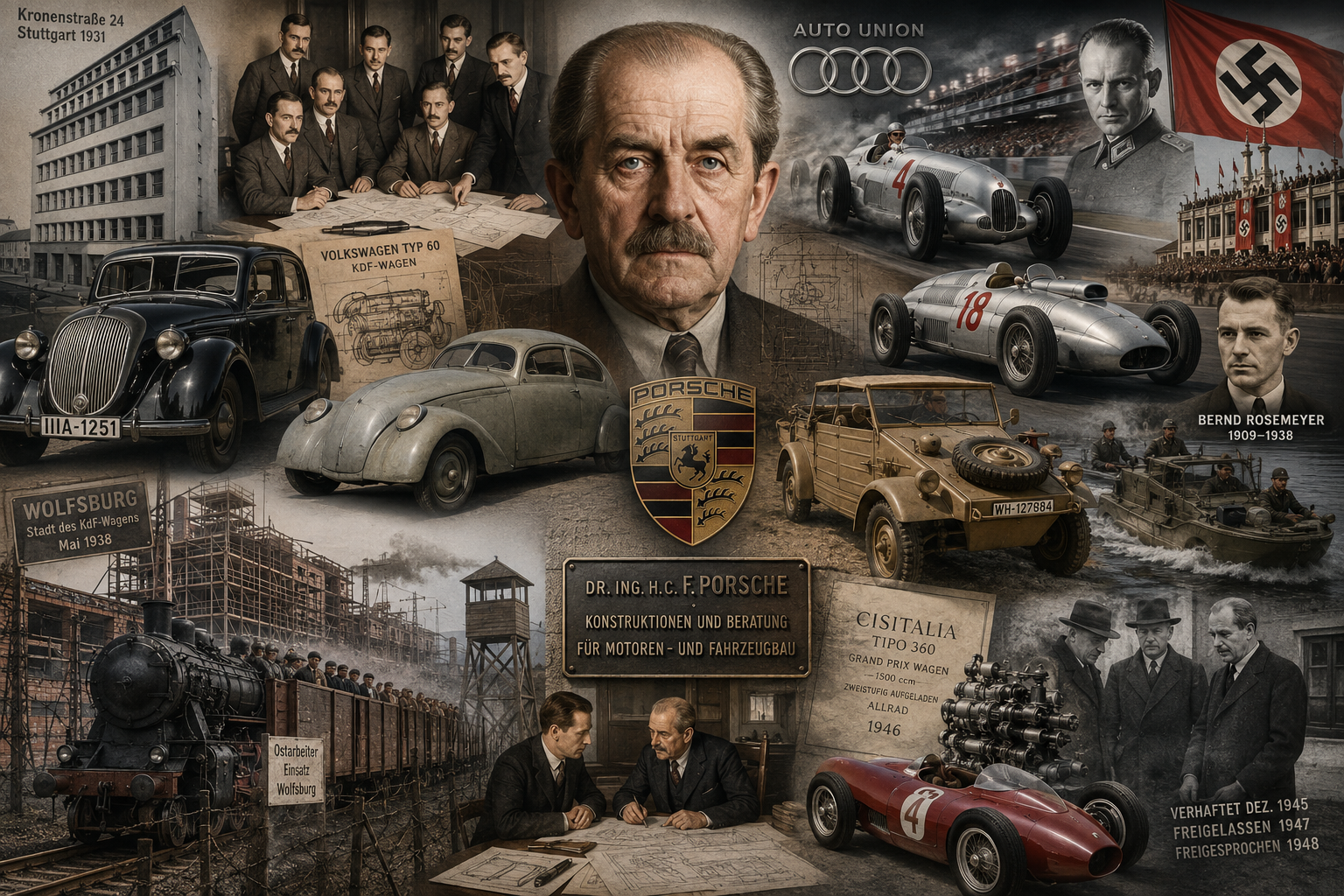
Photorealistic historical mural tracing Porsche’s 1931 engineering office through Auto Union, Volkswagen, wartime production, forced labor, postwar imprisonment, and the Cisitalia Type 360.

A Name Without a Car

On April 25, 1931, the Porsche name officially entered the automobile business.

It did not enter as a badge affixed to the hood of a sports car. There was no factory assembling Porsche automobiles, no dealer network waiting to receive them, and no production line preparing to transform Ferdinand Porsche’s ideas into a recognizable family of road machines. There was not yet a Porsche automobile at all.

What existed was an engineering office.

Its formal name—Dr. Ing. h.c. F. (Honorary Doctor of Engineering) Porsche Gesellschaft mit beschränkter Haftung, Konstruktionen und Beratung für Motoren- und Fahrzeugbau  — announced its purpose with bureaucratic precision in its name: “design and consulting services for engines and vehicles.” The firm would sell knowledge before it sold machinery. It would conceive automobiles for other manufacturers, solve technical problems for industrial clients, prepare prototypes, license designs, and survive by placing Ferdinand Porsche’s experience at the disposal of anyone who was willing and able to pay for it.

When looking at this first iteration of Porsche as an automotive/engineering company, this distinction is paramount. The Stuttgart-based company established in 1931 was not founded to manufacture the 356, because the 356 had not yet been conveived as a potential production vehicle. It was not created around a secret plan to build the 911’s predecessor, or any other production sports car resembling either the 911 or the 356. It was an independent consultancy firm born from professional frustration, economic necessity, personal ambition, and Ferdinand Porsche’s determination that no corporate board should again possess the power to cancel his ideas merely because it considered them too expensive, too unconventional, or too difficult to sell.

He had spent most of his adult life working inside other people’s institutions. Ludwig Lohner had given him his first automotive stage. Austro-Daimler had transformed him from an electrical specialist into a complete vehicle engineer and industrial leader. Daimler-Motoren-Gesellschaft had given him the scale, prestige, and resources to produce supercharged Mercedes performance cars. Steyr had briefly offered another outlet for his ideas before financial consolidation closed that path as well.

At each stop, Porsche had been responsible for the ideas, the engineering, and often the machines that carried those companies into new territory. But the institutions themselves had belonged to someone else. Their boards controlled the budgets, their executives determined which projects advanced, and their financial priorities could overrule even the most ambitious technical vision.

Porsche had learned how quickly an innovative design could be weakened, postponed, or abandoned when it no longer suited the priorities of the company paying for it. No matter how much authority he accumulated, the final decision remained beyond his control. His work could carry his unmistakable engineering signature without ever truly belonging to him.

Now, at fifty-five years old, he intended to change that arrangement. Rather than continue adapting his ambitions to the limits imposed by another manufacturer, Porsche would establish the structure in which his ideas could originate, develop, and survive under his own name. For the first time, he intended to control not only the engineering, but the institution built around it.

The timing could hardly have been worse.

The global economic crisis had shattered markets, weakened banks, and pushed manufacturers toward cutbacks and reduced investment. Germany’s automobile industry was fragmented and financially vulnerable. Even established companies were struggling to maintain production. An independent engineering office possessed none of the protections of a large manufacturer. It needed commissions, and it needed them quickly. Technical brilliance could attract attention, but attention did not cover salaries, rent, materials, prototype construction, or the constant expense of turning drawings into functioning machines.

Colorized historical photograph of the 1931 Porsche engineering office at Kronenstraße 24 in Stuttgart, where Ferdinand Porsche founded his independent automotive design and consulting firm.
In 1931, Ferdinand Porsche established his independent engineering consultancy at Kronenstraße 24 in central Stuttgart, operating from rented offices rather than an automobile factory. Formally registered as Dr. Ing. h.c. F. Porsche GmbH, Engineering Design and Consulting for Engines and Motor Vehicles, the firm was created to develop cars, engines, and mechanical systems for outside manufacturers willing to commission Porsche’s expertise. From this understated building, Porsche and a small team of engineers began pursuing the projects that would soon lead to Wanderer, Auto Union, and the Volkswagen. The purpose was not yet to build cars bearing the Porsche name, but to give Ferdinand Porsche control over the ideas he had spent decades developing inside companies owned by others.

The new firm occupied offices at Kronenstraße 24 in central Stuttgart. Its surroundings lacked the grandeur later associated with the Porsche name. This was not a monumental corporate headquarters. It was a working consultancy built around drafting rooms, calculations, models, technical discussions, and the confidence of a relatively small group of people who believed Ferdinand Porsche’s name could function as a business in its own right.

The mythology of Porsche often places Ferdinand alone at the center of everything. The reality was more collaborative.

His son Ferry Porsche was there, still young but already deeply shaped by his father’s engineering world. Karl Rabe, one of Ferdinand’s most trusted colleagues from the Austro-Daimler period, became a central technical authority and eventually chief designer. Erwin Komenda, whose understanding of body structures and form would prove indispensable, joined the enterprise after work at Steyr and Daimler-Benz. Josef Kales brought engine expertise. Franz Xaver Reimspiess contributed mechanical and engine development skills and would later be associated with both Volkswagen engineering and the familiar VW emblem. Anton Piëch, Ferdinand’s son-in-law and a lawyer, became increasingly important in the legal, financial, and political organization of the family enterprise.

And then there was Adolf Rosenberger.

Adolf Rosenberger
Adolf Rosenberger was a successful racing driver and businessman who joined Ferdinand Porsche and Anton Piëch in founding Dr. Ing. h.c. F. Porsche GmbH in Stuttgart on April 25, 1931. As an original shareholder and the firm’s commercial managing director, he supplied vital start-up capital, secured customers, managed finances, and used his extensive automotive contacts to help Ferdinand Porsche’s new engineering consultancy survive its difficult formative years. Rosenberger’s racing knowledge and industry relationships also contributed to the development of the revolutionary mid-engined Auto Union Grand Prix program.

Rosenberger was not an incidental early employee whose name later wandered into Porsche history. He was a co-founder, shareholder, commercial manager, and financial supporter of the new office. A former racing driver, he understood both competition and the business relationships needed to keep an engineering organization alive. His capital and connections mattered. During the precarious first years, when projects could stall and payments could arrive late, Rosenberger helped provide the commercial foundation beneath Ferdinand Porsche’s technical reputation.

The Porsche office, therefore, began not as the creation of one isolated genius, but as an alliance of engineering talent, family loyalty, legal expertise, financial risk, and outside confidence.

That alliance would produce some of the most consequential vehicles of the twentieth century.

It would not survive intact.

Project Numbers and the Business of Selling Ideas

The new office adopted an internal type-number system to organize its growing body of work. Those numbers would eventually become landmarks in Porsche history, but they were not originally intended as model names in the way later customers understood designations such as 356, 550, or 911. At the time, they functioned primarily as internal project numbers—an orderly record of contracts, studies, engines, chassis, components, and experimental ideas moving through the office.

That numbering system also reveals the true nature of the business Ferdinand Porsche had established. The firm was not yet an automobile manufacturer, nor was it devoted exclusively to designing complete cars. One type number might identify an engine, another a suspension layout, and another an entire vehicle proposal. Some numbers were assigned to racing machines or military studies, while others covered projects that never progressed beyond calculations, drawings, or preliminary prototypes.

The work itself came from several different directions. Some projects were commissioned by established manufacturers seeking outside engineering expertise. Others were developed speculatively, with Porsche and his team investing their own time in the hope that a company, investor, or government agency would eventually provide financial backing. In both cases, the office depended on its ability to transform technical imagination into something commercially useful.

This was engineering as a commercial service.

Ferdinand Porsche’s name opened doors because few engineers in Europe possessed his breadth of experience. He had worked on electric vehicles, high-performance automobiles, aircraft engines, military machinery, and some of the most technically ambitious cars of the prewar era. Manufacturers knew that hiring Porsche gave them access not only to his personal expertise, but also to a compact team capable of developing complex ideas outside the limitations of a large corporate engineering department.

His reputation, however, could be as challenging as it was valuable. Porsche was ambitious, forceful, and rarely interested in timid solutions. He tended to pursue the design he believed was technically correct, even when that approach demanded more money, more development time, or a greater degree of risk than the original assignment anticipated. Clients could expect originality and technical sophistication, but they also had to accept that Porsche’s concepts might grow more complicated—and more expensive—as the work progressed.

The new office therefore had to strike a careful balance. Its proposals needed to be bold enough to justify hiring an independent engineering consultancy, yet practical enough to satisfy clients and generate the income required to keep the business operating. Reputation could attract the first meeting, but only completed contracts and paying customers could secure the firm’s future.

Its first official order came from Wanderer.

Wanderer and the First Lifeline

Porsche Type 7
Commissioned by Wanderer-Werke in the spring of 1931, the Porsche Type 7 was the first major official assignment undertaken by Ferdinand Porsche’s newly established Stuttgart engineering office. The designation referred not to a production model, but to an internal project encompassing a 1.5-liter six-cylinder engine and its accompanying chassis—work that ultimately contributed to the production Wanderer W21 and W22. For Wanderer, the arrangement provided access to Porsche’s advanced engineering expertise, while the commission gave the young consultancy essential income, industrial credibility, and an opportunity to prove it could manage a complete vehicle program. When Wanderer’s automobile operations became part of Auto Union in 1932, that established relationship helped place Porsche within the organization that would soon commission his revolutionary Type 22 Grand Prix racing car. The Type 7 therefore represents both the beginning of Porsche’s celebrated internal numbering system and one of the foundational commercial relationships in the company’s history.

Wanderer-Werke had begun with bicycles and machine tools before expanding into motorcycles and automobiles. By the late 1920s, it had become an established name within Germany’s increasingly competitive motor industry, but the economic collapse that followed placed the company under severe pressure. Like many manufacturers confronting the Depression, Wanderer needed modern products capable of attracting buyers while operating within sharply restricted budgets. It could not afford unlimited experimentation, nor could it maintain all the specialists required for an entirely new automobile program within its own engineering department.

Ferdinand Porsche’s newly established consultancy offered an alternative. Wanderer could purchase the services of an experienced outside design team without assuming the permanent expense of building a comparable organization internally. For Porsche, the arrangement provided something equally important: a credible industrial client willing to entrust the young office with substantial engineering work.

In the spring of 1931, Wanderer commissioned Porsche’s firm to develop a compact automobile. The project received the internal designation Type 7.

The surviving Porsche account describes the assignment as the development of a 1.5-liter six-cylinder engine and chassis. It was a significant first commission. The office was not being asked merely to evaluate an existing design, improve an isolated component, or provide Ferdinand Porsche’s opinion on another engineer’s work. It was being given responsibility for the mechanical foundation of a complete vehicle program.

That distinction mattered. A new engine and chassis required the office to coordinate combustion, cooling, lubrication, transmission placement, suspension geometry, steering, braking, weight distribution, and packaging. Even when the client retained control over the final body and production methods, the engineering team had to consider how each system affected the others. The Type 7 therefore provided an early test of whether Porsche’s consultancy could function as an integrated design organization rather than simply as an extension of its founder’s reputation.

The Porsche Type 8 followed Wanderer’s initial Type 7 commission and became the first complete vehicle developed by Ferdinand Porsche’s newly established Stuttgart engineering office in 1931. Powered by an eight-cylinder engine, the project demonstrated the young consultancy’s ability to move beyond individual components and coordinate an entire automobile program. Although Wanderer never placed the Type 8 into series production, the work provided Porsche with valuable experience, income, and industrial credibility during the firm’s difficult formative period.

A related development, designated Type 8, followed with an eight-cylinder engine. It represented the same appetite for technical ambition that had characterized much of Ferdinand Porsche’s earlier career, but it did not advance into series production. The reasons were as much commercial as technical. Wanderer was operating in a market defined by falling demand, limited capital, and intense pressure to control manufacturing costs. An advanced design might demonstrate engineering capability, yet still prove too expensive or too risky to build in meaningful numbers.

These early Wanderer projects served several purposes at once.

First, they supplied income when the new office urgently needed it. Independent engineering offered freedom, but it also transferred financial risk directly to the firm. Salaries, rent, drawings, calculations, prototypes, and testing all required money long before a project could produce a finished automobile. A substantial industrial commission gave the company a measure of stability at a moment when even established manufacturers were struggling to survive.

Second, the Wanderer work gave Porsche’s employees a shared program through which to develop their own procedures. Many members of the team had previously worked within larger companies such as Daimler-Benz, Steyr, or Austro-Daimler, where responsibilities, budgets, workshops, and reporting structures were already established. The new consultancy had to create its own methods from the ground up. Engineers needed to determine how drawings would be organized, how calculations would be reviewed, how projects would be divided among specialists, and how the office would communicate technical decisions to a paying client.

Third, the commission demonstrated that the firm could manage a broad engineering assignment. Ferdinand Porsche’s name undoubtedly helped secure attention, but reputation alone could not sustain the business. Wanderer needed usable designs, coordinated documentation, and solutions that could be evaluated for production. The Type 7 enabled the consultancy to demonstrate that it could do more than just sell access to a famous engineer. It could assemble a team, organize a program, and deliver the technical foundation of an automobile.

The Wanderer-Porsche Type 8 represented a more ambitious extension of the young Porsche engineering office’s first work for Wanderer. Developed in 1931 as a complete automobile rather than simply an engine-and-chassis assignment, it paired an eight-cylinder powerplant with a streamlined coupé body that reflected Ferdinand Porsche’s preference for advanced, technically confident solutions. Although it never entered series production, the Type 8 demonstrated that Porsche’s new consultancy could conceive and coordinate an entire vehicle program, making it an important early milestone in the company’s development.

The work also exposed a tension that would repeatedly shape the company’s early history. The automobile Ferdinand Porsche wanted to create was not always the automobile a financially constrained client was prepared to manufacture.

An engineering consultancy lives between possibility and permission. Porsche could propose sophisticated engines, advanced chassis layouts, and technically elegant solutions, but the customer ultimately controlled production. Wanderer had to consider far more than performance or mechanical refinement. It had to calculate tooling costs, material requirements, labor, retail price, dealer demand, and the likelihood that enough customers would purchase the finished car to recover the investment.

That difference in perspective could be decisive. To an engineer, a more advanced solution might appear to be the correct one. To a manufacturer facing weak sales and limited credit, the same solution could represent an unacceptable financial risk. A design could be original, effective, and mechanically sound, yet still fail to reach production because the client lacked the money, confidence, or market opportunity to build it.

This vulnerability followed the Porsche office throughout the early 1930s. The firm could control the quality of its engineering, but it could not control its clients’ economic health. Nor could it guarantee that every project would progress from the drawing board to a prototype, or from a prototype to the assembly line. Independent design work depended on decisions made in distant boardrooms, often by executives struggling with circumstances far beyond the engineers’ control.

Wanderer became one of the Porsche engineering office’s most important early clients, beginning with the Type 7 commission in 1931 and continuing with the more ambitious eight-cylinder Type 8. Those projects gave Ferdinand Porsche’s young consultancy essential income, credibility, and an opportunity to prove that it could develop complete automobiles rather than merely advise established manufacturers. When Wanderer became part of Auto Union in 1932, the relationship placed Porsche within a much larger industrial network and helped open the door to the revolutionary Auto Union Grand Prix program. What began as a practical Depression-era engineering contract therefore evolved into one of the partnerships that defined Porsche’s work during the 1930s.

Even so, the Wanderer relationship became far more important than the immediate fate of the Type 7 or Type 8. Wanderer would soon become one of the four marques brought together within the new Auto Union organization, alongside Audi, DKW, and Horch. The commercial ties established through Porsche’s first major commissions placed the consultancy within the network of companies that would shape the next stage of German automotive development.

Those connections became especially valuable when industrial consolidation, government interest, and a new international Grand Prix formula converged. Porsche’s office would soon be offered an opportunity far more visible and technically ambitious than the compact Wanderer program: the creation of one of the most radical racing cars of the period.

Before that happened, however, Ferdinand Porsche returned to a problem that had occupied him for years.

He wanted to build a small car.

The Small-Car Obsession

These images show Ferdinand Porsche’s effort to create a compact automobile around efficiency rather than simply shrinking a conventional larger car. With the Type 12, he pursued a rear-engine layout, streamlined bodywork, reduced mechanical complexity, and improved use of interior space—all aimed at producing an affordable family car that could still deliver useful performance and stability beyond crowded city streets.

The idea of an affordable automobile for ordinary families did not begin with Adolf Hitler, nor did it suddenly appear with the Volkswagen contract of 1934. Engineers and manufacturers across Europe had been trying to solve the same problem for years: how to build a car that working families could realistically afford to buy, operate, and maintain.

That was much harder than simply making an existing automobile smaller. Most cars of the period were still expensive machines built in relatively limited numbers. A true mass-market automobile required a different approach from the beginning. It had to use less material, fewer complicated parts, and simpler manufacturing methods. It needed to be economical on fuel, durable enough to survive rough roads and inconsistent maintenance, and spacious enough to carry a family without becoming too heavy or expensive.

Every decision mattered. A heavier component increased material costs and fuel consumption. A difficult machining process raised the price of production. An unreliable cooling system or complicated suspension could make the car too expensive to service. To succeed, the entire automobile had to be designed around affordability rather than adapted from the assumptions of a larger, more costly car.

Ferdinand Porsche had been thinking about that challenge long before he opened his own engineering office. At Daimler-Benz, he had shown interest in developing a smaller and less expensive automobile, but the company was moving toward more cautious product planning and remained closely associated with larger, more prestigious models. At Steyr, another opportunity appeared briefly, only to disappear when financial and corporate circumstances ended the program before it could develop.

Independence gave Porsche the freedom to return to the idea on his own terms.

The Zündapp logo represents the company that, in 1931, commissioned Ferdinand Porsche to design a compact car as it sought to enter the automobile market. This collaboration resulted in the Porsche Type 12, an early prototype that explored a rear-engine layout and air cooling—key concepts that would evolve in later designs. While the Type 12 never reached production due to Zündapp’s shift back to motorcycles, it marked a critical step in Porsche’s pursuit of an affordable, practical people’s car.

The first serious opportunity came from Zündapp, a successful motorcycle manufacturer based in Nuremberg. In the early 1930s, Zündapp considered expanding into automobile production. The company had manufacturing experience, a recognized name, and an interest in reaching customers who wanted more protection and carrying capacity than a motorcycle could provide. What it lacked was an established automobile engineering department capable of developing a complete car.

Porsche’s new office offered exactly that service.

The project received the internal designation Type 12. Porsche and his engineers developed a compact prototype with its engine mounted behind the passenger compartment. Seen today, the basic shape and mechanical layout appear remarkably familiar because they anticipated several ideas that would later become central to the Volkswagen.

The Type 12 used an unusual rear-mounted, water-cooled 1.2-liter five-cylinder radial engine developed by Zündapp, producing approximately 26 horsepower. Although Ferdinand Porsche preferred a horizontally opposed engine, the compact radial powerplant supported the prototype’s rear-engine layout—an important architectural step toward the later Volkswagen Beetle.

The engine itself, however, was very different from the air-cooled flat-four that would eventually power the Beetle. Zündapp favored a five-cylinder radial engine, a layout more commonly associated with aircraft. Its cylinders were arranged around a central crankshaft rather than placed in a conventional straight line or in opposing banks. Mounted at the rear of the car, the engine formed part of a compact powertrain that also drove the rear wheels.

That arrangement offered real advantages in a small automobile. With the engine removed from the front, more of the car’s length could be devoted to passengers and luggage. There was no need for a long driveshaft running beneath the passenger compartment from a front-mounted engine to the rear wheels. Placing the engine over the driven wheels also improved traction, particularly on wet or uneven roads.

Porsche was also drawn to air cooling. A conventional water-cooled engine required a radiator, hoses, coolant, a water pump, and additional plumbing. Those parts added weight, expense, and potential points of failure. In cold weather, the cooling system could freeze if it was not properly protected. An air-cooled engine promised a simpler and more durable solution, especially for a car intended to serve owners who might have limited access to professional maintenance.

The advantages were clear, but so were the difficulties. Concentrating the engine and transmission at the rear shifted much of the car’s weight behind the passengers. That could improve traction, but it could also make the car less stable if the suspension and steering were not carefully designed. Cooling air had to reach an engine enclosed beneath bodywork. Heat and mechanical noise had to be kept away from the passenger compartment. The suspension had to manage the unusual weight distribution without making the car uncomfortable or unpredictable.

These were not minor details. They were the problems that determined whether the rear-engine idea would work as a complete automobile rather than simply appear promising on paper.

Only three Type 12 prototypes were constructed—two enclosed sedans and one convertible—but Zündapp abandoned plans for series production as the Depression deepened and the investment required became increasingly difficult to justify. None of the original cars survived the Second World War; the example pictured is a carefully reconstructed replica displayed in Nuremberg. Despite its short life, the program established the streamlined body, rear-engine layout and compact “people’s car” philosophy that Porsche would revisit in the Type 32 and, ultimately, the Volkswagen Beetle.

Three Type 12 prototypes were built. They allowed Porsche’s team and Zündapp to test the basic layout and evaluate the car as a possible production model. The project ultimately went no further. Zündapp decided against committing the money and factory capacity required to enter the automobile business and returned its attention to the motorcycles that remained at the center of its operations.

For Porsche, however, the Type 12 was not a failure in the usual sense. It gave his office an opportunity to test ideas that had previously existed mainly as concepts. The engineers had worked through the packaging of a rear-mounted engine, the use of air cooling, the arrangement of the passenger compartment, and the compromises required to make a small car practical.

The project also strengthened Porsche’s belief that an affordable family automobile should not be a reduced version of a conventional luxury car. It needed its own architecture. It should be compact, light, streamlined, and economical, with the engine, suspension, body, and passenger space developed as parts of one complete system.

Zündapp had provided the first opportunity to turn that belief into metal, but not the opportunity to carry it into production. Porsche would not have to wait long before another manufacturer became interested in the same idea.

That company was NSU.

Type 32: The Shape Moves Closer

The Porsche Type 32, developed for NSU in 1933, brought Ferdinand Porsche’s small-car ideas much closer to the form later associated with the Volkswagen. Its rear-mounted, air-cooled flat engine, rounded aerodynamic body, and compact torsion-bar suspension reflected a growing effort to design the entire automobile around efficiency, space, and low production cost. Although NSU’s business arrangements prevented the project from reaching production, the Type 32 gave Porsche’s team valuable experience refining the rear-engine architecture. It was not yet the Volkswagen, but it was an important step toward it.

The next opportunity came from NSU, another major German motorcycle manufacturer with ambitions beyond two wheels. Unlike Zündapp, NSU already had experience building automobiles, but corporate agreements and changing business conditions had limited its freedom to re-enter the car market on a large scale. Even so, the company saw value in a compact, economical automobile and turned to Ferdinand Porsche’s engineering office to explore the idea.

The project received the internal designation Type 32. In several important ways, it brought Porsche’s small-car concept closer to the layout that would later define the Volkswagen. Where the Zündapp Type 12 had used an unusual five-cylinder radial engine, the NSU car employed a horizontally opposed engine mounted behind the passenger compartment. This lower, flatter engine was easier to package beneath the rear bodywork and helped reduce the height of the powertrain.

The body also moved in a more recognizable direction. Rather than looking like a shortened version of a conventional sedan, the Type 32 was rounded and carefully shaped to move through the air with less resistance. Its fenders were integrated more closely into the body, and the roofline flowed gradually toward the rear instead of ending in a separate upright trunk. The result was a cleaner, more unified form that used the car’s limited size more efficiently.

Beneath the body, torsion-bar suspension reflected Porsche’s preference for compact mechanical solutions. Instead of relying on large coil or leaf springs, torsion bars twisted under load to absorb movement from the wheels. The system required relatively little space, which made it especially useful in a small automobile where every part competed for room.

Photographed outside Porsche’s Stuttgart engineering office, the Type 32 shows how closely the young consultancy connected design work with physical testing and client presentation. Rather than existing only as a drawing study, the NSU prototype became a working demonstration of Porsche’s ability to turn a compact-car concept into a complete, roadworthy machine. Its presence at the firm’s headquarters also reflects the growing importance of outside commissions to the office, which depended on projects like this to build experience, reputation, and commercial credibility during the early 1930s.

To modern eyes, the resemblance between the Type 32 and the later Volkswagen Beetle is difficult to miss. Both placed an air-cooled, horizontally opposed engine at the rear. Both used compact suspension systems and rounded bodywork designed around efficient packaging. The Type 32 clearly represented another step toward the basic arrangement that Porsche’s office would continue refining.

That resemblance, however, should not be mistaken for a simple one-car-to-another progression. The Volkswagen did not appear fully formed in a single Type 32 drawing, and its major features were not the work of Ferdinand Porsche alone. Across Europe, engineers were wrestling with the same questions: how to create more interior room within a shorter wheelbase, how to reduce weight and manufacturing cost, and how to improve stability and fuel economy without making the car too complicated.

Rear-mounted engines, air cooling, streamlined bodies, backbone-style structures, and torsion-bar suspension were all being explored in different combinations during this period. In Czechoslovakia, Hans Ledwinka and Tatra were developing sophisticated rear-engine, air-cooled automobiles, while Béla Barényi had proposed ideas connected to compact rear-engine vehicle design. Other engineers were arriving at similar conclusions, largely because they were working against the same physical, mechanical, and economic limitations.

Porsche’s importance did not come from claiming every individual idea as his own. It came from his ability to bring several of those ideas together, test them in practical form, and continue refining them from one project to the next. The Type 12 had explored the rear-engine concept in one form. The Type 32 advanced the engine layout, body shape, and overall packaging. Each project revealed weaknesses, confirmed promising choices, and moved the Porsche office closer to creating a genuinely workable small car.

The Porsche Type 32, developed for NSU in 1933, carried Ferdinand Porsche’s small-car ideas another step closer to maturity. Its rear-mounted, air-cooled engine, rounded bodywork, and compact packaging clearly anticipated the basic formula that would later define the Volkswagen Beetle.

The NSU project still failed to reach production. Contractual restrictions and changing corporate priorities prevented the company from fully committing to the program, leaving the Type 32 as another promising prototype rather than a finished commercial automobile. For Porsche’s engineers, however, the effort was far from wasted. It gave them additional experience with the basic configuration that would soon become central to the firm’s future.

By 1934, Ferdinand Porsche had still not succeeded in placing a small car into mass production. What he had created instead was a sequence of increasingly complete ideas, with each project carrying forward the lessons learned from the one before it.

Then, German politics changed the scale of the opportunity.

The Porsche Office in Hitler’s Germany

Adolf Hitler’s rise to power would dramatically reshape the future of Ferdinand Porsche’s young engineering office. State funding, political access, and major technical programs would open doors that private industry had kept closed—but they would also tie Porsche’s growing influence to a dictatorship that used technology, industry, and motorsport as tools of propaganda and power.

When Adolf Hitler became chancellor in January 1933, the Porsche engineering office was just twenty-one months old. It remained a young consultancy, dependent on outside contracts and still searching for the kind of major assignment that could provide lasting financial security.

At the same time, Germany was changing rapidly around it.

The new regime moved quickly to dismantle democratic institutions, suppress political opposition, control the press, reorganize labor, and remove Jews from public and professional life. Those changes extended far beyond government. They reached directly into German industry, where access to contracts, credit, materials, employment, and public recognition became increasingly dependent on political approval and the priorities of the National Socialist state.

This meeting brought three of Germany’s most influential engineering figures—Ernst Heinkel, Willy Messerschmitt, and Ferdinand Porsche—directly into Adolf Hitler’s political orbit. Their expertise in aviation and automotive design would soon be supported, directed, and exploited by the Nazi state, turning ambitious technical programs into instruments of rearmament, industrial expansion, and propaganda. The encounter captures the uneasy intersection of engineering achievement, personal ambition, and political power that would shape each man’s work during the decade ahead.

For engineers, manufacturers, and business owners, the dictatorship created a profoundly unequal system. Those classified as politically unreliable or racially unacceptable faced dismissal, loss of property, exclusion from their professions, imprisonment, exile, and eventually murder. Others discovered that cooperation with the regime could provide access to funding, government contracts, rearmament work, and major technical programs that private industry might never have supported on its own.

Ferdinand Porsche was not simply swept along by these events. He actively pursued new work, cultivated relationships with powerful officials, and used those connections to advance projects that commercial manufacturers had previously considered too expensive, too risky, or too ambitious. The government placed enormous value on technology as a public demonstration of national strength. Racing victories, record attempts, new highways, military equipment, and the promise of an affordable car for ordinary Germans could all be presented as evidence of national renewal.

That environment aligned closely with Porsche’s ambitions. For years, he had proposed advanced automobiles and racing machines to cautious corporate boards, only to watch many of those projects reduced, delayed, or abandoned. The dictatorship offered something very different: money, urgency, political backing, and a willingness to pursue technically spectacular ideas even when the normal commercial case remained uncertain.

The opportunity was genuine, but it also created dependence. State-supported projects were never politically neutral. They served the regime’s economic, military, and propaganda objectives, while the engineers and companies involved benefited from a system that was simultaneously excluding, dispossessing, and persecuting others.

Two of Porsche’s greatest prewar ambitions would move forward within that system. One was a radical Grand Prix racing car capable of challenging the strongest teams in Europe. The other was a mass-produced automobile presented as a car for the German people.

Both would become major technical achievements.

Both would also become instruments of propaganda.

The P-Wagen: A Racing Car in Search of a Patron

The P-Wagen was Ferdinand Porsche’s bold attempt to rethink Grand Prix racing from the ground up. Developed around a rear-mounted engine, streamlined bodywork, and unusually advanced weight distribution, the concept would become the foundation of the Auto Union racing cars that emerged in the mid-1930s. It was one of the clearest early examples of Porsche using competition as a laboratory for radical engineering ideas.

In October 1932, international motorsport authorities announced a new Grand Prix formula scheduled to take effect for the 1934 season. Its central rule limited the dry weight of a racing car to 750 kilograms, while excluding fuel, oil, coolant, tires, and certain other items from the calculation. Engine displacement, however, was left unrestricted.

The rule was meant in part to control rising speeds by limiting vehicle mass. Instead, it created a new engineering contest.

If every car had to remain below the same basic weight, designers would have a strong incentive to extract as much power as possible from that limit. Engines could grow larger and more heavily supercharged, provided the rest of the car remained light enough. Chassis structures, suspension parts, bodywork, and driveline components had to be made from lighter materials and arranged with extreme efficiency. The regulation therefore favored manufacturers with the money and technical depth to develop powerful engines while saving weight everywhere else.

Ferdinand Porsche immediately recognized the possibilities. His office began developing a Grand Prix car before it had a confirmed customer, treating the project as a speculative design that might attract a manufacturer or sponsor once its potential became clear. The concept became known as the P-Wagen, with the letter “P” identifying Porsche.

This period photograph captures the P-Wagen during its development, the radical Grand Prix concept created under Ferdinand Porsche’s direction. Rather than placing the engine ahead of the driver, Porsche positioned it behind the cockpit and ahead of the rear axle, creating what would now be recognized as a mid-engine layout. The arrangement promised improved traction and more favorable weight distribution, but it also produced handling characteristics that demanded considerable skill from the driver. It was a dramatic break from convention—and the foundation of the Auto Union racers that followed.

Its most radical feature was the engine’s position. Most major racing cars of that era still placed the engine ahead of the driver. Porsche’s design moved the engine behind the cockpit but ahead of the rear axle, creating what would now be recognized as a mid-engine layout.

The idea was not without precedent. Earlier racing cars, including the Benz Tropfenwagen, influenced by Edmund Rumpler’s streamlined designs, had already explored similar arrangements. Adolf Rosenberger had raced the Tropfenwagen and understood both its promise and its difficulties. His experience, along with his business contacts and knowledge of racing, helped shape the environment in which Porsche’s proposal developed.

For Porsche, the mid-engine layout offered several important advantages. Placing the engine near the center of the car kept its heaviest components closer together, allowing the vehicle to change direction more quickly. The driveline could be shorter and more direct because the engine and the driven rear wheels were close together. The driver could sit farther forward, improving his view of the front wheels and the road immediately ahead.

The location of the engine also placed more weight over the rear tires. That was valuable in a car expected to produce enormous power through narrow tires with limited grip. Under acceleration, the rear wheels needed every possible advantage to transmit the torque of a large supercharged engine to the road.

Those benefits came with serious risks.

The P-Wagen’s mid-engine layout placed the driver low and far forward in the chassis, with little structure between the cockpit and the front of the car. That position improved aerodynamics and lowered the center of gravity, but it also left the driver dangerously exposed in a frontal impact. Combined with an open cockpit, limited restraints, and the car’s notoriously demanding handling, even a small mistake could have catastrophic consequences.

The driver sat close to the front axle with relatively little structure ahead of him. The engine, transmission, heat, vibration, and mechanical noise were concentrated directly behind the cockpit. As fuel was consumed during a race, the car’s weight distribution changed. The rear suspension used swing-axle geometry, which could sharply alter wheel camber as the suspension moved, making the car difficult to control near the limit.

Power delivery created another problem. A supercharged engine could overwhelm the rear tires with little warning. The same concentrated mass that allowed the car to respond quickly also meant that it could rotate rapidly once the rear tires lost grip. A slide that began as manageable oversteer could become a spin before the driver had much time to correct it.

The P-Wagen was therefore not simply an unconventional racing car. It was a machine whose advantages depended on the careful development of the engine, chassis, suspension, tires, and weight distribution as a single system. It also required drivers willing and able to manage a level of speed, torque, and instability that few had experienced.

Porsche’s office had created the concept, but a drawing-board project could go only so far. Building and testing such a car would require major industrial support, a powerful engine program, specialized materials, experienced drivers, and funding on a scale the young consultancy could not provide on its own.

The P-Wagen had found its formula.

What was still needed was a patron.

Four Rings and a Government Checkbook

The formation of Auto Union brought Audi, DKW, Horch, and Wanderer together under one corporate structure at a moment when Germany’s automobile industry was fighting to survive. The merger created a company with the scale, resources, and product breadth to challenge Daimler-Benz, while the four interlocking rings gave the new organization a clear visual identity. Just as importantly, Auto Union would provide the backing needed to transform Porsche’s experimental P-Wagen into a full Grand Prix racing program.

Auto Union AG was created in June 1932 under pressure from the State Bank of Saxony, bringing together Audi, DKW, Horch, and the automobile operations of Wanderer. The four interlocking rings adopted as the company’s emblem represented those four constituent marques. The merger was not born from prosperity, but from necessity. Germany’s automobile industry had been devastated by the economic crisis, and consolidation offered shared resources, a broader product range, and a stronger chance of competing with Daimler-Benz.

The new organization quickly became Germany’s second-largest motor-vehicle group, but size alone did not give it the international prestige enjoyed by Mercedes-Benz. Auto Union had no established Grand Prix identity, no dominant racing record, and no competition program capable of presenting the company as a technological leader. The P-Wagen offered a way to change that. Porsche’s radical rear-engined racing concept could give the new corporation a machine—and an image—dramatically different from anything already on the grid.

Seen here examining the Mercedes-Benz W154, Adolf Hitler understood Grand Prix racing as far more than sport. Victories by German cars and drivers could be used to present the nation as technologically advanced, disciplined, and superior—reinforcing the regime’s broader propaganda about German strength in engineering, industry, and society. The W154 became one of the clearest examples of how motorsport was transformed into both a technical contest and an instrument of political power.

The timing also aligned with the priorities of the Nazi government, which understood the propaganda value of motorsport. German victories could be presented as proof of national renewal, technical superiority, discipline, and industrial strength. Grand Prix cars became more than racing machines. They were moving symbols of the regime, driven at extraordinary speeds before enormous crowds and promoted as evidence that Germany had returned to the forefront of European engineering.

State support was therefore extended to German racing programs. The relationship was sometimes described later as little more than conventional sponsorship, but government funding and political endorsement were important parts of the structure that allowed the program to move forward. Audi’s historical accounting states that Auto Union spent approximately 13.2 million Reichsmarks on Grand Prix racing between 1934 and 1939, while receiving roughly 2.7 million Reichsmarks in state subsidies. The government did not finance the entire effort, but it materially supported a program whose political and propaganda value went far beyond ordinary product promotion.

In 1933, Auto Union contracted Ferdinand Porsche’s engineering office to develop the new Grand Prix car. What had begun as the speculative P-Wagen project now gained the corporate backing, funding, and technical resources needed to become real. The concept would emerge as the Auto Union Type A—and launch one of the most radical racing programs of the prewar era.

Type A: The Engine Moves Behind the Driver

The Auto Union Type A was the first full realization of Ferdinand Porsche’s radical P-Wagen concept and one of the most unconventional Grand Prix cars of its era. Introduced for the 1934 season, it placed its supercharged sixteen-cylinder engine behind the driver, giving the car extraordinary power and a layout unlike the front-engined machines fielded by most rivals. That design made the Type A both innovative and notoriously demanding to drive, but it also established the basic formula that would define Auto Union’s early Silver Arrows. In many ways, it marked the moment Porsche’s experimental racing ideas became a headline-making reality.

The first Auto Union Grand Prix car looked unlike almost anything spectators had seen at the front of a major European race. Instead of placing the engine ahead of the driver, Porsche’s Type A carried a 45-degree V16 behind the cockpit, with a single overhead camshaft arrangement operating the valves through rocker mechanisms. A Roots-type supercharger forced mixture into the engine, producing enormous torque from its relatively large displacement and moderate operating speed.

In its first form, the Type A displaced approximately 4.36 liters and developed around 295 horsepower. Those figures would rise quickly as the program evolved, but even the earliest version delivered the kind of acceleration that immediately separated the car from more conventional front-engined rivals.

The chassis used twin longitudinal frame tubes, with torsion bars providing the springing. Trailing-arm arrangements located the front wheels, while swing axles allowed independent movement at the rear. That rear suspension offered important advantages, but it also produced dramatic geometry changes as the car compressed, extended, and shifted its weight through a corner.

The Type A’s bodywork followed the logic of the machinery beneath it. The cockpit sat well forward, while the long tail covered the V16, supercharger, fuel system, gearbox, and rear suspension. Cooling openings and exhaust outlets existed to serve the mechanical package rather than to decorate it. From the driver’s seat, the view ahead was dominated by a relatively short nose, while nearly the entire mass of the powertrain sat directly behind his shoulders.

Early testing revealed both the promise and the danger of the concept. The car accelerated with astonishing force, but its narrow rear tires struggled to transmit the V16’s torque to the road. The centralized mass and quick steering response gave it agility, yet the swing-axle rear suspension, changing fuel load, intense cockpit heat, and inevitable mechanical failures made the car difficult—and sometimes treacherous—to control.

Hans Stuck sits at the wheel of the Auto Union Type A as Ferdinand Porsche and other members of the team gather around the revolutionary new Grand Prix racer. The compact nose and elongated rear body reflected its unconventional architecture, with the supercharged V16 positioned behind the driver rather than ahead of him. The scene captures the moment when Porsche’s speculative P-Wagen concept became a working competition car—and one of the most closely watched machines in European motorsport.

Hans Stuck became the machine’s first great interpreter. Already an accomplished hill-climb specialist, he possessed the strength, sensitivity, and confidence needed to work with the Auto Union’s unfamiliar behavior. Hill climbs rewarded traction, torque, and precision on narrow roads, making the rear-engined V16 especially effective in Stuck’s hands.

The Type A entered public competition in 1934 and immediately delivered victories and records, establishing Auto Union as a genuine rival to Mercedes-Benz. German motorsport now had two Silver Arrow teams, each presenting its own vision of streamlined metal, technical aggression, and state-supported modernity. Whatever the true origin of the “Silver Arrows” name, the image was unmistakable—and the rivalry between Mercedes and Auto Union would push both programs toward even greater performance.

Type B and the Escalation of Power


The 1935 Auto Union Type B refined the radical formula introduced by the Type A, combining a larger V16 engine with continued development of the chassis, suspension, brakes, and bodywork. Its centrally located fuel tank was intended to limit changes in balance during a race, but the car still demanded enormous concentration as tire wear, fuel consumption, and suspension movement altered its behavior. More powerful and more developed than its predecessor, the Type B pushed Porsche’s rear-engined Grand Prix concept another step toward the terrifying performance of the Type C.

For 1935, Porsche’s team enlarged and refined the Auto Union concept. The Type B’s V16 grew to roughly five liters, pushing output into the mid-300-horsepower range, while the chassis, suspension, brakes, and bodywork evolved in an effort to make that additional performance usable. The challenge was no longer simply producing more power. It was building a car capable of delivering it without destroying its tires, overwhelming the driver, or becoming increasingly unstable as a race progressed.

Auto Union positioned the fuel tank near the center of the chassis to reduce changes in balance as fuel was consumed. Even so, no racing car could eliminate the effects of a long Grand Prix. Tire wear, road conditions, suspension movement, driver fatigue, and the steadily falling fuel load all changed the car’s behavior. The machine that started with full tanks and fresh tires could feel very different several hours later.

Seen here at the wheel of the No. 39 Auto Union Type B, Achille Varzi brought precision, restraint, and years of Grand Prix experience to Porsche’s unconventional rear-engined racer. Accustomed to front-engined machinery, Varzi had to retrain many of the instincts that had shaped his career, yet he still delivered important victories for Auto Union. His success demonstrated that the Type B could be mastered by an established Grand Prix driver—even if doing so required an entirely different approach.

Achille Varzi joined the team with a driving style that contrasted sharply with Hans Stuck’s. Varzi was measured, precise, and deeply experienced in the front-engined cars that had long defined Grand Prix racing. Adapting to the Auto Union required him to retrain instincts developed over years of competition, yet he still produced important victories, including wins in Tunis and at the Coppa Acerbo. Even in capable hands, however, the Type B retained its reputation as one of the most difficult cars on the grid.

Bernd Rosemeyer and the Car That Chose Its Driver

Bernd Rosemeyer (1909–1938) became the driver most closely associated with Auto Union’s fearsome rear-engined Grand Prix cars. Coming from motorcycle racing, he adapted to their unusual balance and violent power delivery with remarkable speed, winning the 1936 European Championship and becoming one of Germany’s most celebrated racing figures. His career ended tragically in January 1938 when he was killed during a high-speed record attempt on the Frankfurt–Darmstadt autobahn.

Then Bernd Rosemeyer arrived. A former motorcycle racer with comparatively little Grand Prix experience, he had not spent years learning that the engine belonged ahead of the cockpit. That lack of deeply established habit may have worked in his favor. Motorcycle racing had already taught him to manage balance, sliding, rapid correction, and the physical consequences of operating close to the limit.

Rosemeyer joined Auto Union in 1935 and almost immediately demonstrated an unusual understanding of the car. Where more experienced drivers felt delay followed by sudden rotation, he found a rhythm. He accepted that the rear of the car would move and learned to use that movement rather than wait for it to become a crisis. His success was not mystical. It came from a rare fit between driver and machine, strengthened by courage, practice, and an extraordinary tolerance for risk.

He also possessed the qualities the regime could turn into celebrity. Rosemeyer was young, daring, photogenic, and married to Elly Beinhorn, one of Germany’s most famous aviators. Together, they became symbols of modern German confidence. The reality behind that image was more complicated. Rosemeyer was also a husband, new father, professional driver, and employee working within a system that converted individual achievement into political theater. His victories were real, the danger was real, and the engineering was real. So too was the regime’s use of all three.

Type C: The V16 Reaches Its Terrifying Peak

The 1936 Auto Union Type C represented the peak of Ferdinand Porsche’s original V16 Grand Prix concept. Its six-liter, supercharged engine produced roughly 520 horsepower, delivering immense torque through narrow tires and a chassis that demanded exceptional strength, precision, and courage from its driver. With Bernd Rosemeyer at the wheel, the Type C became one of the defining racing cars of the prewar era and one of the clearest early demonstrations of the competitive potential of placing the engine behind the driver.

The 1936 Type C represented the fullest expression of Ferdinand Porsche’s Auto Union Grand Prix concept. Its V16 grew to approximately six liters and produced around 520 horsepower, with immense torque available at relatively low engine speeds. In suitable form, the car could exceed 300 km/h at a time when racing offered no aerodynamic wings, modern tires, electronic controls, crash structures, or meaningful run-off areas.

The driver sat ahead of a supercharged engine more powerful than many racing cars that would follow decades later. That output reached the road through narrow tires on circuits lined with trees, buildings, stone walls, embankments, spectators, and drainage ditches. Steering loads were heavy, braking required strength and judgment, heat and fumes filled the cockpit, and wheelspin had to be managed entirely through throttle control. Gear changes demanded precision, and mistakes were rarely met with forgiveness.

Bernd Rosemeyer found in the Auto Union Type C a machine that seemed uniquely matched to his instincts. Its immense V16 power, rearward weight concentration, and tendency to move dramatically at the limit demanded constant correction, yet Rosemeyer learned to work with those characteristics rather than fight them. Together, driver and car became the defining force of Auto Union’s 1936 campaign, carrying Rosemeyer to the European Championship and securing the Type C’s place among the most formidable Grand Prix machines of the prewar era.

Rosemeyer mastered that environment more convincingly than anyone else. In 1936, he became European Champion, winning major races and establishing himself as the defining Auto Union driver. The Type C’s success validated Porsche’s central architecture: the engine-behind-the-driver layout, still considered radical in Grand Prix racing, had proven capable of winning at the highest level.

Its success should not be reduced to architecture alone. Mercedes-Benz remained a formidable rival, reliability varied, and different circuits favored different strengths. Auto Union depended upon drivers, mechanics, fuel specialists, tire suppliers, logisticians, managers, and state-supported budgets. Even so, the Type C’s historical importance is difficult to overstate. It placed the majority of the car’s mass where later Grand Prix engineering would eventually place it, offering one of the clearest early demonstrations of the mid-engine formula that would dominate top-level single-seat racing after the Second World War.

It also revealed the limits of progress pursued through speed alone.

Records, Propaganda, and Rosemeyer’s Death

Bernd Rosemeyer is shown at the Frankfurt–Darmstadt autobahn on January 28, 1938, preparing to drive Auto Union’s streamlined record car in pursuit of a new high-speed mark. The attempt was part of the fierce rivalry between Auto Union and Mercedes-Benz, with both teams using the autobahn to demonstrate the limits of German engineering, aerodynamics, and power. For Rosemeyer, it was another chance to push beyond what had previously seemed possible—under conditions that offered almost no margin for error.

Grand Prix racing was not the only arena in which Mercedes-Benz and Auto Union competed. Speed records offered another opportunity to test machinery, capture headlines, and demonstrate German technical power. Specially streamlined cars were developed for use on closed roads and autobahns, with enclosed wheels, reduced drag, and bodywork designed almost entirely around straight-line velocity.

The record attempts produced valuable technical information about aerodynamics, cooling, stability, tires, gearing, and engine performance. They also carried enormous propaganda value. A German car traveling faster than any rival on a German autobahn provided the Nazi regime with a near-perfect image of technological progress, national confidence, and state-built infrastructure. Drivers became symbols of courage, engineers were presented as proof of national genius, and the autobahn itself became part of the spectacle.

The wreckage of Rosemeyer’s Auto Union streamliner reveals the violence of the January 28, 1938 crash. Although the precise sequence remains uncertain, the most widely accepted explanation is that a strong crosswind—or a sudden aerodynamic instability intensified by that wind—caused the car to lose control at more than 400 km/h. Once it left the autobahn, the streamliner became airborne and disintegrated, throwing Rosemeyer from the cockpit and killing him at the age of twenty-eight.

On January 28, 1938, Bernd Rosemeyer took an Auto Union streamliner onto the Frankfurt–Darmstadt autobahn. Mercedes-Benz driver Rudolf Caracciola had already completed a successful run in difficult conditions, but the wind had become a growing concern. Rosemeyer went out anyway. At tremendous speed, the Auto Union lost stability, left the roadway, broke apart, and threw him from the car. He was killed at just twenty-eight years old.

The precise aerodynamic sequence has been studied and debated ever since, but the central truth is far less complicated. A young man died while attempting to push the boundary of speed in conditions that offered almost no margin for error. The regime could transform his death into heroic sacrifice, newspapers could preserve the triumphant language surrounding the Silver Arrows, and engineers could continue studying the wreckage. Elly Beinhorn still lost her husband, and their son lost his father.

The Auto Union story cannot be told honestly through victories, records, and specifications alone. These cars represented some of the most advanced racing engineering of their era, but they placed drivers inside machines whose power had moved far beyond the safety knowledge surrounding them. Ferdinand Porsche believed deeply in proving technology through competition. Rosemeyer’s death revealed what that proof could cost.

The Type D and the Limit of Porsche Attribution

The Auto Union Type D was developed for the new 1938 Grand Prix regulations, which limited supercharged engines to three liters and brought the earlier V16 era to an end. Powered by a supercharged V12 producing more than 400 horsepower, it retained the mid-engine architecture established under Ferdinand Porsche while reflecting the later design leadership of Robert Eberan von Eberhorst. With Tazio Nuvolari at the wheel, the Type D delivered major victories and proved that Auto Union’s unconventional racing formula could survive a dramatic change in regulation.

New Grand Prix regulations introduced for 1938 limited supercharged engines to three liters, bringing the era of Auto Union’s enormous V16 to an end. To remain competitive, the company developed the Type D around a three-liter supercharged V12. The car preserved the mid-engine architecture and much of the technical philosophy established during Porsche’s involvement, but the new machine belonged to a different stage of the program.

Robert Eberan von Eberhorst led the Type D’s design after the formal Porsche contract had ended. That distinction matters. The car remained part of the engineering lineage created by Ferdinand Porsche’s office, but it should not be described as though Porsche personally designed every element of the 1938–1939 racer. Eberan von Eberhorst and Auto Union’s internal competition department deserve direct credit for carrying the concept forward under an entirely new formula.

Viewed from above, the Type D’s tightly packaged form becomes especially clear. The driver sat well forward, while the engine, cooling passages, exhaust outlets, and rear suspension were concentrated behind the cockpit beneath carefully shaped bodywork. The result was a compact, purposeful machine whose layout anticipated the basic architecture that would eventually define modern Grand Prix racing.

The Type D produced more than 400 horsepower, with later twin-supercharger development raising output even further. Tazio Nuvolari, already recognized as one of the greatest drivers of the era, brought the car important victories, including the 1938 Italian Grand Prix and Donington Grand Prix. His success demonstrated that Auto Union’s basic architecture could survive a major regulatory change without losing its ability to compete at the highest level.

War ended the program before the Type D could develop much further. Auto Union’s factories, personnel, and technical resources were redirected toward a very different form of national competition. The cars that had served as symbols of German modernity and propaganda during peacetime became remnants of a motorsport world that had disappeared almost overnight.

Some of those machines were taken to the Soviet Union after the war, while others were destroyed, dismantled, or scattered. Surviving components and later recreations would eventually allow the sound of Auto Union’s V16 and V12 engines to return. Their engineering importance remains undeniable, but so does the political system that funded, promoted, and exploited them.

Adolf Rosenberger and the Breaking of the Founding Alliance

This image commemorates the 1931 founding of Dr. Ing. h.c. F. Porsche GmbH in Stuttgart by Ferdinand Porsche, Anton Piëch, and Adolf Rosenberger. A successful racing driver and businessman, Rosenberger supplied vital early financing, helped keep the young engineering office afloat, and supported the rear- and mid-engine concepts that would become central to Porsche’s identity. As a Jewish partner under the Nazi regime, however, he was forced from the company, stripped of his stake, and briefly imprisoned at the Kislau concentration camp before fleeing Germany. He later rebuilt his life in California as Alan Arthur Robert, while his essential role in Porsche’s creation remained largely absent from the company’s public history for decades.
This image commemorates the 1931 founding of Dr. Ing. h.c. F. Porsche GmbH in Stuttgart by Ferdinand Porsche, Anton Piëch, and Adolf Rosenberger. A successful racing driver and businessman, Rosenberger supplied vital early financing, helped keep the young engineering office afloat, and supported the rear- and mid-engine concepts that would become central to Porsche’s identity. As a Jewish partner under the Nazi regime, however, he was forced from the company, stripped of his stake, and briefly imprisoned at the Kislau concentration camp before fleeing Germany. He later rebuilt his life in California as Alan Arthur Robert, while his essential role in Porsche’s creation remained largely absent from the company’s public history for decades. (Image credit: Porsche.com)

While Ferdinand Porsche’s reputation grew through the Auto Union and Volkswagen programs, Adolf Rosenberger’s position became increasingly dangerous. Rosenberger was Jewish, and under Nazi racial policy, that fact outweighed his service in the First World War, his racing career, his financial investment, and his role as a co-founder and commercial manager of the Porsche engineering office. The state did not judge Jewish Germans by loyalty, achievement, or personal identity. It classified them racially and excluded them systematically from professional and economic life.

Following Adolf Hitler’s rise to power in 1933, Adolf Rosenberger’s Jewish ancestry made him increasingly vulnerable to the machinery of Nazi persecution. This police identification photograph was taken in Pforzheim on September 5, 1935, shortly before he was transferred to the Kislau concentration camp, where he was detained after being accused under the regime’s racist laws. By that time, Rosenberger had already been pushed from Porsche’s management and was soon compelled to surrender his ownership stake for a fraction of its value, despite having been one of the company’s founders and an essential source of its early financing. After his release, he fled Germany, eventually emigrating to the United States and adopting the name Alan Arthur Robert, while his contribution to Porsche’s creation was minimized or omitted for decades.
Following Adolf Hitler’s rise to power in 1933, Adolf Rosenberger’s Jewish ancestry made him increasingly vulnerable to the machinery of Nazi persecution. This police identification photograph was taken in Pforzheim on September 5, 1935, shortly before he was transferred to the Kislau concentration camp, where he was detained after being accused under the regime’s racist laws. By that time, Rosenberger had already been pushed from Porsche’s management and was soon compelled to surrender his ownership stake for a fraction of its value, despite having been one of the company’s founders and an essential source of its early financing. After his release, he fled Germany, eventually emigrating to the United States and adopting the name Alan Arthur Robert, while his contribution to Porsche’s creation was minimized or omitted for decades.  (Photo credit: Rosenberger Archive)

Rosenberger left his management position and transferred his shares during the 1930s. The terms of that transfer, the valuation involved, the pressure placed upon him, and the responsibility of those around him have remained subjects of historical investigation and dispute. What is undisputed is that Rosenberger was persecuted. He was arrested in 1935 and imprisoned at the Kislau concentration camp before being released. He eventually escaped Germany, first going to France and later to the United States, where he became Alan Arthur Robert.

Later accounts of Porsche’s beginnings often reduced the company’s founding story to Ferdinand Porsche, Ferry Porsche, and the family organization that survived the war. Rosenberger’s role became increasingly uncomfortable because it placed a Jewish co-founder at the center of a company whose greatest prewar opportunities came through National Socialist contracts. His removal also raised difficult questions about how the family and firm responded while one of their founding partners was being pushed out of German business and public life.

Joachim Scholtyseck’s Driven Out restores Adolf Rosenberger to the history of the company he helped create, drawing upon previously unpublished family records and independent scholarship to document his accomplishments as a racing driver, financier, managing director, and Porsche co-founder—as well as the antisemitic persecution, coerced removal, and decades of institutional silence that followed. This book served as an important reference in the preparation of this article and offers one of the most complete modern examinations of Rosenberger’s life and legacy. The project emerged from a joint initiative involving Porsche and the Adolf Rosenberger nonprofit after serious questions were raised about how earlier corporate histories had portrayed—or largely ignored—his role, and Porsche has since supported independent research, public discussion, and a more accurate inclusion of Rosenberger within its official narrative. It is an important act of recognition, but also an unavoidably belated one: Rosenberger died in 1967 without seeing his name restored beside those of Ferdinand Porsche and Anton Piëch, making the present effort both necessary and, in the most human sense, far too late.
Joachim Scholtyseck’s Driven Out restores Adolf Rosenberger to the history of the company he helped create, drawing upon previously unpublished family records and independent scholarship to document his accomplishments as a racing driver, financier, managing director, and Porsche co-founder—as well as the antisemitic persecution, coerced removal, and decades of institutional silence that followed. This book served as an important reference in preparing this article and offers one of the most comprehensive modern examinations of Rosenberger’s life and legacy. The project emerged from a joint initiative involving Porsche and the Adolf Rosenberger nonprofit after serious questions were raised about how earlier corporate histories had portrayed—or largely ignored—his role, and Porsche has since supported independent research, public discussion, and a more accurate inclusion of Rosenberger within its official narrative. It is an important act of recognition, but also an unavoidably belated one: Rosenberger died in 1967 without seeing his name restored beside those of Ferdinand Porsche and Anton Piëch, making the present effort both necessary and, in the most human sense, far too late. (Image credit: Amazon.com)

Those questions require care. It would be irresponsible to invent motives unsupported by evidence or reduce a complicated sequence of events to a single accusation. It would be equally irresponsible to describe Rosenberger’s departure as though it were an ordinary business dispute taking place in a neutral commercial environment. There was no neutral commercial environment for a Jewish shareholder in Nazi Germany.

Porsche’s later success cannot restore what Rosenberger lost, and historical recognition cannot erase imprisonment, dispossession, or exile. It can, however, return him to the story where he belongs. The Porsche engineering office did not begin solely as a family achievement. One of the men who helped make it possible was driven from Germany by the same political system that later funded the company’s most important prewar projects.

The People’s Car Proposal

By the mid-1930s, Ferdinand Porsche understood that survival and expansion within Germany’s new political order required access to the Nazi state and the patronage that came with it. The Volkswagen project offered his engineering office unprecedented resources and national importance, but accepting that opportunity also meant working directly within a regime that was already excluding, persecuting, and dispossessing men such as Adolf Rosenberger. Porsche was not merely a passive victim of circumstance: he pursued influence, contracts, and institutional power within the system, even as the system increasingly rewarded political conformity and personal proximity to Hitler. The result was a relationship defined by both dependence and ambition, in which professional survival became inseparable from moral compromise.

On January 17, 1934, Ferdinand Porsche submitted a memorandum outlining his vision for a German people’s car. The proposal did not emerge in an intellectual vacuum. Porsche had already explored the basic principles of an affordable rear-engine automobile through the Zündapp Type 12 and NSU Type 32, while other European engineers and manufacturers were pursuing related small-car concepts of their own. What changed in 1934 was not the fundamental idea, but the scale of the opportunity.

Adolf Hitler had publicly promoted the development of an automobile that ordinary German families could supposedly afford. For the Nazi regime, the project offered far more than transportation. The people’s car could be presented as evidence of national renewal, expanding mobility, consumer opportunity, and technological progress. It also served the regime’s political theater, promising inclusion within the racial “national community” even as Jews and other targeted groups were being stripped of their rights and excluded from German public life.

On June 22, 1934, the Reich Association of the German Automotive Industry awarded Porsche’s engineering office a contract to develop and construct prototypes. The requirements were severe. The car was expected to carry a family, maintain speeds suitable for the new autobahn network, consume relatively little fuel, withstand prolonged use, and sell for approximately 1,000 Reichsmarks.

That price was not the product of a conventional engineering or manufacturing study. It was a political target imposed from above.

German automobile manufacturers understood the difficulty immediately. A car could be made less expensive by reducing its size, performance, complexity, or material content, or by spreading its development and tooling costs across enormous production volumes. The regime, however, demanded low cost, durability, practical family accommodation, useful road speed, and economical operation at the same time. Those expectations were difficult to reconcile, particularly within an industry that had not yet developed the production capacity necessary to manufacture automobiles on the required scale.

Porsche accepted the assignment. It represented the kind of engineering opportunity he had pursued for years: the chance to develop a complete automobile around his preferred technical principles and prepare it for mass production. At the same time, the contract tied his office far more closely to Hitler’s government and made the future of the company increasingly dependent upon the priorities, financing, and approval of the Nazi state.

Type 60: Turning the Small-Car Idea Into a System

These three drawings trace the Volkswagen project from early aerodynamic studies to the increasingly standardized automobile developed under Porsche’s internal designation Type 60. The first sketches explore the rounded roofline, enclosed fenders, and streamlined body form that would become central to the car’s identity, while the intermediate engineering drawing shows how those shapes were integrated with the chassis, torsion-bar suspension, passenger compartment, and rear-mounted powertrain. By the final 1938 KdF-Wagen blueprint, the familiar Beetle silhouette had been formalized in front, side, rear, and plan views, reflecting the transition from experimental prototypes such as the V-series and W30 test cars toward a design suitable for mass production. Together, the drawings show that the Volkswagen was not the product of a single breakthrough, but of years of systematic refinement by Ferdinand Porsche’s engineering team in response to demanding technical, political, and manufacturing requirements.

The Volkswagen project received the internal Porsche designation Type 60. Its basic architecture consolidated many of the ideas previously explored through the Type 12 and Type 32, including a rear-mounted engine, air cooling, torsion-bar suspension, compact mechanical packaging, and rounded bodywork shaped with increasing attention to aerodynamic efficiency.

The engine developed into a horizontally opposed four-cylinder unit. Air cooling eliminated the radiator and its associated plumbing while reducing the risk of freezing in cold weather. Mounting the engine at the rear shortened the driveline and freed space within the passenger compartment, but it also created significant challenges involving weight distribution, cooling, lubrication, structural design, and long-term durability. The chassis, floor structure, suspension, and body all had to work as an integrated system while remaining simple enough to support large-scale manufacture.

Ferry Porsche became increasingly involved in the Volkswagen’s development as the project evolved from his father’s Type 60 concept into a vehicle intended for mass production. Working alongside Ferdinand Porsche and the engineering team, Ferry participated in prototype construction, testing, technical evaluation, and the continuing refinement of the car’s rear-engine architecture, torsion-bar suspension, packaging, and body design. The experience gave him a practical education in turning an experimental automobile into a durable, manufacturable product—knowledge he would later apply when directing the creation of the first sports car to bear the Porsche name.

Although Ferdinand Porsche directed the program, the Type 60 was never the work of one man. Erwin Komenda played a major role in the development of the body, while Josef Kales and Franz Xaver Reimspiess contributed to the engine and other mechanical systems. Karl Rabe coordinated much of the engineering work beneath Porsche, and Ferry Porsche became increasingly involved in testing and development. The resulting automobile emerged from a coordinated engineering team working under intense technical and political pressure, while also drawing upon a much broader European tradition of small-car experimentation.

Franz Xaver Reimspieß was one of the experienced engineers Ferdinand Porsche recruited when he established his Stuttgart design office in 1931. During development of the Type 60 Volkswagen, Reimspieß contributed to the car’s mechanical engineering, particularly the compact, air-cooled flat-four engine that became central to its rear-engine architecture and later powered millions of Beetles. His work helped convert Porsche’s small-car concept into a durable and practical production design rather than merely an experimental prototype. Reimspieß remained associated with Porsche after the war and is also credited with designing the early Volkswagen emblem and, in 1952, the original Porsche crest.

The early prototypes evolved through several stages, and the development process quickly exposed how far the project remained from production readiness. Engines failed. Suspension components broke. Lubrication and cooling problems appeared under sustained use. Body structures, controls, mountings, and other seemingly minor parts required repeated redesign. The regime demanded visible progress, but a vehicle intended for mass production could not be validated through appearance or demonstration alone. It had to survive prolonged, repetitive, and often punishing use.

The W30 test program became one of the most important steps in that process. In 1937, Daimler-Benz constructed a fleet of thirty prototypes that were subjected to a structured endurance program covering millions of kilometers. Drivers operated the cars day and night across changing roads, gradients, weather conditions, and speeds. Failures were documented, components were inspected, revised parts were installed, and the cars were returned to service.

The W30 prototype series represented one of the most important development stages in the creation of Porsche’s Type 60 Volkswagen. Built in 1937 by Daimler-Benz for Porsche’s office, the thirty-car W30 fleet was subjected to an extensive endurance program that logged roughly 1.5 million test kilometers under day-and-night driving conditions. Engineers used the cars to evaluate durability, cooling, lubrication, suspension behavior, and overall roadworthiness across a wide range of surfaces, speeds, and weather conditions. Far from being simple showpieces, the W30 prototypes were working test vehicles that helped turn the Volkswagen from an experimental idea into a car capable of mass production.

This relentless testing formed the largely unromantic foundation beneath the later Volkswagen legend. The finished car would eventually appear simple, cohesive, and almost inevitable, but its development was anything but straightforward. The air-cooled engine had to survive sustained load. Oil temperatures had to remain within acceptable limits. Cylinder heads, suspension components, doors, latches, seats, controls, and body mountings all had to withstand repeated use over roads that were often far rougher than the new autobahns featured in government propaganda.

By the end of the program, the Type 60 was no longer simply another experimental small car. It was becoming a complete industrial proposition, designed not only to function as an automobile but to be manufactured in numbers far beyond anything Porsche’s own office could produce. Turning that proposition into reality would require more than further refinement of the car. It would require an entirely new factory.

From Volkswagen to KdF-Wagen

The public unveiling of the early KdF-Wagen presented the automobile as far more than the product of Ferdinand Porsche’s engineering office. Displayed before large crowds and surrounded by the visual language of the Nazi state, the car became part of a carefully staged political spectacle linking technological progress with the authority of the regime and the German Labour Front. These events were designed to make the Volkswagen appear both modern and attainable, reinforcing the promise that ordinary German families would soon gain access to personal mobility. In practice, the ceremonies revealed how thoroughly the project had been absorbed into the state’s propaganda machinery.

In May 1937, the German Labour Front established the Gesellschaft zur Vorbereitung des Deutschen Volkswagens mbH, the company created to prepare the German people’s car for production. The name was bureaucratic, but the purpose was clear. Porsche’s Type 60 had moved beyond the boundaries of a private engineering contract and was becoming a state-directed industrial program.

The involvement of the German Labour Front was fundamental to that transformation. After the Nazi regime destroyed Germany’s independent trade unions in 1933, it replaced them with the Deutsche Arbeitsfront, or DAF, an organization controlled by the state. German workers no longer possessed free unions through which they could organize, bargain, or challenge employers. The same apparatus that removed those rights now presented itself as the provider of leisure, travel, recreation, and consumer opportunity.

This 1938 KdF-Wagen propaganda poster shows how the automobile was marketed as far more than a practical means of transportation. Through the Kraft durch Freude program, the regime connected the car with leisure, family travel, social advancement, and participation in a modern consumer future supposedly available to ordinary German workers. The imagery helped transform the Volkswagen from an engineering project into a political promise, one intended to demonstrate that loyalty to the state would be rewarded with mobility and prosperity. In reality, the poster promoted an idealized vision that the regime would never deliver to most of the people who paid into the program.

That promise was promoted through the DAF’s Kraft durch Freude, or Strength Through Joy, organization. KdF arranged vacations, cultural events, cruises, and other activities intended to demonstrate that the regime could deliver material benefits to ordinary Germans. These programs were never politically neutral. They were designed to bind workers more closely to the state, replace class identity with national identity, and portray obedience as the path to participation in a modern and prosperous Germany.

The people’s car fit naturally within that strategy. It offered the image of personal mobility, family travel, and access to a consumer product that had previously remained beyond the reach of most German households. The automobile was therefore presented not simply as a machine, but as proof that the regime intended to extend the rewards of modern life to members of its national community.

In 1938, the company was renamed Volkswagenwerk GmbH, and the automobile became publicly identified with the Strength Through Joy movement. The familiar name “Beetle” did not define the project during this period. Officially, the car was the KdF-Wagen, a name that tied it directly to the political organization responsible for marketing the regime’s vision of worker prosperity.

The change was more than cosmetic. Ferdinand Porsche and his engineering team had developed the automobile, but the Nazi state was now constructing the institutional, financial, and propaganda framework around it. The KdF-Wagen would be associated with a new company, a new factory, and a national savings program, all presented as parts of a single promise.

That distinction is essential to understanding the project. Porsche had designed a technically ambitious small car. The regime transformed it into a political instrument—one intended to symbolize inclusion, mobility, and technological progress while operating through institutions built upon the destruction of independent labor and the exclusion of those the state no longer considered part of the German national community.

Looking to Ford and Building Wolfsburg

Although the Volkswagen was conceived as a mass-produced automobile in the 1930s, true civilian mass production never fully materialized before the Second World War intervened. Ferdinand Porsche’s Type 60 was engineered specifically for large-scale manufacture, and the massive new factory at Fallersleben was built to produce the KdF-Wagen in numbers the regime claimed would motorize ordinary German families. But while prototypes, test cars, and a limited number of prewar examples were completed, the factory was diverted toward military production before the promised civilian program could be fulfilled. In that sense, the 1930s established the industrial and engineering foundation for Volkswagen mass production, but the dream itself remained largely unrealized until the postwar era.

Mass production required far more than a successful automobile. It demanded an industrial system capable of producing standardized components in enormous quantities, moving them through the factory in a controlled sequence, and assembling them with minimal variation, delay, or waste. Specialized machinery, dependable suppliers, rail connections, power generation, worker housing, transportation networks, and substantial capital were all as important as the vehicle itself.

Germany did not yet possess an automobile plant capable of producing the KdF-Wagen at the scale promised by the regime. Existing manufacturers could build cars efficiently by European standards, but the project envisioned output on a level associated with American mass production. Without a purpose-built factory, the politically imposed selling price and projected production volume had little chance of being achieved.

Ferdinand Porsche and other members of the Volkswagen organization therefore studied American manufacturing methods, particularly those developed by Ford. The United States had demonstrated that standardized automobiles could be produced in extraordinary numbers when the product, machinery, workforce, and factory layout were designed as parts of a single production system. The moving assembly line, interchangeable components, dedicated machine tools, coordinated supply networks, and constant reduction of assembly time offered the clearest available model for mass motorization.

The German project sought to reproduce that industrial logic within a very different political and economic environment. Ford’s system had developed within a consumer economy built around expanding private ownership, while the KdF-Wagen program operated under a dictatorship increasingly committed to autarky, centralized control, and rearmament. The factory was intended to produce an affordable civilian automobile, but it was being built inside an economy whose raw materials, labor, and industrial capacity were already being redirected toward military preparation.

A site near Fallersleben was selected for the new plant. The location offered access to rail lines, waterways, central transportation routes, and sufficient land for a factory of unprecedented scale. Because the surrounding region could not supply the required workforce or housing, the project also called for the construction of an entirely new town beside the plant.

That settlement was created around the needs of the KdF-Wagen factory and initially bore a name directly associated with the project. It was intended to house workers, administrators, and their families while providing the infrastructure necessary to sustain the industrial complex. Only after the war would the town be renamed Wolfsburg, the name by which both the city and the Volkswagen headquarters would later become internationally known.

The 1938 foundation ceremony for the Volkswagen factory near Fallersleben marked the point at which Porsche’s Type 60 moved beyond prototype development and became the centerpiece of a vast state-directed industrial program. The event was staged with full political ceremony, presenting the new factory as proof that the Nazi regime could deliver modern manufacturing, employment, mobility, and consumer opportunity on a national scale. In reality, the project depended upon the resources and authority of the German Labour Front, while the KdF-Wagen itself was increasingly used as a symbol of loyalty, progress, and inclusion within the regime’s racial community. The ceremony therefore represented both an important industrial milestone and a carefully managed propaganda event. It was the moment when Porsche’s automobile became inseparable from the political system financing, promoting, and ultimately controlling its future.

On May 26, 1938, Adolf Hitler laid the factory’s cornerstone during an elaborate public ceremony. The event presented the plant as a monument to German technological progress and as proof that the regime intended to make personal automobile ownership available to ordinary workers. Examples of the car were displayed before the crowd, while Ferdinand Porsche appeared beside senior political leaders as the engineer whose work had given physical form to the promise.

The ceremony obscured how uncertain the undertaking remained. The factory was still incomplete, specialized machinery had to be designed and installed, and the cost of preparing for production was immense. The advertised price could be approached only through extraordinary manufacturing volume, yet the plant had not produced a single civilian car in series.

At the same time, Germany’s economy was moving steadily toward war. Steel, fuel, rubber, machinery, capital, and skilled labor were all subject to growing military demands. The KdF-Wagen remained a genuine and increasingly mature automobile, but the industrial structure intended to produce it was being created within a state whose priorities were rapidly shifting away from civilian consumption.

Even so, the regime began collecting money from the workers to whom the car had been promised.

Five Reichsmarks a Week and a Car That Never Came

This 1938 promotional brochure presented the KdF-Wagen as a gateway to mobility, leisure, and personal progress for ordinary German workers. Through the associated savings program, participants were encouraged to make regular weekly payments toward the advertised 990-Reichsmark purchase price, gradually filling a savings book with official stamps. The alpine scenery connected automobile ownership with family travel, recreation, and access to the open road, while the payment plan made the car appear attainable to households that could not afford it outright. Together, the brochure and savings scheme transformed the KdF-Wagen into a carefully packaged promise of modern consumer life.

The KdF-Wagen savings plan was presented as the mechanism through which ordinary German workers could purchase the new automobile. Participants bought savings stamps through regular weekly payments, generally contributing at least five Reichsmarks toward an advertised price of 990 Reichsmarks. Once enough stamps had been accumulated, the saver was supposed to become eligible to receive a car.

For many working families, five Reichsmarks per week represented a substantial financial commitment. Participation required years of disciplined payments toward a product that did not yet exist in series production. The program nevertheless carried enormous appeal because it promised access to something that had long remained beyond the reach of most German households.

The arrangement was not a conventional automobile purchase supported by normal contracts, dealer inventories, or meaningful consumer protections. Savers did not place a deposit on a completed vehicle or receive a guaranteed delivery date. They accumulated stamps within a state-controlled system that offered a future promise rather than an enforceable commercial transaction.

This five-mark KdF-Wagen savings stamp represented far more than a small piece of paper. Each stamp marked another weekly payment toward the promised people’s car, but for many German workers, five Reichsmarks was a meaningful expense that required real sacrifice from already limited household budgets. Filling a savings book demanded patience, discipline, and faith that the regime’s promise of future car ownership would eventually be fulfilled. In that sense, the stamp became both a symbol of aspiration and a measure of how deeply ordinary citizens were being asked to invest in the KdF-Wagen dream.

The regime benefited immediately. The plan generated funds, encouraged public participation, and gave the KdF-Wagen project a powerful appearance of popular legitimacy. Each savings book became evidence that German workers believed in the promise of affordable mobility, while the growing number of participants could be used to support the claim that the regime was building a more prosperous consumer society.

By the end of the war, 336,638 people had enrolled in the program.

None received a KdF-Wagen through it.

The reason was not that the automobile itself had failed. Porsche’s engineering team had developed a functional and increasingly refined vehicle whose basic architecture would later support one of the most successful production cars in automotive history. The failure lay in the political and industrial system surrounding it.

Before civilian mass production could begin, war redirected the factory and its resources. The vast plant built to manufacture automobiles for German families became part of the armaments economy, producing military vehicles and other war-related material. The machinery, workforce, and industrial capacity intended for the KdF-Wagen were absorbed by priorities the regime regarded as more urgent.

Hundreds of thousands of Germans paid into the KdF savings program expecting to receive an affordable “people’s car,” but the promise was never fulfilled for nearly all of them. After war began in 1939, the Volkswagen factory and its resources were redirected toward military production, while savers were left without either the cars they had been promised or meaningful reimbursement.

That outcome exposed the central contradiction of the entire project. The Volkswagen was technically real, but the consumer vision promoted around it was never independent of the dictatorship that controlled its financing, production, and public meaning. The same state that promised leisure, mobility, and ownership was already organizing its economy around racial expansion, military conquest, and war.

The savers, therefore, did not merely lose their cars because conflict arrived unexpectedly. They had committed their money to a promise made by a regime whose industrial priorities were already moving in another direction. The KdF-Wagen savings plan was presented as a path toward personal mobility, but it ultimately became another instrument through which the state extracted money, loyalty, and belief without delivering the reward it had advertised.

The Civilian Car Becomes a Military Tool

Following the outbreak of war in September 1939, the Volkswagen project was redirected away from civilian production and toward military requirements. The Type 82 Kübelwagen adapted the basic rear-engine Volkswagen architecture into a lightweight, open-bodied field vehicle designed for simplicity, durability, and ease of maintenance. Although it lacked conventional four-wheel drive, its low weight, rear-mounted engine, specialized gearing, and generous ground clearance gave it impressive mobility across sand, mud, snow, and damaged roads. Its air-cooled engine also eliminated the vulnerable radiator and coolant systems found in many other vehicles, making the Kübelwagen especially useful in extreme climates. What had begun as the mechanical foundation for an affordable family car had become one of Germany’s most practical military transport vehicles.

Once war began in September 1939, the Volkswagen project’s military usefulness quickly overtook its civilian promise. The same basic architecture developed to provide affordable transportation for German families was redirected toward vehicles intended to support the Wehrmacht across Europe, North Africa, and the Soviet Union.

The most familiar of these was the Type 82 Kübelwagen. Built around Volkswagen’s compact mechanical layout, it replaced the civilian body with a lightweight, open military design featuring simple doors, generous ground clearance, and little in the way of unnecessary equipment. It did not rely on conventional four-wheel drive, yet its low weight, rear-engine traction, reduction gearing in key versions, and carefully selected tires gave it surprisingly capable performance over sand, mud, snow, and damaged roads.

Its simplicity became one of its greatest strengths.

The Kübelwagen required fewer strategic materials than many heavier military vehicles, and its straightforward construction made it comparatively easy to service in the field. The air-cooled engine eliminated the radiator, hoses, and coolant systems that could freeze, leak, or become vulnerable under difficult operating conditions. Whether deployed in desert heat, severe cold, or regions where maintained roads had ceased to exist, the vehicle proved adaptable, durable, and effective.

The Type 166 Schwimmwagen expanded the Volkswagen military platform into a compact amphibious vehicle capable of traveling both across difficult terrain and through water. Its watertight, boat-shaped body incorporated four-wheel drive for improved off-road mobility, while a hinged propeller at the rear could be lowered and connected directly to the engine for water propulsion. Once afloat, the driver steered with the front wheels, which acted as rudders through normal steering input. The Schwimmwagen demonstrated just how far Porsche’s original small-car architecture could be adapted, transforming a civilian transportation concept into one of the war’s most distinctive military vehicles.

The Type 166 Schwimmwagen carried the same idea even further. Its watertight body allowed it to operate as an amphibious vehicle, while a deployable propeller at the rear connected to the engine to provide propulsion in water. Steering inputs turned the front wheels, which acted as rudders once the vehicle was afloat, and the addition of four-wheel drive improved its mobility over difficult terrain before and after entering the water.

Both vehicles demonstrated the remarkable flexibility of Porsche’s small-car architecture. A compact drivetrain conceived for civilian transportation could be adapted into a practical field vehicle, an amphibious machine, and a dependable platform capable of operating under widely different conditions.

That technical achievement cannot be separated from the purpose it served.

This image captures the defining versatility of the Type 166 Schwimmwagen as it transitions directly from water onto steep, uneven ground. Its watertight hull allowed it to cross rivers and flooded terrain, while four-wheel drive and aggressive gearing helped it regain traction once ashore. The rear-mounted propeller provided propulsion in the water, but the same compact Volkswagen drivetrain carried the vehicle forward on land. Few military vehicles of its size could move so seamlessly between both environments, making the Schwimmwagen one of the most adaptable machines derived from Porsche’s original small-car architecture.

The Kübelwagen was not simply an ingenious light vehicle. Its reliability supported an army engaged in conquest. The Schwimmwagen was not merely an impressive exercise in amphibious engineering. Its capabilities were used in military operations conducted on behalf of a criminal regime.

The same powertrain that had been presented as the foundation of a car for ordinary German families became the basis for vehicles that carried soldiers through occupied Europe and deep into the Soviet Union. The technology remained impressive, but its use changed its historical and moral meaning.

The Porsche engineering office did not stand outside that transformation.

It became part of it.

Ferdinand Porsche and the Regime

Ferdinand Porsche formally joined the Nazi Party in 1937, transforming an already advantageous relationship with the regime into an official political affiliation. The decision strengthened his access to Hitler, senior government officials, state contracts, materials, labor, and the institutional support needed to pursue increasingly ambitious engineering programs. Whatever Porsche’s personal devotion to Nazi ideology may have been, party membership was neither incidental nor imposed upon a powerless outsider; it was a calculated step taken by an established industrialist who understood the opportunities created by proximity to political power. His engineering achievements cannot be separated from that choice—or from the dictatorship that financed, protected, and ultimately weaponized his work.

Ferdinand Porsche’s relationship with the Nazi regime was neither incidental nor remote. He joined the Nazi Party in 1937, received an honorary rank in the SS, and developed direct access to Adolf Hitler and other senior officials. Few engineers or industrialists occupied a comparable position. Porsche’s reputation, technical ability, Austrian background, forceful personality, and willingness to pursue projects that others considered impractical made him particularly valuable to a government determined to transform industrial ambition into political and military power.

The arrangement benefited Porsche just as clearly. Political access opened doors to state contracts, materials, facilities, labor, staff protections, and the authority required to advance programs that might otherwise have remained beyond the reach of a private engineering office. Porsche was able to move between industry and government as a figure whose technical judgment carried unusual influence. His ideas reached the officials who controlled budgets, production priorities, raw materials, and military procurement, giving him opportunities that talent alone could not have secured.

This image captures more than a meeting between Ferdinand Porsche and Adolf Hitler; it shows how thoroughly the Volkswagen project had become embedded in the regime’s political theater. Porsche’s status as an SS officer placed him inside the system of honors, influence, and personal loyalty that surrounded Hitler, while public appearances such as this helped present the automobile as a triumph of National Socialist planning rather than the work of an independent engineering office. That association elevated Porsche’s public stature, but it also narrowed the distance between his technical work and the regime’s propaganda objectives. The Volkswagen was no longer being introduced simply as a new car—it was being displayed as evidence of Hitler’s promised transformation of German life, with Porsche positioned as one of the engineers helping turn that promise into machinery.

The regime gained an engineer prepared to tackle difficult and unconventional assignments. Porsche gained a political system willing to fund those assignments on an extraordinary scale. That exchange became one of the defining realities of his career during the 1930s and 1940s.

It would be misleading to reduce Ferdinand Porsche to a political ideologue whose engineering work existed solely to advance National Socialism. His deepest and most consistent obsession was with machines: how they could be made faster, lighter, more powerful, more efficient, or simply different from what had come before. He was driven by technical challenges and by the opportunity to prove that ideas others dismissed could be made to work.

That distinction is important, but it does not absolve him. Engineering ambition can coexist with political opportunism. A person does not need to be motivated primarily by ideology to benefit from a dictatorship, accept its patronage, and place his abilities at its disposal. Political indifference does not neutralize participation, and technical concentration does not erase the consequences of the contracts accepted, the labor employed, or the institutions served.

Presented on April 20, 1939, as a gift marking Adolf Hitler’s fiftieth birthday, this specially prepared convertible Volkswagen became a carefully staged symbol of the regime’s claim that political power, industrial planning, and modern engineering were moving in the same direction. Ferdinand Porsche, standing in the dark suit, appears beside Hitler and Robert Ley, head of the German Labour Front, as the group inspects the car before an audience of uniformed officials. The scene captures Porsche not simply as the designer of a new automobile, but as a visible participant in the ceremonial world surrounding Nazi leadership, where engineering achievements were folded directly into propaganda and personal loyalty to the Führer. Appearances such as this strengthened the public association between Porsche, the Volkswagen project, and the regime itself—an association that would become impossible to dismiss once the war ended and Allied authorities began examining the relationships, contracts, and decisions that had shaped his wartime career.

Historical research later commissioned by Porsche concluded that Ferdinand used his proximity to the Nazi leadership to pursue business opportunities. That assessment is more accurate than either heroic denial or simplistic caricature. He was not merely a powerless engineer compelled to follow orders, nor can every aspect of his career be explained solely through ideological commitment. He was an ambitious industrial actor who understood that political access could provide the money, materials, labor, and authority necessary to pursue the projects he wanted to build.

His technical achievements remain significant, but they cannot be separated from the circumstances that made many of them possible. Porsche did not simply work under the dictatorship. He developed a mutually beneficial relationship with it, and that relationship became increasingly consequential as Germany moved from rearmament to war.

The Tank That Chose the Wrong Transmission

The VK 45.01 (P) represented Ferdinand Porsche’s attempt to translate his long-standing interest in electric power transmission into a heavy armored vehicle. Instead of relying on a conventional mechanical drivetrain, the design used gasoline engines to drive generators, which then supplied electricity to motors powering the tracks. The concept promised smoother power delivery and an alternative way to manage the enormous torque produced by a vehicle of this weight, but it also introduced excessive complexity, added mass, cooling problems, and a heavy demand for scarce copper. Although Porsche advanced the design with considerable confidence, the competing Henschel chassis was ultimately selected for production as the Tiger I, leaving the unused Porsche chassis to be converted into the Ferdinand and later Elefant tank destroyers.

The war drew Ferdinand Porsche away from compact civilian transportation and toward increasingly heavy and ambitious military vehicles. Even as the scale of his work changed, his attraction to unconventional power transmission remained constant. The petrol-electric principles that had shaped the Semper Vivus decades earlier returned in armored form, with combustion engines driving generators that supplied electrical power to motors connected to the tracks.

The theoretical advantages were substantial. Extremely heavy tanks placed enormous torque loads on conventional gearboxes, clutches, shafts, and final drives. An electric transmission offered an alternative method of routing power and controlling the tracks while eliminating some of the mechanical components that were especially vulnerable under such loads. It also allowed Porsche to revisit a technical system he had understood and championed since the earliest stages of his career.

In practice, however, the disadvantages proved severe. Electric transmission required large quantities of copper at a time when the material was strategically scarce. Generators, motors, wiring, and control equipment added weight and complexity to vehicles already burdened by heavy armor and armament. Cooling was difficult, reliability suffered, and repairs demanded specialized skills and parts that were not readily available near the front. A system that appeared elegant in theory became increasingly difficult to justify under wartime conditions.

This view of the VK 45.01 (P) during inspection also reveals several problems that extended beyond its unconventional transmission. At nearly 60 tons, the Porsche Tiger placed severe demands on its running gear, steering system, engines, and cooling arrangements, while its relatively short road range and heavy fuel consumption further reduced its usefulness as a mobile battlefield vehicle. Trials indicated that it was less maneuverable than the competing Henschel design, and the underdeveloped power system required frequent maintenance that would have been difficult to provide under field conditions. Porsche’s decision to advance chassis construction before the competition had been settled magnified the consequences: once the design was rejected, Germany was left with dozens of expensive hulls for a tank the army no longer intended to produce. Most were therefore repurposed rather than discarded, turning an unsuccessful heavy-tank program into the foundation for the Ferdinand tank destroyer.

The VK 45.01 (P), commonly associated with the Porsche Tiger program, competed against the Henschel design for Germany’s new heavy-tank requirement. Porsche approached the contest with considerable confidence, and chassis production advanced before his design had secured final selection. That decision reflected both his personal influence and a procurement environment in which political access could encourage production commitments before testing had resolved the most important technical questions.

The Henschel vehicle ultimately won the competition and became the production Tiger I. Porsche was left with a number of substantial chassis built around a transmission system that the army had rejected for the primary tank contract. Rather than discard them, German authorities converted many into heavy tank destroyers. The resulting vehicle was initially known as the Ferdinand and was later modified and renamed the Elefant.

The Ferdinand possessed formidable offensive capability. Its 8.8-centimeter Pak 43 gun could destroy most enemy tanks at ranges from which many opponents could not respond effectively, while its heavy frontal armor made it extremely difficult to defeat in a direct engagement. In prepared defensive positions, supported by infantry and operating across open fields of fire, the vehicle could be devastating.

Its weaknesses became equally apparent once it entered combat. The vehicle was exceptionally heavy, mechanically complicated, and difficult to recover after a breakdown or mobility failure. Early examples lacked an effective close-defense machine gun, leaving them vulnerable when infantry approached at short range. Mines, broken tracks, mechanical faults, and difficult terrain could immobilize the vehicle, after which its weight made recovery under battlefield conditions extraordinarily difficult.

At the Battle of Kursk in July 1943, Porsche’s rejected Tiger chassis entered combat in a new form as the Ferdinand heavy tank destroyer. Its greatest strengths were the long-range accuracy and exceptional penetration of its 8.8-centimeter Pak 43 gun, combined with frontal armor that was extremely difficult for most Soviet anti-tank weapons to defeat. When positioned correctly and supported by other units, the Ferdinand could engage enemy armor with devastating effectiveness. Its weaknesses became equally clear during the offensive: immense weight, limited mobility, poor visibility, mechanical unreliability, and the difficulty of recovering disabled vehicles turned mines, broken tracks, and drivetrain failures into potentially permanent losses. Early Ferdinands also lacked a hull-mounted machine gun, leaving them dangerously exposed to infantry at close range and demonstrating that formidable armor and firepower could not compensate for inadequate support, mobility, and battlefield awareness.

During the Battle of Kursk in 1943, Ferdinands achieved significant numbers of armored kills, but they also suffered losses from mines, artillery, infantry attacks, mechanical failures, and abandonment. Their battlefield record was therefore more complicated than either total failure or unqualified success. The gun and armor could be highly effective, but the vehicle’s complexity and logistical burden repeatedly limited what it could accomplish.

The design embodied both Porsche’s strengths and his weaknesses. It was technically bold, heavily armed, and unlike more conventional solutions, but it was also difficult to manufacture, maintain, and support. Its development demonstrated what could happen when engineering ambition, personal influence, and political enthusiasm advanced faster than testing, logistics, and operational discipline.

The wrong transmission did not make the Ferdinand useless. It made the vehicle an unusually clear example of the difference between technical possibility and military practicality.

Maus: Gigantism at the Edge of Defeat

The Panzer VIII Maus represented the most extreme expression of Ferdinand Porsche’s wartime armored-vehicle work. Developed as a super-heavy tank, the Maus was intended to combine massive armor protection with overwhelming firepower, and Porsche played a central role in its engineering, including the continued use of his favored electrical transmission concepts to manage the enormous weight and power demands involved. In many ways, the project reflected both his brilliance and his excesses: technically ambitious, mechanically fascinating, and entirely willing to ignore ordinary limits of size and complexity. Yet the Maus also exposed the growing disconnect between spectacular engineering and battlefield reality, as its immense weight created crippling problems involving mobility, transport, fuel consumption, and practical military usefulness. Only prototypes were completed, leaving the Maus less as a successful weapon than as a powerful symbol of how far Porsche’s technical ambition had been drawn into the regime’s increasingly unrealistic search for extraordinary machines.

The Panzer VIII Maus pushed German armored-vehicle development beyond ordinary ambition and toward something approaching strategic absurdity. The concept called for a super-heavy tank combining extraordinary armor protection with powerful armament and an imposing battlefield presence. Its scale appealed directly to Hitler’s fascination with weapons that seemed capable of achieving invulnerability through size, firepower, and technological spectacle.

Viewed as a collection of specifications, the Maus appeared formidable. Its armor promised protection against most contemporary anti-tank weapons, while its main gun was intended to destroy heavily protected targets at long range. Yet tanks do not operate as specifications alone. They must travel by rail, cross bridges, traverse roads and soft ground, consume fuel that can actually be delivered, and be recovered when mechanical failure occurs.

The Maus made nearly every one of those requirements more difficult. Its extraordinary weight meant that most bridges could not be assumed to carry it. Rail transportation required special accommodations, while roads, embankments, and soft terrain presented constant mobility concerns. Fuel consumption was severe, maintenance was complex, and recovering an immobilized vehicle would have required an operation nearly as demanding as moving it into combat in the first place.

Porsche’s electrical transmission concepts again appeared within the design. As with his earlier heavy-tank work, combustion engines were used to generate electrical power for traction motors rather than relying entirely on a conventional mechanical drivetrain. The system represented an effort to manage the enormous power and torque demands created by a vehicle of unprecedented mass, but it also introduced the same fundamental problems of weight, heat, material consumption, and complexity.

Those problems were especially serious because of the point at which the Maus was developed. By the later years of the war, Germany faced fuel shortages, sustained bombing, deteriorating transportation networks, shrinking access to raw materials, and mounting pressure on its industrial capacity. The army needed reliable vehicles that could be produced in useful numbers, maintained in the field, and supplied with fuel and replacement parts. The Maus concentrated enormous resources into a machine that offered almost none of those advantages.

This cutaway schematic illustrates how Ferdinand Porsche’s favored petrol-electric drive concept was adapted to the enormous demands of the Panzer VIII Maus, designated Porsche Type 205. A Daimler-Benz V-12 powered a generator, which supplied electricity to separate traction motors driving the tracks—an arrangement intended to manage the immense torque created by a vehicle weighing approximately 188 tons. Porsche’s team was responsible for the overall vehicle concept and propulsion architecture, while Krupp developed the turret, armor components, and main armament. Only two prototypes were completed, and the Maus never entered combat, but its internal layout remains a striking example of Porsche’s willingness to pursue technically daring solutions even when weight, complexity, and logistics made the resulting machine impractical. (Image credit: Stuttcars.com)

Only prototypes were completed, and the vehicle never became a practical battlefield weapon. Its historical importance therefore lies less in combat performance than in what the project reveals about the relationship between Ferdinand Porsche’s engineering ambitions and Hitler’s appetite for extraordinary weapons. Porsche was attracted to projects that pushed beyond conventional limits, while Hitler encouraged machines whose symbolic value and apparent power could eclipse questions of production, logistics, and strategic necessity.

By this stage of the war, those tendencies had become mutually reinforcing. Technical daring was no longer being balanced by realistic consideration of what German industry or the battlefield could sustain. The result was a vehicle that demonstrated remarkable engineering effort while remaining fundamentally disconnected from the conditions under which it would have been expected to fight.

The contrast with the Volkswagen project was striking. The people’s car had been conceived around compactness, simplicity, affordability, and mass production. The Maus pursued size, concentration, complexity, and near-total indifference to ordinary logistical limits. One had been intended as a machine for millions of civilians; the other became a machine so burdensome that even an army could scarcely have used it effectively.

Both projects emerged from the same engineering organization under the same dictatorship. Together, they demonstrate how dramatically the priorities surrounding Porsche’s work changed as the regime moved from promises of civilian prosperity to the increasingly desperate pursuit of military power.

Forced Labor and the People Behind the Machines

Forced labor became an essential part of the Volkswagen plant’s wartime operation as military production expanded and conventional workers became increasingly scarce. Beginning with 300 Polish women brought to the factory in 1940, the system eventually drew approximately 20,000 coerced workers from across occupied Europe, including roughly 5,000 concentration-camp prisoners; by 1944, forced laborers made up about two-thirds of the company’s workforce. They worked under discriminatory, restrictive, and frequently brutal conditions while producing military vehicles, aircraft components, and other armaments for the Nazi war economy. In 1999, Volkswagen opened the Place of Remembrance of Forced Labor in the Volkswagen Factory at its Wolfsburg plant, ensuring that the people compelled to sustain wartime production are remembered not as anonymous labor statistics, but as individuals whose freedom and dignity were taken from them.

No responsible account of Porsche’s wartime engineering can treat forced labor as a brief qualification added after the machines have been described. Coerced labor was not peripheral to the German war economy. As the conflict expanded and millions of German workers entered military service, the regime increasingly relied on foreign civilians, prisoners of war, concentration-camp inmates, and deported workers to sustain industrial production.

These people did not enter German factories under ordinary employment conditions. Many were forcibly removed from their homes and transported across occupied Europe. Others were trapped within labor systems that denied them any meaningful ability to refuse work or leave their assigned positions. Their treatment varied according to nationality, racial classification, legal status, location, and employer, but coercion remained the central feature of the system.

The Volkswagen factory became a major site within that economy. The industrial complex, originally built to manufacture an affordable civilian automobile, was redirected toward military production, and its labor requirements expanded as the war continued. Foreign and coerced workers eventually formed a substantial share of the workforce, while forced-labor and concentration-camp facilities became connected to the plant.

The United States Holocaust Memorial Museum records four concentration camps and eight forced-labor camps associated with the Volkswagen complex. By May 1944, more than 4,800 so-called Eastern workers were present there, many of them forcibly deported, and approximately half were women. These figures demonstrate the scale of the system, but they should not be allowed to reduce individual lives to industrial statistics.

The wartime Volkswagen plant was not merely a factory caught in history’s current; it became an active part of the Nazi war economy, sustained in large measure by forced labor. From the summer of 1940 onward, the company increasingly relied on coerced workers, and by 1944 an estimated 20,000 forced laborers, prisoners of war, and concentration-camp inmates had been assigned to its operations, making up roughly two-thirds of the workforce. These men, women, and children lived without rights and endured racial discrimination, inadequate food, exploitation, and physical violence—conditions that damaged their health and, in many cases, cost them their lives. Any honest telling of Porsche and Volkswagen history must confront that reality, because the vehicles, machinery, and wartime output of the plant were inseparable from the suffering of the people compelled to produce them. This is a historical judgment, not a statement about the Volkswagen of today, which has publicly acknowledged and documented this past. But time does not lessen the obligation to remember, because these victims were not statistics in an industrial record—they were human beings whose suffering deserves to be seen, understood, and never forgotten.

Each number represented a person removed from a home, family, community, or country. Many lived in overcrowded or inadequate accommodations, received insufficient food, and worked under conditions shaped by discrimination, surveillance, punishment, and fear. They faced the ordinary hazards of heavy industry along with exhaustion, bombing, illness, and the constant reality that they were not free to determine the course of their own lives.

The vehicles, engines, weapons, and components produced during the war did not emerge from engineering drawings alone. They required human labor, and a meaningful portion of that labor was supplied through force. The technical achievements associated with Porsche and Volkswagen were therefore materially connected to a labor system that denied thousands of people their freedom.

Porsche KG also employed forced laborers directly. Historical research commissioned by the company found that more than 400 forced laborers worked for the firm. Their individual circumstances varied across locations and periods, but those distinctions do not change the central conclusion: the company benefited from coerced labor.

Two common evasions should be rejected when considering this history. The first argues that forced labor was widespread throughout German industry and that Porsche should therefore not be examined separately. The widespread nature of the system makes its study more important, not less. Shared participation does not transform institutional wrongdoing into innocence.

The second evasion attempts to separate the engineers from the labor system by arguing that they did not personally design or administer it. Degrees of knowledge, authority, and responsibility certainly varied, and those distinctions are necessary for accurate historical judgment. Nevertheless, technical work cannot be detached completely from the conditions under which it was transformed into physical machinery. Designs required factories, factories required workers, and many of those workers were present only because the state had compelled them to be there.

Ferdinand Porsche and Anton Piëch occupied positions of substantial authority within the enterprises they directed. They were not minor employees isolated from questions of contracts, staffing, production, or institutional organization. The labor systems surrounding their operations cannot be dismissed as administrative details beyond their knowledge or concern.

Acknowledging that responsibility does not require assigning every abuse directly to either man. It does require recognizing that their companies operated within, and benefited from, a coercive economic structure. Postwar legal outcomes did not erase that historical reality, because legal judgment addresses specific charges and evidentiary standards, while historical responsibility also considers power, knowledge, benefit, choice, and consequence.

Porsche’s wartime legacy includes ambitious engineering, influential technical ideas, and machines that remain objects of serious historical study. It also includes the people who were compelled to manufacture those machines under conditions they did not choose. Their experience is not an appendix to the engineering story. It is part of the story itself.

Bombs Over Stuttgart

By 1943 and 1944, Stuttgart’s importance as an industrial and transportation center made it a major target of Allied bombing. Repeated air raids damaged factories, workshops, rail connections, and surrounding infrastructure, placing Porsche’s operations in Zuffenhausen under increasing threat. The destruction shown here reflects the physical collapse of the industrial environment in which Ferdinand Porsche’s engineering office had expanded during the war. As attacks intensified and continued work became increasingly difficult, Porsche transferred much of the organization to Gmünd, Austria, in 1944. The move was not the romantic beginning of a sports-car company it would later become in popular memory, but an act of wartime dispersal intended to preserve the staff, equipment, and engineering work as Stuttgart came under sustained attack.
Stuttgart’s importance as an industrial and transportation center made it a major target of Allied bombing. Between 1943 and 1944, repeated air raids damaged factories, workshops, rail connections, and surrounding infrastructure, placing Porsche’s operations in Zuffenhausen under increasing threat. The destruction shown here reflects the physical collapse of the industrial environment into which Ferdinand Porsche’s engineering office had expanded during the war. As attacks intensified and continued work became increasingly difficult, Porsche transferred much of the organization to Gmünd, Austria, in 1944. The move was not the romantic beginning of a sports-car company that it would later become in popular memory, but an act of wartime dispersal intended to preserve the staff, equipment, and engineering work as Stuttgart came under sustained attack.

By 1943 and 1944, Stuttgart had become an increasingly dangerous place to conduct engineering work. The city was a major center of German industry, transportation, and armaments production, making its factories, rail networks, workshops, and technical facilities recurring targets for Allied bombing. Air raids destroyed buildings, disrupted communications, killed civilians, and forced companies throughout the region to reconsider where and how their operations could continue.

Porsche’s engineering office was not immune to those pressures. As the bombing intensified and the German industrial system began dispersing vulnerable facilities from major cities, the company transferred substantial portions of its operations from Stuttgart to Gmünd in Carinthia, Austria. During 1944, workshops were established in and around a former sawmill complex, providing the staff with a place to continue design and development work at a safer distance from the air war. The Porsche family’s connections to nearby Zell am See, where the Schüttgut estate offered another Austrian base, made the region a practical destination.

Later histories often describe Gmünd as a romantic Alpine refuge: an isolated workshop where gifted engineers worked by hand and eventually created the first Porsche sports cars. That image contains a measure of truth, but it belongs primarily to what came afterward. The original move was not a deliberate search for an artisanal home or the beginning of a carefully planned sports-car enterprise. It was an act of wartime survival and industrial dispersal.

Although this present-day view of Gmünd shows a quiet Alpine town, it also illustrates the stark contrast that made the location so valuable to Porsche during the final years of the war. As Stuttgart came under increasingly destructive Allied bombing, the company transferred major portions of its engineering operation to Gmünd in 1944, using workshops established around a former sawmill complex. The move allowed Porsche to preserve personnel, equipment, and ongoing design work at a safer distance from the industrial targets of southern Germany. It was not yet the romantic birthplace of the Porsche sports car, but a wartime refuge chosen so the organization could continue functioning while the industrial world around Stuttgart was being destroyed.

Gmünd offered greater protection from the bombing that threatened Stuttgart, but safety remained relative. Germany was losing the war, transportation networks were deteriorating, raw materials were increasingly difficult to obtain, and communications could no longer be relied upon. Employees and their families faced conscription, displacement, food shortages, and profound uncertainty. Even as the Reich contracted, the government continued demanding engineering and production work from the companies that remained under its control.

Porsche therefore arrived in Gmünd not as the founder of an independent sports-car company seeking a picturesque new beginning, but as the head of a wartime engineering organization attempting to remain functional while the political and industrial system that had financed its rise moved toward collapse. The location would eventually become central to Porsche mythology, but in 1944 it represented something more immediate: distance from the bombs and a final opportunity to keep working.

The End of the Reich

This newspaper captured one of the most consequential headlines of the twentieth century: the collapse of Nazi Germany and the end of the war in Europe. For Ferdinand Porsche and the industrial world that had grown under the regime, Victory in Europe Day marked far more than a military defeat—it signaled the sudden destruction of the political order, contracts, and privileges that had sustained their wartime work. In a single moment, the Third Reich was finished, and the reckoning with what it had built—and what it had done—could no longer be postponed.

Nazi Germany collapsed during the spring of 1945. Adolf Hitler killed himself in Berlin, German forces surrendered, and the state that had dominated Europe through violence and conquest ceased to exist. Cities lay in ruins, industrial districts had been shattered, and millions of people were dead, displaced, imprisoned, or searching for missing relatives. The liberation of concentration camps exposed the physical evidence of systematic mass murder on a scale that could no longer be concealed.

The industrial world in which Ferdinand Porsche had operated was destroyed along with the regime. Government contracts disappeared, military programs ended, supply networks fractured, and companies that had prospered through rearmament and war suddenly found themselves without the political structures, materials, and financial guarantees upon which they had depended. Technical prestige offered little protection in a Europe confronting occupation, hunger, destroyed infrastructure, and the legal consequences of collaboration with the Nazi state.

The Volkswagen plant passed first into American and then British control. Despite years of propaganda and the funds collected through the KdF savings scheme, the factory had never delivered civilian Volkswagens to the hundreds of thousands of German savers who had contributed to them. Its principal output during the war had been military vehicles and related equipment, leaving both the plant and the original civilian program with uncertain futures.

In the ruins of postwar Germany, British Army officer Major Ivan Hirst recognized that the damaged Volkswagen plant still possessed the tools, workforce, and basic design needed to begin again. Rather than allowing the factory to be dismantled or abandoned, he helped restore production under British control, initially building Volkswagens to meet the transportation needs of the occupying forces. By March 1946, the plant had completed its 1,000th postwar car—a modest milestone that signaled something far greater than renewed output. Hirst’s intervention transformed a factory created for dictatorship and war into an engine of civilian recovery, employment, and mobility. What emerged from the rubble was not simply the survival of an automobile, but an early symbol of Europe’s capacity to rebuild.

Under British administration, Major Ivan Hirst played a central role in organizing the damaged plant and restoring vehicle production. The initial purpose was practical rather than symbolic: the occupation authorities needed dependable transportation, and the Volkswagen offered a design that could be produced with the facilities and tooling already available. From that improvised beginning, the car originally promoted as an achievement of Hitler’s regime survived the state that had claimed it as its own and gradually became associated with postwar civilian mobility.

Ferdinand Porsche did not direct that transformation. The Volkswagen’s postwar revival occurred beyond his authority, under Allied supervision and without his control over either the factory or the design’s future. His immediate concerns were much closer to home. The Porsche organization had lost the economic foundation provided by the German state, its Stuttgart operations had been disrupted, and the family faced the possibility of legal scrutiny for its wartime activities.

The end of the Reich therefore represented more than the loss of contracts. It stripped Ferdinand Porsche of the political access, institutional influence, and industrial authority that had supported his work for more than a decade. He and his family now had to preserve the engineering office, establish sources of income, and confront questions about the relationships and decisions that had helped make their wartime position possible.

France and the Volkswagen Question

In December 1945, French authorities arrested Ferdinand Porsche, his son Ferry, and his son-in-law Anton Piëch while investigating their roles in Germany’s wartime industrial system. All three had been connected to enterprises that served the Nazi state, but their circumstances were not identical: Ferry was released after a comparatively brief detention, while Ferdinand and Piëch remained imprisoned in France for nearly twenty months. The arrests marked a sudden reversal for men who had once moved through the highest levels of German industry and government, replacing political access and technical authority with confinement, uncertainty, and the possibility of prosecution. Ferdinand Porsche was ultimately not convicted as a war criminal, but the episode forced the family to confront the legal and historical consequences of the relationships, contracts, and labor systems that had sustained its wartime work.
In December 1945, French authorities arrested Ferdinand Porsche, his son Ferry (far left, left), and his son-in-law Anton Piëch (right) while investigating their roles in Germany’s wartime industrial system. All three had been connected to enterprises that served the Nazi state, but their circumstances were not identical: Ferry was released after a comparatively brief detention, while Ferdinand and Piëch remained imprisoned in France for nearly twenty months. The arrests marked a sudden reversal for men who had once moved through the highest levels of German industry and government, replacing political access and technical authority with confinement, uncertainty, and the possibility of prosecution. Ferdinand Porsche was ultimately not convicted as a war criminal, but the episode forced the family to confront the legal and historical consequences of the relationships, contracts, and labor systems that had sustained its wartime work.

France emerged from German occupation with damaged factories, severe material shortages, political division, and an urgent need to rebuild its industrial economy. Automobile production was viewed as an important part of that reconstruction, but the industry faced difficult questions about national planning, competition, ownership, and the allocation of scarce resources.

Within that unsettled environment, Ferdinand Porsche’s knowledge of small-car design attracted attention. Discussions during 1945 involved Ferdinand, Anton Piëch, Ferry Porsche, and French officials considering how Porsche’s experience might contribute to a French mass-market automobile. The proposal has been described in several ways: as an attempt to adapt the Volkswagen for French production, as technical advice connected with Renault, or as a broader effort to employ Porsche’s expertise within France’s recovering motor industry.

The discussions were never purely technical. French manufacturers and government officials did not share a single position, and competing industrial interests shaped the response. Jean-Pierre Peugeot opposed arrangements that might strengthen a rival manufacturer or allow German engineering expertise to occupy a privileged place within French reconstruction. Renault had entered an equally complicated period following the death of Louis Renault and the nationalization of the company bearing his name. In that climate, any proposal involving Ferdinand Porsche carried economic, political, and symbolic consequences.

The negotiations became entangled in these competing interests. France was attempting to rebuild after occupation, and Porsche was not simply a neutral foreign engineer offering useful ideas. He had held senior positions in German wartime industry, maintained close relations with the Nazi leadership, participated in armaments development, and worked within enterprises that used forced labor. French authorities therefore had legitimate reasons to examine his conduct and that of the people who had helped direct his operations.

In December 1945, Ferdinand Porsche, Anton Piëch, and Ferry Porsche were arrested by French authorities. Ferry was released after a comparatively brief detention, while Ferdinand and Piëch remained in custody for a substantially longer period. The circumstances surrounding the arrests have generated sharply different interpretations, particularly in later accounts written either to defend Porsche or to summarize his wartime record in the broadest possible terms.

It is common to read that Ferdinand Porsche was simply arrested as a war criminal. That description compresses investigation, accusation, detention, and conviction into a single phrase and therefore obscures more than it explains. French authorities had substantial questions to examine, but Ferdinand Porsche was never convicted of war crimes. Later historical research commissioned by Porsche argued that his continued detention also reflected economic and political conflict surrounding the proposed French automobile work and the competing interests threatened by it.

That interpretation should not be used to dismiss the legitimate issues raised by Porsche’s wartime career. Political and industrial motives could coexist with serious investigation. His imprisonment occurred within a postwar environment in which questions of responsibility, reconstruction, national interest, and commercial rivalry frequently overlapped.

The essential distinction is straightforward: Porsche’s work for the Nazi state justified scrutiny, but scrutiny was not a conviction. His detention became one of the most consequential events in the family’s postwar history, yet the legal process never produced the war-crimes judgment that later shorthand sometimes implies.

Detention and the Aging Engineer

Ferdinand Porsche was seventy years old when French authorities arrested him. His health was already vulnerable, and prolonged detention removed him from the engineering organization that had defined nearly every aspect of his adult life. For a man accustomed to directing projects, commanding staff, negotiating with government officials, and imposing his judgment upon difficult technical problems, imprisonment created a form of helplessness for which he had little preparation.

He could no longer supervise the Gmünd office, pursue contracts, protect the family’s commercial interests, or determine the direction of the work being undertaken in his name. Decisions that had once depended upon his approval now had to be made without him. That loss of authority was not merely administrative. Ferdinand’s identity was inseparable from engineering activity and personal command, making enforced inactivity especially difficult.

With Ferdinand Porsche and Anton Piëch detained in France after the war, responsibility for keeping the family engineering business alive fell largely to Ferry Porsche and Louise Piëch. Ferry carried the technical burden, holding the Gmünd operation together through repair work, agricultural machinery, and any paid engineering assignments the company could secure in a shattered postwar economy. Louise, Ferdinand’s daughter and Anton Piëch’s wife, was equally important on the business side, using her authority, discipline, and Austrian connections to help stabilize the company while two of its senior figures remained imprisoned. Their leadership was born out of crisis rather than succession planning, but it proved decisive. In Ferdinand’s absence, Ferry and Louise preserved the Porsche organization long enough for the Cisitalia commission, the first 356 work, and ultimately the rebirth of the company as something very different from the wartime engineering office their father had built.

Anton Piëch remained detained with him. His imprisonment carried its own consequences for the family and the business, because Piëch had played a central role in the financial, legal, and administrative structures surrounding Porsche’s wartime enterprises. With both men absent, responsibility shifted to Ferry Porsche and Louise Piëch at a moment when the organization possessed few secure assets and no dependable source of income.

The financial conditions connected with their release placed an additional burden on the family. Whatever political and legal considerations shaped the detention, obtaining Ferdinand and Piëch’s freedom required a sum that was formidable for a private engineering office operating in the shattered postwar economy. The German state contracts that had once sustained the organization no longer existed; the Volkswagen factory was under Allied control, and the company’s remaining operations in Austria could not generate substantial money through routine repair work alone.

Ferry Porsche returned to Austria carrying several responsibilities at once. He had to keep the office functioning, preserve the engineering team, secure contracts from customers able to pay in meaningful currency, and help raise the funds required to bring his father and brother-in-law home. The situation forced him into a leadership role that the family hierarchy had previously reserved for Ferdinand.

Detention therefore altered more than Ferdinand Porsche’s personal circumstances. It accelerated a transfer of authority within the family business. The organization could no longer wait for its founder to return before making decisions, and Ferry could no longer remain simply the talented son working within his father’s orbit.

Ferry Porsche Inherits the Burden

By the late 1940s, Ferry Porsche had moved from being Ferdinand Porsche’s son and technical understudy to the man responsible for keeping the family company alive. With Ferdinand weakened by age, imprisonment, and the collapse of Germany’s wartime industrial order, Ferry assumed day-to-day leadership at Gmünd and guided the firm through repair work, outside engineering contracts, and the first serious steps toward building a car under the Porsche name. His leadership was practical rather than ceremonial: he had to find money, preserve talent, manage scarce materials, and prove that Porsche could survive without the political machinery that had supported so much of its prewar and wartime work. Out of that pressure came the Cisitalia commission, the early 356, and the beginning of Porsche’s transformation from an engineering office into a true sports-car manufacturer.

Ferry Porsche had spent his life surrounded by his father’s work. He grew up in workshops, rode in experimental automobiles, observed testing programs, and absorbed engineering through direct involvement rather than through distance or theory. Few people understood Ferdinand’s methods more intimately, but that proximity also defined Ferry’s place within a rigid family hierarchy. Ferdinand remained the commanding intelligence, while Ferry developed his abilities inside a world that was still organized around his father’s authority.

The postwar crisis changed that relationship immediately. With Ferdinand imprisoned and the old sources of income gone, Ferry could not defer difficult decisions or wait for instructions. He had to assume responsibility for the employees in Gmünd, identify work the company could perform with its limited facilities, and rebuild a commercial reputation no longer supported by the German government.

Much of the available work lacked the glamour later associated with the Porsche name. The office designed, repaired, and developed agricultural machinery, tractors, winches, and other practical equipment required in an economy suffering from shortages and physical destruction. Such assignments were modest compared with Grand Prix cars, military vehicles, or state-sponsored automobile programs, but they provided income, retained employees, and preserved the organization’s technical capability.

In the late 1940s, Porsche’s future was not secured by sports cars alone. Before the 356 became the company’s defining postwar product, Ferry Porsche and the Gmünd team took on practical engineering work that could keep the doors open, including agricultural equipment and tractor development. The logic was straightforward: postwar Europe needed food, farms needed mechanization, and Porsche needed paying work that could preserve its engineers, craftsmen, and technical credibility. The tractor program drew on ideas Ferdinand Porsche had explored before the war, including compact, efficient machinery for ordinary working people, but in the late 1940s it became something more urgent—a way for the company to survive. These unglamorous machines helped bridge the gap between Porsche’s compromised wartime past and its emerging identity as a postwar engineering and sports-car manufacturer.

The tractor work was especially important because postwar Europe needed food, transportation, and practical machines more urgently than it needed prestige engineering. Porsche had explored tractor concepts before the war, including a small, efficient “people’s tractor” to help mechanize farming for smaller agricultural operations. After 1945, that kind of thinking gained new relevance. Farmers needed durable, economical equipment, and Porsche’s experience with compact air-cooled engines, efficient packaging, and simplified mechanical systems could be redirected toward machines intended for fields rather than racetracks or battlefields.

Porsche did not immediately become a large-scale tractor manufacturer in the 1945–1948 period, but the company’s postwar survival work helped keep those designs and ideas alive. The more formal Allgaier “System Porsche” tractor program would emerge shortly afterward, with cooperation beginning in 1949 and the first Allgaier-Porsche tractors appearing around 1950. That later success had its roots in the difficult Gmünd years, when Ferry Porsche and the remaining staff were forced to apply their engineering ability to practical agricultural and industrial problems rather than glamorous automobile projects.

They also imposed a useful discipline. Porsche could no longer rely on political prestige, personal access, or the scale of government procurement. Survival depended upon solving immediate problems for customers whose resources were limited and whose needs were practical. Every project had to justify itself through usefulness and payment rather than through symbolism or state favor.

Before the 356 became Porsche’s defining postwar breakthrough, Gmünd was a survival operation. Ferry Porsche and Louise Piëch kept the company alive through practical engineering work, repairs, agricultural machinery, water pumps, lathes, and outside commissions—whatever could generate income in a ruined postwar economy. The Volkswagen seen here is a reminder that Porsche’s immediate postwar world was still tied to the small-car architecture Ferdinand had helped create before the war, even as Ferry and Louise were beginning to move the family firm toward something new. From these modest workshops in Austria came the Cisitalia commission, the first 356 drawings, and ultimately the first cars to carry the Porsche name—proof that the company’s rebirth began not in glamour, but in necessity.

In April 1947, Ferry Porsche and his sister Louise Piëch established Porsche Konstruktionsbüro GmbH in Gmünd. The company formalized the postwar organization and created a structure through which the family could pursue design work independently of the institutions that had sustained it during the war. Ferry provided technical leadership, while Louise contributed business judgment, family authority, and the ability to negotiate within Austria’s unstable postwar environment.

Louise’s role was essential. She was not a passive relative standing at the edge of the enterprise, but a capable participant whose influence helped preserve the business and shape its future. Her connections and commercial instincts became particularly important as the family searched beyond Austria and Germany for clients able to support serious engineering work.

That search produced the commission that changed the organization’s immediate fortunes. It did not yet create a production sports-car company, nor did it resolve every uncertainty surrounding Ferdinand’s detention. It did, however, give Ferry an opportunity to demonstrate that the engineering office could undertake a project of extraordinary sophistication without Ferdinand directing each stage.

Carlo Abarth, Piero Dusio, and a Door Into Italy

Karl Abarth—later known internationally as Carlo Abarth—became one of the unlikely but crucial figures in Porsche’s postwar survival story. Through his connections to the Piëch family and the European racing world, Abarth helped open the door to Italian industrialist Piero Dusio, whose Cisitalia Grand Prix commission gave the struggling Gmünd office exactly what it needed: serious paid engineering work at a moment when the company was still fighting to stay alive. That project, the Porsche Type 360, did not become a successful race car, but the money behind it helped sustain Ferry Porsche’s team and contributed to the funds needed to secure Ferdinand Porsche and Anton Piëch’s release from French custody. In that sense, Abarth’s role was far larger than a simple introduction; he helped reconnect Porsche to international motorsport, foreign capital, and the kind of ambitious engineering work that allowed the family company to move beyond wartime collapse. Without that bridge into Italy, Porsche’s transition from damaged postwar engineering office to the sports-car company we know today would have been far more difficult.

Karl Abarth, later internationally known as Carlo Abarth, helped connect the Gmünd organization with a potential source of substantial work. His background crossed national borders and combined racing, engineering, entrepreneurship, and relationships developed through the Piëch family’s prewar network. In the fragmented economy of postwar Europe, those personal connections could be as valuable as factories or machinery.

Through Abarth, Porsche reached Piero Dusio, an Italian industrialist whose career had already extended through business, football, motor racing, and automobile manufacturing. Dusio’s company, Cisitalia, had earned attention for producing elegant small sports and racing cars that combined advanced thinking with visual restraint. His ambitions, however, extended beyond the modest machines for which the company had become known.

Piero Dusio entered Porsche’s postwar story at exactly the moment the company needed someone willing to believe in it. Through Carlo Abarth, Dusio commissioned Ferry Porsche and the Gmünd team to design the Cisitalia Type 360, an extraordinarily ambitious Grand Prix car with a mid-engine layout, advanced suspension, a supercharged flat-twelve, and selectable all-wheel drive. The car itself would never become a racing success, but the commission mattered enormously: it gave Porsche serious paid engineering work, kept the battered postwar company alive, and helped generate the money needed to secure Ferdinand Porsche and Anton Piëch’s release from French custody. For Ferry Porsche, the Type 360 was more than a customer project; it was proof that he could lead the family firm through crisis and still produce machinery worthy of the Porsche name. In that sense, Dusio’s gamble helped transform Porsche from a displaced wartime engineering office into a company capable of building its own future.

Dusio wanted to challenge the highest level of international motor racing with a Grand Prix car of exceptional technical sophistication. He possessed enthusiasm, access to capital, and a willingness to support unconventional ideas, although his financial resources were not unlimited. For the Gmünd office, the proposal offered something otherwise difficult to find: a major foreign engineering commission paid by a patron outside the defeated German state.

The work promised immediate financial value, but it also carried broader significance. It gave Ferry Porsche and the Gmünd team an opportunity to demonstrate that their engineering abilities had survived the war and the imprisonment of the company’s founder. Instead of limiting themselves to agricultural equipment and repair work, they could once again address the complex problems of high-performance automobile design.

The project received the Porsche type designation 360. It soon became one of the most ambitious racing-car designs of the immediate postwar period and one of the clearest demonstrations that technical daring remained deeply embedded within the Porsche organization.

Cisitalia Type 360: A Grand Prix Car Beyond Its Time

The Cisitalia Type 360 emerged from one of the most consequential commissions of Porsche’s early postwar history. Conceived for Piero Dusio’s ambitious Grand Prix program, the car gave Ferry Porsche and the Gmünd engineering team an opportunity to prove that the organization could still produce extraordinary machinery despite Ferdinand Porsche’s absence and Europe’s shattered industrial conditions. Sleek, compact, and unmistakably purposeful, the Type 360 represented a return to advanced racing design at the precise moment the Porsche family needed both technical credibility and meaningful paid work.

The Cisitalia Type 360 was conceived for the postwar Grand Prix regulations that permitted supercharged 1.5-liter engines. Working within that displacement limit, the Porsche team proposed a machine of extraordinary mechanical complexity. Rather than adopting a relatively conventional four-, six-, or eight-cylinder engine, the design used a water-cooled, horizontally opposed twelve-cylinder unit arranged with an effective 180-degree bank angle.

The flat configuration kept the center of gravity low and allowed the engine to be packaged compactly behind the driver. Four overhead camshafts were driven through vertical shafts, while two-stage supercharging was developed to extract exceptional power from the limited displacement. Published figures vary by stage of development, but Porsche records cite an output of approximately 385 horsepower at 10,600 rpm. For a 1.5-liter engine created during the immediate postwar period, that target was remarkable.

The Cisitalia Type 360 engine was one of Porsche’s most ambitious postwar powerplants: a 1.5-liter, water-cooled, horizontally opposed twelve-cylinder designed for the supercharged Grand Prix formula. Its flat configuration kept the center of gravity low, while four overhead camshafts and two-stage supercharging allowed Porsche to chase extraordinary output from very small displacement. Period Porsche figures cite roughly 385 horsepower at more than 10,000 rpm, an astonishing target for the late 1940s. The engine embodied both the brilliance and the excess of the Type 360 program—compact, advanced, and technically daring, but enormously expensive and complex for a struggling postwar company to develop.

The engine alone would have made the Type 360 technically significant, but the drivetrain extended the design far beyond ordinary Grand Prix practice. The car placed its engine behind the driver, continuing the mid-engine principles Porsche had explored during the Auto Union racing program. It also employed a sequential transmission and selectable all-wheel drive, allowing the driver to engage additional front-wheel traction when acceleration, loose surfaces, or difficult weather made it advantageous.

Its suspension was equally sophisticated. The front used independent geometry with double longitudinal control arms, while the rear incorporated an advanced arrangement that Porsche records describe as a double-joint swing axle. The low bodywork enclosed the machinery tightly, with the cockpit positioned ahead of the engine and the overall proportions shaped around function rather than adaptation from any existing road car.

The Type 360 brought together ideas that had appeared throughout Ferdinand Porsche’s career. Its all-wheel-drive system recalled the traction experiments of the Lohner-Porsche period. Its unconventional transmission reflected the same willingness to redirect power through unusual mechanical arrangements that had informed Porsche’s earliest work. The mid-engine layout carried forward the architecture of the Auto Union Grand Prix cars, while the compact packaging and intense search for efficiency echoed the small Sascha racing cars developed decades earlier.

The project also preserved one of the recurring weaknesses in Porsche engineering: the tendency to allow technical ambition to outrun the financial and industrial circumstances surrounding it. Nearly every major system in the Type 360 demanded expensive development, specialized manufacturing, and prolonged testing. The result was a machine conceived beyond the practical reach of the patron paying for it.

A Car Too Expensive for Its Patron

The Cisitalia Type 360 was exactly the kind of car Piero Dusio wanted to believe could change everything—and exactly the kind of car his company could not afford to finish. Its supercharged flat-twelve engine, advanced chassis, mid-engine layout, and selectable all-wheel-drive system made it one of the most ambitious Grand Prix cars of the immediate postwar era, but every one of those ideas demanded money, tooling, testing, and development time that Cisitalia did not have. In these images, Dusio’s expression seems to carry both sides of the story: admiration for a machine of astonishing promise, and the frustration of knowing that promise was slipping beyond his financial reach. The Type 360 never started a Grand Prix, but its failure as a race program should not obscure its importance. For Porsche, the commission helped keep the Gmünd office alive, proved Ferry Porsche’s leadership, and provided the financial bridge that allowed the company to move from postwar survival toward its own future.

The Type 360’s sophistication made it extraordinarily expensive. Developing a high-revving flat-twelve engine would have strained a well-funded manufacturer operating under stable conditions. Combining that engine with two-stage supercharging, selectable all-wheel drive, a specialized transmission, and an advanced chassis multiplied the cost and complexity.

Gmünd possessed talented engineers and craftsmen, but it did not possess the resources of a major prewar racing department. Components had to be produced through a network of suppliers scattered across a Europe still recovering from war. Materials remained scarce, transportation was unreliable, and precision manufacturing capacity could not be assumed. Every technical problem generated additional design work, new parts, further testing, and greater expense.

Dusio’s finances began to weaken as Cisitalia expanded rapidly and pursued several ambitious projects at once. The Grand Prix car absorbed money without producing the competition appearances or publicity that might have justified the investment. Development continued, but the prospect of entering a race moved progressively farther away.

The Type 360 never started a Grand Prix. Judged strictly as a racing program, that outcome represented failure. A competition car that never reaches the starting grid cannot demonstrate its speed, reliability, handling, or strategic value against its intended rivals. Its most impressive claims therefore remained unproven in the environment for which the machine had been created.

The article presents the Cisitalia Type 360 as one of the boldest Grand Prix projects of the immediate postwar era—a mid-engine, twelve-cylinder racing car conceived by Porsche for Piero Dusio and intended for Tazio Nuvolari. It highlights the car’s projected 350-horsepower output, all-wheel drive, enormous hydraulic drum brakes, advanced suspension geometry, and highly specialized transmission, all engineered with the goal of creating a machine capable of overwhelming its competition. Carlo Abarth, Rudolf Hruska, Ferry Porsche, and other experienced engineers helped connect the Gmünd design office with Dusio’s Italian operation, where the car was to be constructed in Turin. The article also emphasizes the enormous financial gamble involved: Dusio invested heavily in a machine of extraordinary sophistication, but the project consumed resources faster than Cisitalia could sustain them. The Type 360 never reached the starting grid, yet it remained a remarkable demonstration of Porsche’s postwar engineering ambition and Ferry Porsche’s growing ability to lead the company beyond his father’s direct control.

Describing the Type 360 only as a failure, however, misses much of its historical importance. As an engineering object, it concentrated a remarkable range of advanced ideas within a single design. Its rear-engine layout, sophisticated flat-twelve, selectable all-wheel drive, and complex transmission anticipated solutions that would remain unusual in top-level racing for years.

The car’s greatest immediate success was not competitive but financial. The Cisitalia commission brought substantial paid engineering work to Gmünd at the precise moment when the Porsche organization needed it most. Although the project weakened Dusio’s company and never fulfilled its sporting purpose, it helped preserve Porsche’s staff, sustain the office, and provide money that the family could use in its effort to secure Ferdinand Porsche and Anton Piëch’s release.

The Commission That Brought Ferdinand Home

The Cisitalia Type 360 never fulfilled Piero Dusio’s dream of competing at the highest level of Grand Prix racing, but it achieved something just as consequential for the Porsche family. The substantial engineering payments from the project kept the Gmünd office working and, according to Louise Piëch, helped provide the bail money required to secure the release of Ferdinand Porsche and Anton Piëch from French custody. Ferdinand returned to Austria in 1947 and found that Ferry, Louise, and the small Gmünd team had preserved the company while completing one of the most sophisticated racing designs of the postwar era. The Type 360 never reached a starting grid, but it helped bring Porsche’s founder home and gave the struggling family firm the financial breathing room needed to begin building its future.

The income generated by the Cisitalia project kept the Gmünd office functioning and provided a source of funds unavailable through the company’s smaller agricultural and repair assignments. According to Louise Piëch’s later recollection, the commission also made it possible to assemble the money required to secure the release of Ferdinand Porsche and Anton Piëch from French custody.

This point is important because later Porsche mythology sometimes compresses the company’s postwar history into a cleaner sequence than the evidence supports. The Porsche 356 did not finance Ferdinand’s release. At that stage, it had not yet become an established production automobile capable of generating substantial revenue. The decisive income came from the engineering work undertaken for Cisitalia.

Ferdinand was released in 1947 after approximately twenty months in detention. The French proceedings ultimately produced no war-crimes conviction, and the case against him was later concluded without the judgment implied by the common claim that he had been found guilty and then freed. His return to Austria came as he approached his seventy-second birthday, physically weakened and entering an organization that had changed substantially during his absence.

Ferdinand Porsche was released from French custody in 1947 after nearly twenty months of detention, returning to Austria as an aging and physically diminished man. During his absence, Ferry Porsche and Louise Piëch had preserved the family engineering firm, secured the Cisitalia commission, and raised the money necessary to help obtain his freedom. Porsche was never convicted as a war criminal, but his release did not erase the unresolved questions surrounding his wartime relationships, contracts, and use of forced labor. When he returned to Gmünd, he found that the company had survived without his daily command—and that leadership was already beginning to pass to the next generation.

Ferry had directed major technical work, pursued international business, and assumed responsibility for employees and finances. Louise had helped stabilize the family enterprise and develop the relationships necessary to keep it operating. The Gmünd team had demonstrated that it could create one of the period’s most advanced racing-car designs without Ferdinand supervising every calculation or decision.

Authority within the family had therefore begun to shift, not through a formal succession plan, but through necessity. Ferdinand remained the dominant figure in reputation and experience, yet the people around him had learned to operate without his constant command.

Ferry later recalled showing his father the Cisitalia work and asking for his judgment. Ferdinand reportedly responded that he would have approached the problem in the same way. Praise from Ferdinand Porsche was rarely elaborate, and it did not need to be. For Ferry, the remark represented recognition that he and the Gmünd team had preserved not only the business, but the engineering standards upon which the family identity rested.

Acquittal Is Not Exoneration From History

Ferdinand Porsche was never convicted as a war criminal, but legal outcome and historical judgment are not the same thing. His career during the Third Reich was deeply intertwined with a regime responsible for persecution, war, and mass atrocity, and he benefited from that relationship through prestige, protection, and state-sponsored work. The choices he made did not occur in a vacuum: ambition, nationalism, professional opportunity, dependence on government contracts, and the realities of operating inside a dictatorship all helped shape his path. But those factors explain the decisions; they do not excuse them. History requires us to hold both truths at once—that Porsche was a gifted engineer, and that his work and associations were connected to one of the darkest political systems of the twentieth century.

Ferdinand Porsche’s release and the conclusion of the French proceedings require precise language. He was detained and investigated, but he was not convicted as a war criminal. That legal fact should be stated clearly, particularly because accusation, detention, and conviction are too often treated as interchangeable in abbreviated accounts of his life.

The absence of a conviction does not establish that every aspect of his wartime conduct was fully examined and found morally innocent. Postwar justice was uneven across Europe. Jurisdictions operated under different legal standards, documentary evidence was incomplete, and political or economic priorities frequently influenced which cases advanced. Many industrial leaders who had served the Nazi state received limited punishment, avoided trial, or returned to positions of economic influence within a few years.

Criminal law also asks narrower questions than history. A court must determine whether specific charges can be proved against an individual under the laws, evidence, and jurisdiction available at the time. Historical analysis considers a broader range of issues, including authority, knowledge, commercial benefit, political access, institutional participation, and the consequences of decisions that may not have produced a criminal conviction.

In Ferdinand Porsche’s case, several conclusions can be supported simultaneously. He used his access to Hitler and other senior officials to obtain technical and commercial opportunities. Porsche KG employed forced labor. He participated in military programs central to Germany’s war effort. He also left French custody without having been convicted as a war criminal.

These statements do not contradict one another. They describe different dimensions of the historical record.

Photographs such as this document proximity to power—not merely professional success, but sustained access to the leadership of the Nazi state. Porsche’s position grew because his engineering ambitions aligned with the regime’s political goals, from mass motorization and propaganda to military production. Personal relationships, institutional loyalty, and the advantages conferred by state patronage made disengagement increasingly difficult, but they also made continued cooperation materially rewarding. That context matters because historical responsibility is measured not only by criminal conviction, but by the degree to which expertise, reputation, and influence were placed in service of a system built on coercion, exploitation, and violence.

The purpose of serious history is not to force those dimensions into a verdict selected in advance. Ferdinand Porsche should not be portrayed as innocent simply because he possessed extraordinary engineering ability, nor should every technical achievement be dismissed as though it had no existence beyond the regime that supported it. Accuracy requires distinguishing what is documented, what remains contested, and what the legal outcome did—or did not—establish.

Ferdinand Porsche was one of the most consequential vehicle engineers of his generation. His designs influenced electric propulsion, racing-car architecture, mass-market automobiles, military vehicles, and the sports cars later produced under his family name. He was also an industrial actor who benefited from his relationship with a criminal dictatorship and contributed materially to projects that served it.

Neither truth cancels the other. Understanding Porsche requires holding both in view.

The Name Survives the Ruins

In the difficult years after World War II, Ferry Porsche assumed increasing responsibility for rebuilding the family enterprise while Ferdinand Porsche remained detained in France. Working from Gmünd, Austria, with limited resources and a small team, Ferry began redirecting the company beyond contract engineering and toward the possibility of producing a car of its own—a compact, lightweight sports machine shaped by his belief that performance should come from balance, simplicity, and low mass rather than sheer power. That ambition would soon give Porsche something it had never possessed before: an automobile carrying the family name and the foundation of an independent marque with a philosophy and identity entirely its own.

By the end of 1947, the Porsche name had survived events that could easily have destroyed it. The engineering office founded in 1931 had endured the Depression through contract work, gained international prestige through Auto Union, secured its largest opportunity through the Volkswagen project, and expanded during the war through government and military commissions.

That survival came at considerable cost. The company had been dispersed by bombing, drawn into a coercive wartime economy that used forced labor, and stripped of the political and industrial relationships that had sustained it under the Reich. Ferdinand Porsche and Anton Piëch, the family’s senior lawyer and business partner, had been imprisoned in France, while many of the firm’s principal German connections had collapsed with the end of the war.

Even so, the engineering group remained alive in Gmünd. Its resources were limited and its future uncertain, but the organization had not disappeared. The engineers, technical knowledge, drawings, patents, and accumulated experience of the Porsche office had survived, giving the family at least the foundation from which to begin again.

What remained unresolved was the form that recovery would take. The old consultancy model was still available. Porsche could continue designing automobiles, engines, tractors, and mechanical systems for other manufacturers, earning its living through commissions, licensing agreements, intellectual property, and engineering services. That model had defined the company from the beginning and had carried it through some of the most unstable years in European industry.

The surviving Porsche works at Gmünd stand as one of the most important physical reminders of the company’s uncertain postwar rebirth. Modest, improvised, and far removed from the industrial power structures that had defined the firm’s wartime years, this quiet workshop marked the rapidly fading end of one era while quietly foreshadowing another. Here, amid scarcity, displacement, and rebuilding, Porsche began to shift from an engineering office serving outside clients into something more independent and enduring. As the light was beginning to fall on the old world that had shaped Ferdinand Porsche’s career, it was in Gmünd that the first signs of a new future emerged—one that would soon define Porsche not by the contracts it fulfilled, but by the cars that would carry its own name.

Ferry Porsche, however, had spent much of his life watching his father create automobiles for other people. Ferdinand Porsche had designed for Lohner, Austro-Daimler, Daimler-Benz, Auto Union, Volkswagen, and military authorities. His ideas had appeared in machines carrying other companies’ names, while the Porsche name itself remained confined to technical drawings, invoices, correspondence, and office doors.

By the late 1940s, that distinction had become increasingly difficult to accept. The postwar crisis had weakened the company, but it had also dismantled many of the structures that had previously limited Porsche to the role of an outside engineering consultant. Former clients were gone, reorganized, compromised, or unable to support major new programs, leaving the family to decide whether it would rebuild the old business or use the disruption to create something fundamentally different.

For the first time, the idea of producing an automobile under the Porsche name was no longer simply an expression of ambition. It was becoming a practical answer to what the company would be in the postwar world.

Toward the First Porsche

The Cisitalia commission became a lifeline for Porsche during the leanest years of its postwar existence. Under Ferry Porsche’s direction, the small Gmünd team developed the extraordinarily ambitious Type 360 Grand Prix car, combining a supercharged 1.5-liter flat-twelve with all-wheel drive and a highly advanced chassis. Although the car would never fulfill its competitive promise, the work kept Porsche’s engineers employed, restored the company’s technical credibility, and generated desperately needed income at a moment when its survival was far from assured. The Cisitalia project also demonstrated Ferry’s growing ability to lead the organization independently, turning one difficult foreign contract into the financial and technical bridge that allowed Porsche to endure long enough to pursue an automobile of its own.

The Cisitalia project proved that Ferry Porsche and the Gmünd team could carry a major engineering program without Ferdinand Porsche directing each decision. It required coordination, technical judgment, and the discipline to keep working under conditions that offered little margin for error. Just as importantly, the commission gave the company financial breathing room at a moment when its survival remained uncertain.

With that experience behind him, Ferry began thinking about a smaller and more personal machine: a compact sports car built from components that were available, familiar, and economically realistic. Volkswagen parts offered the most logical foundation. Porsche’s engineers understood them intimately because they had helped create them, and in a Europe still defined by shortages, damaged industry, and limited capital, that familiarity mattered.

This image points directly toward the next chapter of the story. The hard years of survival, improvisation, and contract engineering were giving way to something more ambitious: the emergence of Porsche as a true automobile manufacturer under Ferry Porsche’s leadership. That transition would come fully into view with the arrival of the 356—the car that would transform Porsche from a struggling postwar engineering concern into the sports-car company the world now recognizes. What had begun as endurance and necessity was about to become identity, purpose, and a brand with a future all its own.

But a Volkswagen was not a sports car, and Ferry understood that simply repurposing its components would not be enough. The challenge was to reorganize familiar mechanical pieces around an entirely different purpose. The car would need to be light, compact, aerodynamically efficient, and responsive. It would have to deliver its character through balance, precision, and intelligent use of limited resources rather than displacement, brute power, or expensive materials.

The idea had not yet become a finished automobile, but the essential question was already taking shape. Ferdinand Porsche had spent his career solving problems for governments, manufacturers, racing teams, and military clients. Ferry now faced a different challenge: what kind of car should exist if the Porsche family designed one not for another company, not for a state program, and not for a patron’s commission, but for itself?

The answer would have to emerge from Gmünd, where the Porsche organization operated from improvised workshops in a converted sawmill, surrounded by scarcity rather than abundance. The company had little capital, limited manufacturing capacity, and no guarantee that a sports car bearing the Porsche name could find a market. What it did have was experience, technical discipline, and a hard-won understanding that a lightweight, efficient car could offer something larger and more powerful automobiles often could not.

The Cisitalia commission had helped preserve the engineering firm through one of the most precarious periods in its history. The next project would have to do something more lasting. It would have to give the Porsche name a future independent of the clients, governments, and manufacturers it had served for decades.

That future would soon take shape as the first automobile to carry the Porsche name. It would mark the beginning of the company we recognize today, though not without one final transition: the passing of authority from Ferdinand Porsche, the founder whose brilliance and compromises had defined the old era, to Ferry Porsche, whose vision would define the new one.