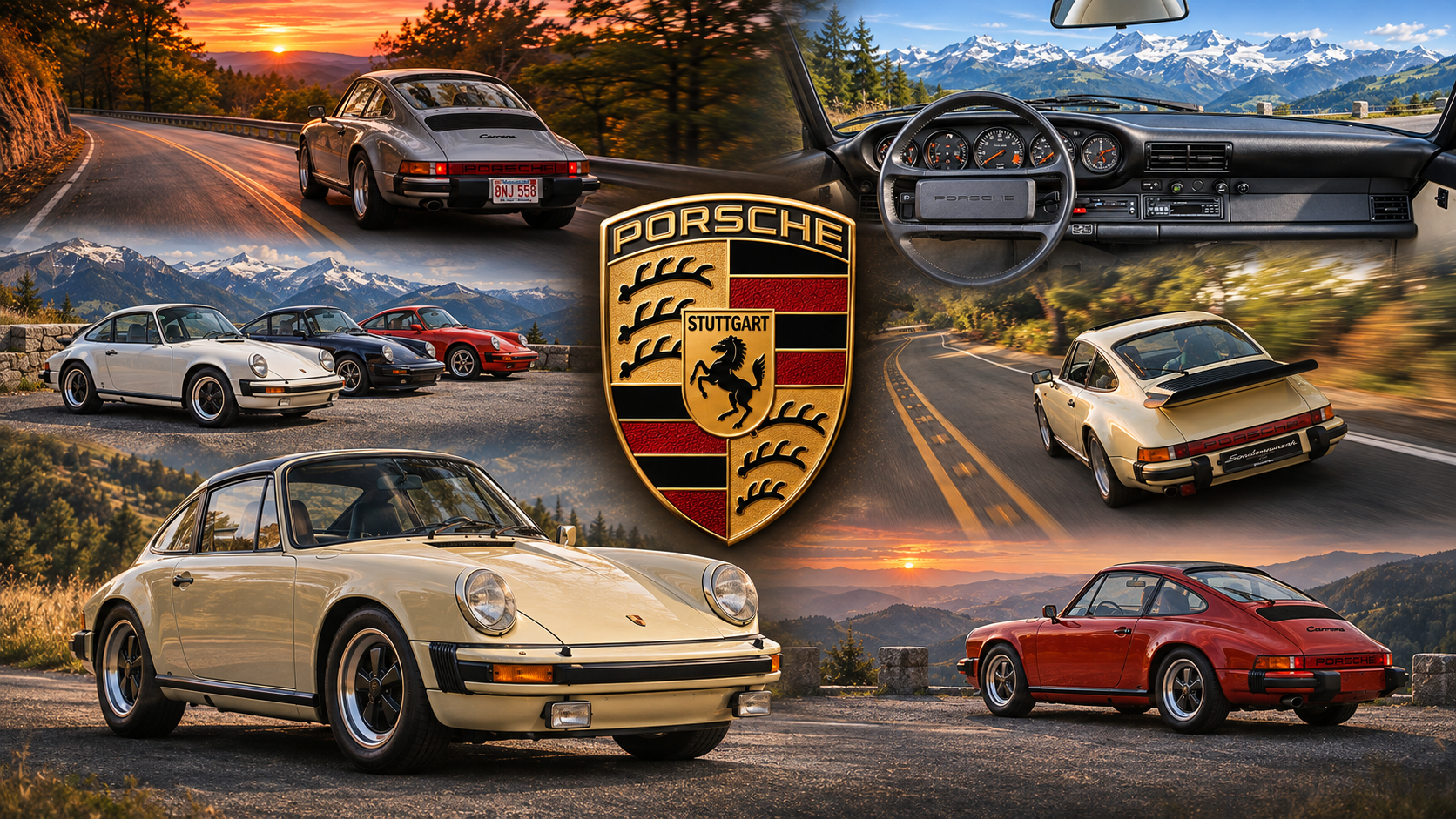
Impact Bumpers, Emissions, and Survival: The G-Series 911 (1974-1989)
How Porsche’s most recognizable sports car survived changing regulations, economic uncertainty, and an internal campaign to replace it—and emerged stronger than ever.
Few automobiles in automotive history have undergone an evolution quite as remarkable as the Porsche 911. When it entered production in 1964, the 911 represented the next chapter in a relatively young company’s rise from a small German sports-car manufacturer to an internationally respected name in performance engineering and motorsport. Building upon the success of the 356, Porsche introduced an automobile that was more powerful, more sophisticated, and better suited to the demands of an expanding international market. Yet the 911 retained many of the engineering principles that had defined its predecessor, most notably its rear-mounted, air-cooled engine and the unmistakable driving characteristics that accompanied it. These qualities helped establish Porsche’s reputation among a growing community of enthusiasts who appreciated the company’s distinctive approach to building performance automobiles.
The original Porsche 911 entered production in 1964, introducing a more powerful and sophisticated successor to the 356 while retaining the rear-mounted, air-cooled engine configuration that had defined Porsche’s earliest sports cars. Its distinctive silhouette would become one of the most enduring designs in automotive history.
By the beginning of the 1970s, however, the automotive industry was undergoing a period of substantial change. Government regulations, economic pressures, and shifting consumer expectations were reshaping how manufacturers approached vehicle design and engineering. Automobiles were becoming more sophisticated, incorporating increasingly complex safety systems, improved emissions controls, and technologies intended to deliver greater comfort and refinement. For Porsche, whose most recognizable automobile was built around engineering principles established more than a decade earlier, these developments presented a series of technical challenges. The 911’s rear-engine configuration, its air-cooled flat-six, and its compact proportions had all contributed to the car’s considerable success, but maintaining those characteristics while meeting the demands of a changing industry would require increasingly creative solutions.
No Subscription? You’re missing out
Get immediate ad-free access to all our premium content.