Porsche 550 Spyder: The Origin of Porsche’s Racing Dominance

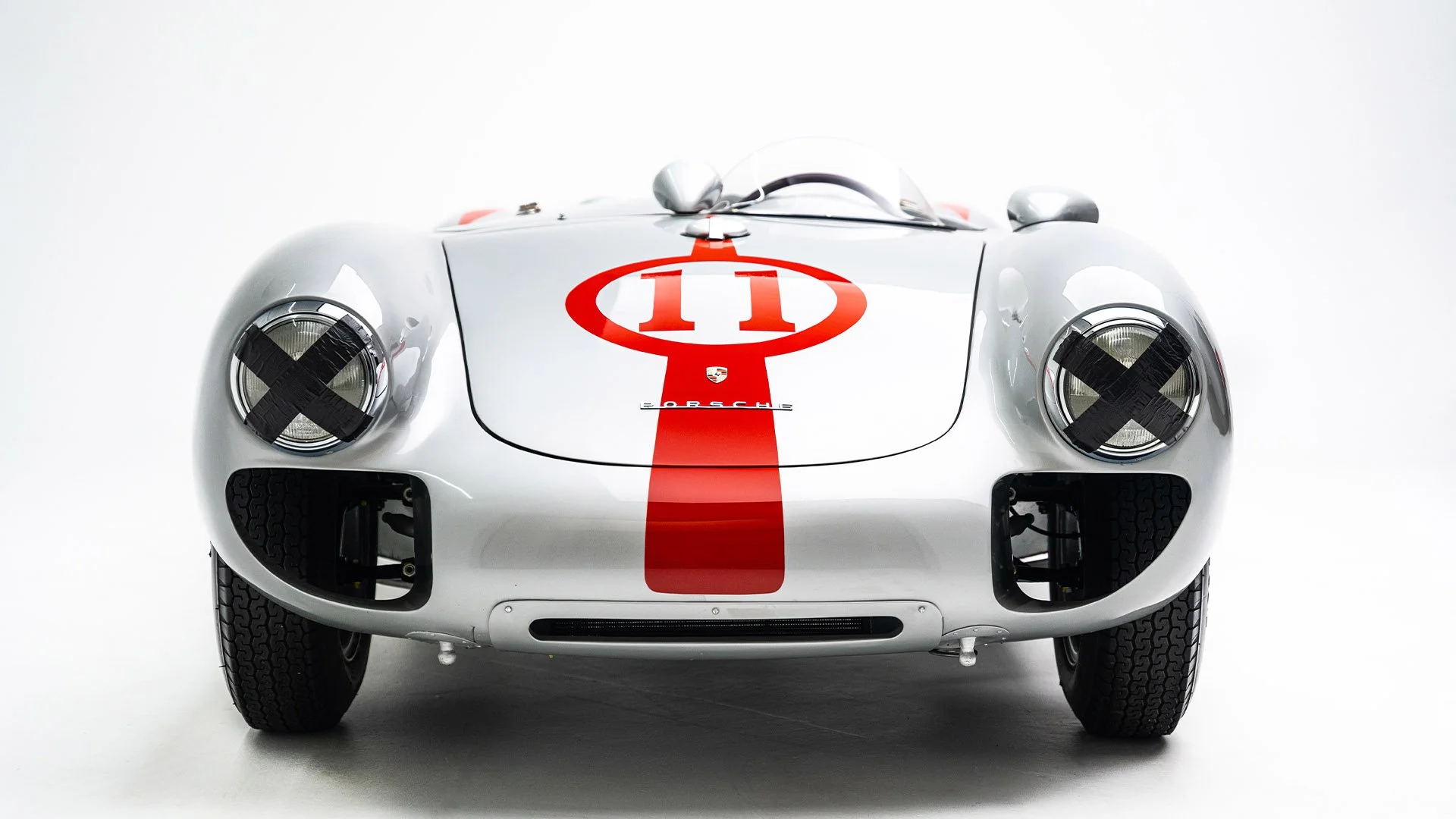
1954 Porsche 550 Spyder (Image credit: Petersen Auto Museum)

The Car That Taught Porsche How to Win

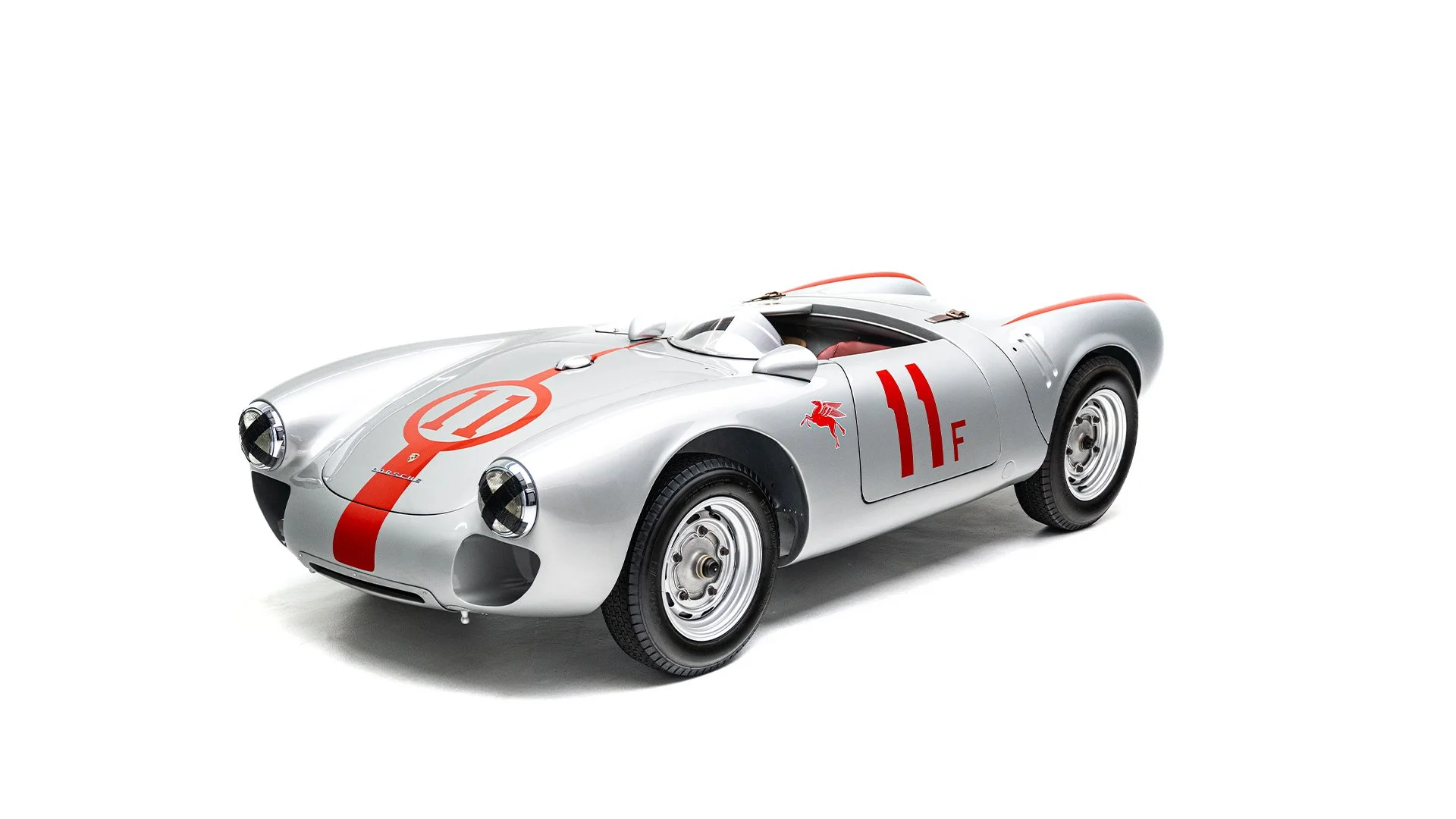
1954 Porsche 550 Spyder (Image credit: Petersen Auto Museum)

There is a difference between building a fast car and building a car that changes the trajectory of a company.

The Porsche 550 Spyder did the latter.

By 1952, Porsche was no longer an unknown company. The 356 (in each of its various iterations) had established the young company as inventive, disciplined, and capable of extracting remarkable performance from modest mechanical foundations. Derived in part from Volkswagen architecture, the 356 proved that light weight, balance, and intelligent engineering could produce positive results on both the open road and the race circuit alike. The car evolved quickly – class wins were accumulated, and through those victories, respect for the brand was earned. Porsche had quickly garnered a reputation as the clever underdog—its engines small in displacement, its performance large in efficiency.

But Ferry Porsche was not interested in being merely clever.

1956 Le Mans: Ferry Porsche among his cars before the start. (Image Credit: Porsche)
1956 Le Mans: Ferry Porsche among his cars before the start of that year’s 24-Hour race. (Image Credit: Porsche)

He understood that class victories in modified production cars, while valuable, were not the same as building a machine born solely for competition. The 356 could be sharpened, lightened, tuned, and campaigned successfully. Yet at its core it remained a road car adapted for racing. Its architecture carried necessary compromises inherent in its origin and ultimate purpose. To compete directly with the likes of Ferrari’s Barchetta, Maserati’s purpose-built sports racers, Jaguar’s aerodynamic endurance machines, and the looming technical might of Mercedes-Benz, Porsche would need to take a decisive step forward.

It would need to develop its own racing car that actually began life as a racing car.

That distinction may sound subtle, but in practice it was profound. A purpose-built competition car is not shaped by convenience or production realities. It is shaped by intent. Its chassis is conceived around stiffness and weight, not passenger comfort. Its engine is selected and positioned for balance, not packaging efficiency. Its body is formed for airflow and mass reduction, not showroom appeal. Every decision flows from a singular question: what is required to drive faster and more efficiently?

Prior to the debut of the Porsche 550, cars such as the Ferrari 166 MM Barchetta had already established the modern lightweight sports-racing template. The Barchetta combined a compact displacement engine, aluminum bodywork, minimal frontal area, and disciplined mass management to maximize efficiency rather than brute output. Its success demonstrated that balance, chassis composure, and aerodynamic cleanliness could offset larger engines. Porsche internalized these principles. The 550 translated that same engineering logic into a mid-engine configuration, refining the concept with improved weight distribution and structural focus rather than simply replicating Italian form.

The Porsche 550 was the answer to that question.

From the first pencil stroke, the Porsche 550 was engineered as a competition instrument. Nothing about it was derivative of Porsche’s existing road models. Nothing about it was an adaptation. It represented a philosophical shift inside the company—a recognition that if Porsche wished to redefine its place in motorsports, it had to construct a car that owed nothing to compromise. This was not evolution. It was an elevation to a new ideology – the mindset that to win on raceday, you had to build a racer that left nothing on the track at the end of its run.

This technical plate captures the disciplined engineering that defined the early Porsche 550. The compact wheelbase, tightly packaged cockpit, and minimal overhangs reveal a chassis engineered for balance rather than excess. Viewed in orthographic form, the 550’s low frontal area and clean body surfaces underscore a singular objective: reduce mass, centralize weight, and optimize aerodynamic efficiency for competition.

The mission behind the 550 was as disciplined as it was ambitious: extract maximum performance from minimum displacement, and do so with the durability required to survive Europe’s most punishing road races and endurance events. Rather than chase larger engines and brute output, Porsche doubled down on what it understood best—lightweight and balanced chassis, mechanical efficiency, and relentless engineering refinement. If the competition would rely on horsepower, Porsche would rely on precision.

The result was a machine that embodied clarity of purpose. Compact, low, and uncompromising, the 550 was built to be driven hard for long periods without a notable loss of performance or operability. It was conceived not as a specialty project, but as a declaration. Porsche would compete at the highest levels not by mimicking its rivals, but by outthinking them.

And almost from the very start, their strategy worked.

1953: Nürburgring — The First Statement

On May 31, 1953, the Porsche 550 made its competition debut at the Eifelrennen on the Nürburgring—a circuit notorious for exposing mechanical weakness and rewarding chassis precision. Entered in the 1.5-liter sports category, the lightweight Spyder immediately validated Porsche’s engineering thesis. Against larger-displacement rivals, the 550 secured a class victory, signaling that balance, efficiency, and structural discipline could triumph over brute horsepower. It was not merely a debut; it was a declaration of intent.

On May 31, 1953, at the Nürburgring Eifelrennen, the Porsche 550 announced itself. Competing in the 1.5-liter sports category, the car secured a class victory. That matters more than it may seem at first glance.

The Nürburgring in the early 1950s was not merely a race circuit; it was a proving ground that exposed weakness without apology. Long before modern runoff areas and engineered safety margins, the Nordschleife was a relentless ribbon of elevation changes, blind crests, tightening radii, and uneven surfaces. It punished excess weight. It punished imbalance. It punished overconfidence. Power alone could not conquer it. What the circuit demanded was discipline — mechanical, aerodynamic, and psychological.

For a young company introducing its first purpose-built racing car, there were easier places to seek validation. Nürburgring was not chosen for convenience. It was chosen because if the concept worked there, it would work anywhere.

At the 1953 Eifelrennen on the Nürburgring, it was Richard von Frankenberg who delivered the defining performance in the new Porsche 550. A seasoned journalist, test driver, and competitor deeply embedded in Porsche’s development circle, von Frankenberg was uniquely positioned to translate engineering theory into race-winning execution. His class victory in the 1.5-liter sports category on May 31, 1953 was more than a result—it was external validation of Porsche’s mid-engine balance and lightweight strategy on one of Europe’s most punishing circuits. In doing so, he helped establish the 550 not merely as a promising prototype, but as a credible international racing weapon from its very first outing.

The 550’s mid-engine configuration proved decisive. By placing the engine ahead of the rear axle, Porsche shifted the car’s mass toward its center, reducing the polar moment of inertia and improving directional stability. Through the Nürburgring’s fast sweepers and technical sequences, this translated into composure — the kind of composure that allows a driver to carry speed without inducing instability. Where larger-displacement competitors leaned on horsepower to recover time on straights, the 550 found its advantage in transitional portions of the track: braking zones, corner entry, mid-corner balance, and corner exit traction.

The significance of that class victory lies not only in the result but in what that result revealed. The 550 was not competing as an adapted road car, seeking pace. It arrived fully formed for its specific purpose. The car’s balance, weight distribution, and engineering clarity were not theoretical advantages. They translated immediately into performance under pressure.

That distinction is critical.

A debut victory at Nürburgring did not crown the Porsche 550 as the new “king” in the arena of auto racing. It did not overturn the established order, which continued to be dominated by manufacturers like Ferrari and Maserati (amongst others), overnight. But it demonstrated that Porsche’s new direction — a purpose-built competition race car specifically engineered around balance rather than brute force — was a viable competitor at one of Europe’s most demanding circuits.

It told the paddock that Porsche had crossed a threshold.

This was not a boutique experiment.
This was a blueprint.

1953: 24 Hours of Le Mans — Endurance Validation

At the 1953 24 Hours of Le Mans, the Porsche 550 did not arrive as a headline favorite — it arrived as a calculated engineering exercise. Entered in the 1.5-liter class, it secured a class victory and finished impressively high overall, competing against cars with dramatically larger displacement. Over 24 hours, on a circuit that punished fragility and rewarded efficiency, the 550 validated Porsche’s core thesis: minimize mass, maximize balance, and let durability compound over distance. Le Mans did not make the 550 famous overnight — it confirmed that Porsche’s racing philosophy was structurally sound.

If the 1953 Nürburgring race was the announcement that a new contender had arrived, Le Mans was validation that it could perform.

By June of 1953, Porsche had already proven the 550 could win on Europe’s most technical (and harrowing) race circuit. But the 24 Hours of Le Mans was something altogether different. It was not simply about cornering balance or class pace. It was about surviving an uninterrupted mechanical siege of a 24-hour marathon event that challenged even the staunchest, most established competitors in the field.

The LeSarthe circuit punished everything. The long Mulsanne Straight demanded sustained full-throttle operation. Brakes were expected to cool rapidly and then perform repeatedly through Arnage and Mulsanne corners. Gearboxes absorbed constant load transitions. Oil temperatures crept upward in the afternoon heat, only to stabilize in the cool of the night. Every weak component was guaranteed to reveal itself before dawn.

For automotive manufacturers, this is the event where engineering is stripped of theory and pushed to its limits by the rigors of surviving a 24-hour endurance race on Le Mans 8.4-mile track (its approximate length circa 1953).

The Porsche 550 was powered by the Type 547 “Fuhrmann” engine — a 1.5-liter, air-cooled flat-four engineered with dual overhead camshafts and roller-bearing crankshaft construction. On paper, its output was impressive for displacement; in practice, its durability was the true differentiator. At events like the 24 Hours of Le Mans, the 547 sustained high RPM for extended periods along the Mulsanne without sacrificing mechanical integrity. That ability to combine advanced valvetrain architecture with endurance reliability allowed Porsche to compete — and win its class — against significantly larger engines.

The Type 547 “Fuhrmann” engine was, in many ways, a statement of intent. Ernst Führmann did not design a simple pushrod motor optimized for short bursts of speed. Instead, he engineered a four-camshaft, shaft-driven valvetrain capable of maintaining precise timing at high revolutions for extended periods of time. The engine’s dual ignition enhanced combustion stability. The vertical shaft system reduced the elastic timing variations that chains could introduce under load. Internally, the engine was meticulously balanced to sustain elevated RPM without destructive vibration.

For a 1.5-liter engine in 1953, this was advanced mechanical architecture.

On paper, 110 horsepower seems modest. In context, it was strategic. Combined with the 550’s approximately 550-kilogram curb weight, the car required less brake energy, less tire load, and less drivetrain strain per mile than larger competitors. The mid-engine configuration placed mass centrally, reducing the pendulum effect and preserving composure under fatigue conditions.

Over twenty-four hours, those efficiencies compound.

Le Mans did not crown Porsche the overall winner in 1953. That was never the objective. What it did was confirm that Porsche’s philosophy — lightweight construction, mechanical precision, and efficient power — was scalable to endurance competition’s highest proving ground.

When the 550 secured its class victory, Porsche was no longer simply a small manufacturer experimenting above its weight. It was an endurance constructor. A company capable of building machines that could operate at maximum output for an entire day and emerge intact.

That identity would echo through the 718, the 904, the 906, the 917 — and eventually to the modern 911 endurance programs.

Le Mans validated more than a car. It validated a methodology.

1953–1954: Carrera Panamericana — A Name Is Born

The Carrera Panamericana was one of the most demanding open-road endurance races of the era — a multi-stage, border-to-border competition across Mexico that combined extreme speed with punishing terrain. In 1953 and again in 1954, the Porsche 550 entered this environment not as the most powerful car in the field, but as one of the most efficient. The 550 secured strong class finishes, reinforcing its durability and mechanical resilience over long, high-speed public-road stages. Against larger-displacement Ferraris and American V8 machinery, Porsche relied on balance, braking stability, and sustained reliability. The results further established the 550’s reputation as a disciplined endurance platform capable of surviving — and succeeding — in the harshest competitive conditions of the period.

If Le Mans tested mechanical durability, the Carrera Panamericana tested existential resilience.

Held across Mexico’s open highways, the Carrera Panamericana was not a controlled circuit environment with runoff areas and predictable surfaces. It was a continental-scale road race stretching over multiple days and stages, traversing mountain passes, desert flats, and remote towns connected by public roads temporarily closed for competition. Drivers confronted dramatic altitude swings that altered carburation and power delivery, blistering ambient temperatures that stressed cooling systems and tires, and dust-laden air that punished filtration and internal tolerances. Long, uninterrupted flat-out sections demanded sustained high-RPM operation, often for distances that would expose even minor weaknesses in lubrication or valvetrain stability. Mechanical attrition was not incidental to the event’s identity — it was an embedded variable. To finish was an achievement; to remain competitive required engineering discipline that was second only to driver bravery.

Drivers faced hundreds of miles per stage, not in isolated sprints but in sustained, cumulative mechanical exposure. Engines operated in thin mountain air where carburetion mixtures shifted unpredictably, forcing constant adaptation in fuel delivery and combustion efficiency while cooling systems were pushed toward their thermal limits. Suspension components absorbed imperfect public-road surfaces — expansion joints, patched asphalt, cambers never designed for racing — all at sustained high velocity. Brake systems were repeatedly loaded against gravity on prolonged descents few European circuits could replicate, converting speed into heat with little margin for fade. The race did not simply test performance; it interrogated structural integrity over distance.

This was motorsports at its rawest.

The poster declares Porsche “the sensation of the 1954 race” at the Carrera Panamericana — and the results justify the claim. In the under-1500 cc sports car category, Hans Herrmann secured first place while Jaroslav Juhan followed in second, a disciplined demonstration of the Porsche 550’s balance and durability. More tellingly, Porsche captured 3rd and 4th overall in the general classification, competing against significantly larger-displacement machinery. On Dunlop tires and lubricated by Castrol, the 550 reinforced its reputation as a lightweight endurance platform capable of surviving — and succeeding — across Mexico’s punishing open-road stages.

In 1953, Porsche secured a class victory. In 1954, the 550 Spyder — with Hans Herrmann among its pilots — further reinforced its competitiveness in conditions that bordered on hostile. These were not short sprint validations. They were demonstrations of composure under chaos.

The Type 547 engine’s efficiency proved decisive at altitude. Reduced displacement translated into lower thermal load, more stable combustion, and less cumulative mechanical stress across long stages. The lightweight chassis reduced demand on tires and braking systems over extended distances, preserving consistency where heavier cars consumed their components. And the 550’s balance — its engine positioned ahead of the rear axle — delivered composure over imperfect road surfaces that could unsettle front-heavy rivals at speed.

Where others relied on brute displacement, Porsche relied on engineering discipline.

And it is here that the 550’s legacy moves beyond finishing positions.

Hans Herrmann (right) and mechanic Herbert Linge take a break at the 1954 Carrera Panamericana, their Porsche 550 paused against the vast Mexican landscape. The image captures the paradox of the event: moments of stillness set within a race defined by relentless mechanical and environmental strain. At altitude, across mountain passes and sun-baked straights, the 550’s balance and efficiency were not theoretical virtues — they were survival tools. Herrmann’s eventual class victory was earned not only through speed, but through discipline, restraint, and mechanical sympathy across one of the harshest road races of the era.

The name Carrera did not originate as a marketing construct. It was recognition — earned on Mexican highways during the Carrera Panamericana. When Porsche later applied the Carrera designation to its road cars, it was not aspirational branding. It was an acknowledgment of competition lineage.

The 550’s performances embedded the word into Porsche’s internal vocabulary. It linked the brand not merely to circuits, but to endurance under variable, unforgiving conditions — altitude shifts, heat, imperfect pavement, sustained speed. It signaled that Porsche engineered machines capable of surviving beyond controlled environments.

Every Carrera that followed — from the early four-cam 356 Carreras to air-cooled 911s and contemporary interpretations — carries that inheritance.

The Nürburgring introduced the Porsche 550.
Le Mans confirmed its durability.
Mexico gave it mythology.

The 550 was not simply a successful race car. It was the crucible in which Porsche’s endurance identity — and its most enduring nameplate — were forged.

The Engineering Core: The Fuhrmann Four-Cam

The Type 547 “Fuhrmann” engine that powered the Porsche 550 was a 1,498 cc air-cooled flat four built around an aluminum crankcase with a roller-bearing crankshaft — a choice that reduced friction and allowed sustained high rotational speeds. Each cylinder bank carried dual overhead camshafts driven by vertical shafts and bevel gears, eliminating the timing elasticity associated with chains and providing exceptional valve-event precision at elevated RPM. The hemispherical combustion chambers employed dual spark plugs per cylinder, improving flame propagation and combustion stability under variable load and altitude conditions. Dry-sump lubrication ensured consistent oil delivery during prolonged high-speed cornering and extended flat-out operation, critical for endurance competition. Twin carburetors supplied mixture through short intake tracts designed to optimize volumetric efficiency without sacrificing throttle response. With early outputs around 110 horsepower and later evolutions exceeding 130 horsepower at over 7,000 RPM, the 547 was engineered not merely for peak figures but for mechanical survivability at sustained revs — a defining advantage in long-distance racing.

Now we go deeper.

The Type 547 was not simply advanced within Porsche’s internal portfolio — it was advanced relative to the global sports-car field of the early 1950s. Many competitors still relied on pushrod valvetrains and conservative rotational ceilings designed to protect components rather than exploit them. Porsche moved in the opposite direction. With the 547, complexity was not avoided; it was embraced. Precision, high-RPM stability, and sustained durability became the competitive differentiator, packaged inside a 1,498 cubic centimeter air-cooled flat four that, on paper, appeared modest.

Architecture was the headline. Dual overhead camshafts per bank — four camshafts in total — combined with dual spark plugs per cylinder set the Type 547 apart from much of its early-1950s competition. An initial 110 brake horsepower at roughly 6,200 RPM sounded modest until it was placed in period context. The latter 550A’s climb toward 135 horsepower at 7,200 RPM revealed the true intent. In that era, sustained operation north of 7,000 RPM was not commonplace; it required an engine specifically engineered to continuously operate at that speed, not one that could merely reach those numbers when pushed to its limits.

And the Type 547 was capable of achieving this objective because valve control was treated as a foundational component of its design.

Camshafts were driven by vertical shafts with bevel gears — a design that was a more intricate and expensive solution than chains or pushrods. It was a choice that prioritized timing precision. The vertical shaft and bevel gear arrangement delivered consistent valve-event accuracy and reduced elastic variation under sustained thermal and mechanical load. At elevated RPM, that stability was not about peak power; it was about maintaining predictable engine “breathing” as oil temperatures climbed and clearances changed. It separated an engine capable of short bursts from one engineered for extended high-speed operation.

Disassembled, the Ernst Fuhrmann–designed Type 547 revealed just how complex Porsche’s 1.5-liter four truly was. Four overhead camshafts, driven by vertical shafts and bevel gears, eliminated timing instability at high engine speeds, while a roller-bearing crankshaft reduced friction and controlled heat under sustained load. Dual spark plugs per cylinder improved combustion efficiency and stability, particularly critical as revs climbed beyond 7,000 RPM in later competition form. Dry-sump lubrication ensured constant oil supply during prolonged high-speed cornering and extended flat-out operation. The result was not simply a high-revving engine, but one engineered to survive at those speeds for hours — a defining requirement in endurance racing.

This was why the Type 547 was not merely “advanced.” Its sophistication was directed specifically at durability under sustained stress.

Dual ignition reflected the same engineering logic. Two spark plugs per cylinder improved flame propagation and stabilized combustion across varying altitude, temperature, and mixture conditions. In endurance competition — where engines operated for hours under heavy load — combustion consistency directly influenced thermal management and component longevity. The 547’s output figures were therefore less about spectacle and more about sustained, repeatable performance.

Internally, the impact on Porsche was practical. The 547 established a precedent of selecting mechanically precise solutions even when they increased manufacturing complexity. The Porsche 550 was not conceived as a cost-efficient racing entry. It was engineered as a structurally rigorous platform built around controlled, high-RPM durability.

It was not inexpensive. It was not simple. It was engineered to meet a defined endurance objective — and it did so consistently, changing the narrative for Porsche as a serious, disciplined contender on race day.

1955–1956: The Evolution — 550A

The Porsche 550A was not a cosmetic evolution — it was a structural refinement. Introduced with a tubular spaceframe chassis replacing the earlier ladder-type structure, rigidity increased while overall weight remained tightly controlled at roughly 530 kilograms. Power continued to come from the Type 547 four-cam flat-four, now pushing toward 135 horsepower at over 7,000 RPM in competition trim. The result was improved torsional stiffness, sharper response, and greater durability under sustained racing loads. If the original 550 proved the concept, the 550A optimized it.

Porsche did not freeze development after finding early success on the racetrack. That is one of the most important tells in the 550 story. A lesser company would have taken the early wins, polished what they’d built, and kept building the same car until the market — or the competition — moved on. Instead, Porsche treated each victory as data. The 550 was not a finished product in 1953 or 1954. It was a foundation. And Porsche did what engineers do when they believe in a concept: they refined it, lightened it, stiffened it, and sharpened it until it behaved exactly the way they wanted under load.

The 550A was the result of that mindset.

Its most meaningful change was structural. The 550A introduced a tubular spaceframe chassis that was both lighter and stiffer than its predecessor. That combination matters because stiffness is not a marketing adjective — it’s a functional multiplier. A stiffer chassis allows suspension geometry to do its job consistently because the chassis is no longer flexing and absorbing forces that should be managed by springs, dampers, and anti-roll behavior. You get cleaner tire contact patches, more predictable transient response, and a car that holds alignment and balance deeper into a corner and harder under braking. In a road race, that means less drama and more repeatable speed.

Weight distribution improved as well, and with it the 550A’s composure at the limit. The car became more planted, more stable in transition, less wasteful with momentum. Structural rigidity increased, and output climbed in racing trim — not because Porsche suddenly decided power was the new priority, but because the platform was now capable of using that power more effectively. The 550A was not a reinvention. It was a refinement of a philosophy already proven correct.

Open the door of the Porsche 550A and the priorities are immediately clear. Thin aluminum panels, exposed structure, a centrally positioned tachometer, and a drilled floor are not stylistic flourishes — they are decisions. The driver sits low, legs extended, hands on a simple wood-rim wheel, with only the information necessary to manage revs, temperature, and pressure. It feels less like an interior and more like a calibrated instrument — a space built to translate mechanical feedback directly into action.

Then came June 10, 1956 — the Targa Florio.

If you want a single day that crystallizes why the 550A matters, it is this one.

Umberto Maglioli drove a 550A Spyder to overall victory. Not a class win. Overall. That distinction is everything. Class wins are proof of competence within boundaries. Overall wins are proof of superiority without excuses. The Targa Florio was not a sanitized circuit where horsepower could paper over inefficiency. It was Sicily — a mountainous, punishing, technical labyrinth of public roads where the car was asked to brake, turn, climb, descend, and survive, over and over, with no mercy and no reset button.

This is the moment that must be understood clearly.

Ferrari and Maserati were building cars with substantially larger engines. They had power advantages. They had prestige. They had the gravitational pull of expectation — the assumption that, when the dust settled, displacement and horsepower would reclaim their place at the top. That is exactly what Porsche disrupted.

With its tubular spaceframe chassis increasing torsional rigidity and the four-cam Type 547 pushing into the mid-130 horsepower range, the 550A translated engineering refinement directly into results. In 1956, it delivered one of Porsche’s defining early victories with Umberto Maglioli’s overall win at the Targa Florio, defeating significantly larger-engined rivals on outright pace and endurance. It continued to secure class victories at Le Mans and across European hill climbs and road races, reinforcing Porsche’s efficiency-over-displacement doctrine. By the time the 550A’s career matured, it had moved Porsche from promising upstart to disciplined international contender.

The Porsche 550A won because it was lighter, more efficient, more balanced, and engineered with ruthless focus. It conserved tires and brakes. It carried speed through sections where heavier cars bled momentum. It asked less of its components per mile and therefore could maintain pace without paying the same mechanical tax. It was not merely quick — it was sustainable. And in a race like the Targa, sustainability is performance.

This was the first time Porsche defeated significantly more powerful competitors outright on a world stage. Not by luck. Not by attrition alone. By design. By philosophy made real.

That victory was not symbolic. It was definitional.

It told Porsche — and the racing world — that the company’s hierarchy of priorities was not a clever workaround for being small. It was, in fact, a superior method. Balance first. Weight second. Power third. The 550A didn’t just validate that order. It weaponized it.

Performance and Acceleration

The Porsche 550 was not defined by raw horsepower, but by how efficiently it used it. With roughly 110–135 horsepower depending on specification and a curb weight near 1,200 pounds (about 550 kg), the 550 could reach top speeds in the range of 135–140 mph (approximately 220–225 km/h). For a 1.5-liter car in the mid-1950s, those numbers were not just competitive — they were strategically disruptive.

Performance numbers for the Porsche 550 live in a slightly different universe than the clean modern world of standardized testing. In the early 1950s, a racing car like the 550 was not built to satisfy a magazine’s stopwatch routine. It was built to win events — and events demanded configuration. Gearing changed depending on circuit length and straightaway speed. Carburetion and ignition settings shifted with altitude and temperature. Even “early specification” can mean multiple legitimate states of tune depending on whether the car was prepared for Le Mans, the Nürburgring, Mexico, or Sicily. That is why official 0–60 mph times are not consistently recorded in primary sources, and why any single number must be treated as an approximation rather than a universal truth.

That said, we can still speak intelligently about what the 550 was capable of.

Based on its power-to-weight ratio and the way contemporary cars with similar output and mass performed under comparable conditions, modern estimates often place the early Porsche 550’s zero to 60 acceleration in the neighborhood of 7 to 8 seconds. The phrase “must be presented cautiously” matters here, because race gearing can make the same car feel either punchy or long-legged depending on the specific race/roadcourse its being set up for. A 550 optimized for sustained top-end speed may not leap off the line the way a road-geared example would. Conversely, a shorter-geared setup designed for tighter circuits could feel more urgent at lower speeds while sacrificing ultimate maximum velocity.

But the deeper point is not the exact number. It’s what these numbers represented in 1953.

This was a 1.5-liter car producing roughly 110 brake horsepower in its earliest form, pulling a body and chassis that hovered around 550 kilograms (which is also where the race car’s “550” designation originated). That combination created a kind of immediacy that larger, heavier cars often could not replicate outside of straight-line power zones. The 550 didn’t need massive horsepower to feel fast — it needed momentum, gearing, and a light platform all engineered to maximize performance and eliminate any “waste” (excess body styling, features, or other options that would increase weight unnecessarily). Acceleration in that context was less about dramatic engine revving or being able to melt the tires in a victory lap burnout, and more about clean, efficient conversion of power into forward motion.

The Porsche 550’s top speed is a little more reliably cited, and figures commonly land at approximately 220 kilometers per hour — about 137 miles per hour — in early specification. In context, that is an extraordinary statement for a small-displacement sports racer in 1953. It speaks not only to power, but to aerodynamic efficiency and mechanical stability at sustained speed. It also reinforces the 550’s aforementioned superpower: it could hold pace, not merely touch it.

That is the essential distinction. Many cars can achieve moments of incredibly high speed, especially in a long straight away where the driver can wind out the engine and maximize acceleration. However, endurance racing punishes these types of “fast moments.” It rewards speed you can maintain without the car coming apart beneath you. The 550’s performance envelope was defined by usable speed — speed that did not demand heroics from the driver, and speed that did not consume the car itself in the process.

So while modern estimates place the 550’s sprint to sixty miles per hour in the seven-to-eight-second range, that figure simply provides a general sense of how responsive and immediate it felt under acceleration. And the 136-137 mph top speed gives you a clearer sense of its long-legged capability. But the 550’s true performance cannot be reduced to a single sprint figure. Its brilliance was that it combined respectable, outright pace with mechanical discipline — and in 1953, for a car equipped with a small, 1.5-liter engine, that combination was exceptional.

Chassis Philosophy: Why It Worked

This detailed cutaway illustration of the Porsche 550 chassis — artwork by Shin Yoshikawa — makes clear how deliberate the car’s structure truly was. The original 550 utilized a lightweight ladder-type frame with welded steel tubing, keeping mass low while providing sufficient rigidity for competition. With the engine positioned ahead of the rear axle, weight distribution was optimized for balance rather than straight-line bias. The simplicity of the chassis was strategic: minimal structure, minimal weight, and maximum mechanical accessibility — a racing architecture designed around efficiency, not excess.

As we stated near the start of this article, the 550 worked because it was engineered as a weapon for real roads and real racing, not as a grand touring car forced into competition. Its brilliance wasn’t a single breakthrough feature — it was the way every decision reinforced the next. Porsche built the 550 around efficiency of motion: it minimized wasted energy, it minimized stress on components, and it let balance do the heavy lifting.

You can start with the fundamentals. The 550 employed a torsion bar suspension — compact, robust, and well-suited to the realities of mid-twentieth-century racing, where surfaces were imperfect, and endurance mattered as much as outright pace. Torsion bars allowed the car to keep its packaging tight and its mass low, and they offered a durability advantage over more delicate arrangements. Combine that with a naturally low center of gravity from the flat-four engine, and you get a car that resisted roll, stayed composed under braking, and maintained consistent tire contact through long, loaded corners. The chassis didn’t ask the driver to “manage” the car every moment. It asked for inputs — and then it responded cleanly.

Compact dimensions mattered more than people like to admit. The 550 was small, narrow, and tightly packaged, which meant it could thread itself through technical sections with minimal correction. Less mass and less rotational inertia reduced the energy required to change direction. In practice, that translated into something the stopwatch cares about: the car could carry speed through transitions where larger machines had to brake earlier, turn slower, and accelerate later. Over a lap, and especially during a ten, twelve, or twenty-four endurance race, that is not a minor advantage. That is the difference between surviving on horsepower and winning on long-range endurance and consistency.

Where this became decisive was in how the 550 treated consumables. Larger, heavier, often front-engined competitors simply demanded more from their brakes and tires to achieve the same result. More mass meant more energy to shed under braking, higher tire loads, elevated temperatures — and over distance, that compounded into fade, slip, understeer, and growing mechanical strain. The Porsche, by contrast, conserved by design. It was not gentle; it was efficient. It asked less of its components per mile, which allowed it to sustain pace longer while fewer liabilities accumulated against it.

In the Porsche 550, the engine’s placement ahead of the rear axle was the defining structural decision. By centralizing mass and reducing polar moment, the chassis rotated more progressively and recovered more predictably at the limit. Combined with the car’s low overall weight, that balance reduced strain on tires and brakes while giving drivers greater control under load — especially over long distances where consistency mattered more than theatrics.

The defining decision was the choice of chassis layout: mid-engine. By placing the engine ahead of the rear axle, Porsche reduced polar moment of inertia and centralized mass, eliminating the pendulum effect common to rear-heavy designs of the period. That translated directly into a rotation that felt progressive and recoverable rather than abrupt. A chassis with centralized mass changed direction more cleanly and regained composure more predictably at the limit. The 550 could be driven hard without constantly threatening to penalize minor misjudgments — that behavior was engineered, not incidental.

In that sense, the 550 did more than win races; it clarified Porsche’s competitive method. Performance was not treated as an output number but as a systems equation — how efficiently the chassis converted available horsepower into repeatable forward motion. The car extracted speed while limiting cumulative mechanical stress, a critical distinction in endurance racing.

The hierarchy that emerged was disciplined and deliberate. Balance came first, ensuring consistent behavior across surfaces and conditions. Weight followed, reducing wasted energy and preserving tires, brakes, and suspension components. Power came third, because output only mattered once the structure could deploy it effectively. That order of operations defined the 550’s chassis philosophy — and it remained foundational to Porsche’s endurance approach long after the car left the grid.

Production and Rarity

Even though the 1955 Porsche 550 shown here did not sell when offered by RM Sotheby’s in Monterey, the millionaire-plus asking price it carried — in the low-to-mid-$4 million range — is telling about the 550’s current market stature. At recent auctions, well-documented 550 Spyders have surpassed $4 million and even climbed above $5 million, underscoring strong demand for these rare, historically significant racers. That pricing reflects rarity (only ~90 built), competitive pedigree, and cultural resonance that few post-war sports racers can match. In today’s collector car market, the 550 sits firmly in the upper echelon of 1950s competition machinery.

Between 1953 and 1956, approximately 90 examples of the Porsche 550 were constructed. In absolute production terms, that is an extraordinarily small figure. Even by early postwar sports car standards, the 550 was never intended to be a high-volume product. It was built in limited numbers, assembled with racing intent, and delivered to privateers and factory-backed race teams who understood exactly what it was: a purpose-built competition instrument.

In simple numerical terms, ninety cars create exclusivity. In historical terms, those ninety cars created a blueprint.

The scarcity of cars like the Porsche 550 undeniably fuels modern mystique. Auction prices, concours appearances, and museum displays reinforce the aura. But mystique is not the source of the 550’s value. Rarity alone does not guarantee importance. There are obscure cars built in even smaller numbers that occupy only footnotes in automotive history.

The 550 is different.

Its significance is not rooted in how few were built, but in what those few accomplished — and what they made possible.

The 1954 Porsche 550 on display at the Petersen Automotive Museum is a reminder that these cars are not just valuable — they are scarce to the point of near invisibility. Fewer than 100 were built, and far fewer survive today with intact chassis identity and documented competition history. Most reside in tightly held private collections, rarely seen and even more rarely offered. When one is publicly exhibited, it isn’t simply a showpiece — it’s a rare opportunity to stand inches away from a foundational chapter of Porsche’s competition story.

The Rennsport philosophy — the “RS” designation that would later define Porsche’s most focused machines — traced its conceptual origin here. The Porsche 550 formalized the idea that Porsche’s most serious cars would be lighter, sharper, and engineered around performance first. That doctrine carried forward through the 718 RSK, the 904, the 906, and ultimately into the prototype era that reshaped endurance racing in the 1960s.

Without the 550’s early validation, the pathway to cars like the 917 becomes far less certain. Porsche’s confidence on the global stage did not emerge in isolation; it was built on proof that precision, balance, and disciplined engineering could defeat larger rivals.

And then there is identity. The Carrera name was not chosen because it sounded dramatic. It was earned in Mexico. From that point forward, Carrera signified lineage — endurance, efficiency, and competitive credibility embedded into a single word.

The 550 was not simply an early model. It marked the moment Porsche’s character crystallized: lightweight construction, mechanical sophistication, and an unwillingness to chase displacement for its own sake.

Ninety cars were enough.

Enough to define a philosophy.
Enough to establish a reputation.
Enough to shape everything that followed.

The Loss That Changed the Narrative – September 30, 1955

Here, James Dean sits behind the wheel of his Porsche 550**, chassis 550-0055 — the car he nicknamed “Little Bastard.” The number 130 is already on the nose, the stance low and purposeful, the moment charged with the kind of optimism that only exists before history intervenes. Within weeks, that same car would be involved in the crash on Route 466 that ended Dean’s life at 24. From that point forward, “Little Bastard” ceased being a playful nickname and became one of the most haunting footnotes in automotive and Hollywood lore.

On September 30, 1955, James Dean was killed while driving his Porsche 550 — chassis 550-0055 — on California’s Route 466. He was 24 years old. The collision ended a career that was still ascending and, in an instant, attached the 550 to one of the most enduring cultural tragedies of the twentieth century. What had been a purpose-built European competition machine now entered the American mainstream under profoundly different circumstances.

The loss mattered because of timing. Dean was not merely a film actor; he had become a generational symbol of restlessness and velocity — traits the 550 visually embodied. When the crash occurred, the narrative fused man and machine. The car was no longer discussed solely in terms of class victories or engineering discipline; it became shorthand for risk, youth, and consequence.

The engineering legacy of the 550 was already secure in racing circles. Dean’s death expanded its footprint far beyond them. From that moment forward, the 550 carried dual identities: a disciplined endurance weapon — and a cultural artifact tied to one of Hollywood’s most haunting losses.

Why the Porsche 550 Still Matters

The Porsche 550 still matters because it was the moment Porsche stopped experimenting and started defining itself. It proved that balance could beat brute force, that precision could outlast power — and it carried those lessons forward into every serious machine that followed. The shadow of James Dean ensured it would never live only in paddocks and record books; it entered modern pop culture as both icon and cautionary tale.A small silver Spyder at the edge of an open road — that is where Porsche’s identity truly began.
The Porsche 550 still matters because it was the moment Porsche stopped experimenting and started defining itself. It proved that balance could beat brute force, that precision could outlast power — and it carried those lessons forward into every serious machine that followed. The shadow of James Dean ensured it would never live only in paddocks and record books; it entered modern pop culture as both icon and cautionary tale.
A small silver Spyder at the edge of an open road — that is where Porsche’s identity truly began.

The Porsche 550 mattered because it was the first moment Porsche’s DNA came into full focus. Before it, the company was clever and ambitious. With the 550, it became self-defined. Small displacement was no longer a constraint — it was a deliberate strategy. Balance, weight discipline, and efficiency were not supporting traits; they were the foundation.

The mid-engine layout was part of that clarity. Centralized mass reduced polar moment and gave the car a neutrality others simply didn’t have. It rotated cleanly, recovered predictably, and treated physics as an ally. That wasn’t novelty — it was competitive leverage, and Porsche understood it early.

The Fuhrmann four-cam engine reinforced the same point. It was complex and expensive, but it delivered sustained high-RPM durability when it mattered. Porsche chose precision over convenience. That decision pattern — invest in the superior mechanical solution — became cultural inside the company.

And then there was identity. Mexico gave “Carrera” its legitimacy. The 550 didn’t just win races; it established doctrine. Lightweight first. Engineering first. Efficiency first. That hierarchy still defines Porsche’s most serious machines — and it began here.