Forced Induction, Forced to Win

Porsche won Le Mans for the first time in June 1970. A victory that, by any reasonable measure, should have been enough for one summer. It wasn’t. Within four weeks, the company had set its sights on the Canadian American Challenge Cup, Can-Am, a North American racing series where the competition was running open-cockpit prototypes with naturally aspirated engines pushing past 790 horsepower. 

Porsche’s 917, the same car that had just conquered La Sarthe, made 572 hp from a 4.5-liter flat-twelve. That was a serious deficit, and everyone in Weissach knew it. The solution they landed on wasn’t more displacement or more cylinders. It was a turbine spinning in the exhaust stream, and it would change the company for the next fifty years.

A Smaller Turbo, A Smarter Idea

Porsche 917/10 at a racetrack
Credit: Porsche

Turbocharging had been around for decades. Cargo ships used it, commercial trucks used it, and teams racing on American oval tracks had squeezed enormous power out of turbocharged engines for years. The problem is that ovals are forgiving in a specific way. Throttle inputs are steady, engine speeds don’t fluctuate much, and a sluggish turbocharger that needs a moment to build boost isn’t a serious liability. Road courses are nothing like that.

Valentin Schäffer, head of racing engine development at Porsche, worked out a more practical approach to the problem. Rather than dumping excess charge air through an outlet valve when boost pressure got too high, which was the common solution on oval cars, his design routed excess exhaust gases around the turbine through a bypass valve. That valve, what engineers call a wastegate, meant boost pressure could be kept stable and predictable. It also made smaller turbochargers viable, since the system no longer needed to be sized for peak pressure and then bled down. Smaller turbos meant less rotating mass. Less rotating mass meant faster response off a corner.

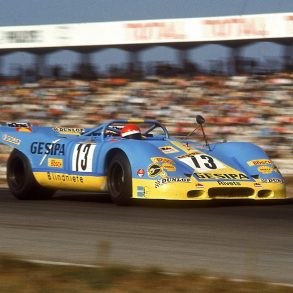
By late July 1971, a 917/10 Spyder running a twin-turbo 12-cylinder was making laps at Weissach. The engineers had also been developing a naturally aspirated 16-cylinder as a potential alternative; it weighed 320 kg (706 lbs) and was 25 centimeters longer than the turbo option. The 4.5-liter twin-turbo produced 838 horsepower at 270 kg (595 lbs). That comparison settled things quickly.

Can-Am and the Numbers That Still Stand

Porsche 917/30 Spyder
Credit: Porsche

The 917/10 Spyder made its Can-Am debut at Mosport Park on June 11, 1972, running five liters of displacement and 986 horsepower. The Penske team took the car to six wins in nine races, and driver George Follmer walked away with the series title. In 1973, the displacement went up to 5.4 liters in the revised 917/30, output climbed to 1,085 horsepower, and Penske driver Mark Donohue won the championship again. Six wins from eight race weekends that season.

When the Can-Am organizers introduced fuel consumption limits for turbocharged cars ahead of 1974, a fairly transparent attempt to rein in Porsche’s advantage, the factory decided it wasn’t worth the bother and pulled out. Before leaving for good, the 917/30 made one more appearance at Talladega Superspeedway in August 1975, where Donohue set a closed-course speed record of 221 mph (355.8 km/h) with an engine producing 1,213 horsepower. That record lasted for years.

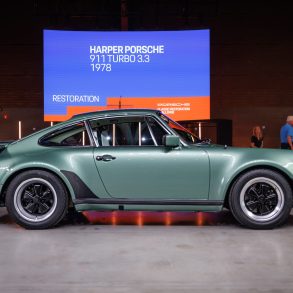
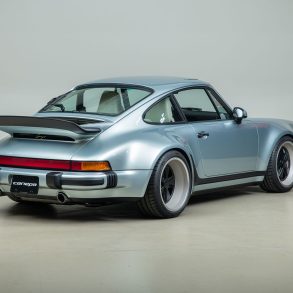
The road car connection came faster than most people realize. The production 911 Turbo went on sale in 1974, the same year Porsche withdrew from Can-Am. By 1977 it had an intercooler, the same basic technology Schäffer and his team had been developing on racing engines since the early part of the decade.

The 935 and Four Straight Championships

Porsche 935 K3 at a pit stop
Credit: Porsche

The Porsche 935 tends to get described as a racing version of the 911 Turbo, which is technically accurate but undersells how extensively it was developed. Starting in 1976 with a single-turbo 2.85-liter flat-six producing 582 horsepower, the car faced significant driveability challenges due to the massive lag of its lone turbine. To solve this, Porsche moved to a twin-turbo setup in 1977. By using two smaller turbines, engineers improved throttle response and pushed output to 630 horsepower. 

The most extreme factory version was the 935/78, which the Porsche crew nicknamed “Moby Dick” for its long, low bodywork. Its 3.2-liter twin-turbo engine used water-cooled, multi-valve cylinder heads, a notable technical departure, and produced 833 horsepower. A lot of what Porsche tested in that car showed up later in other projects.

Le Mans and the Prototype Era

Porsche 956 at a racetrack
Credit: Porsche

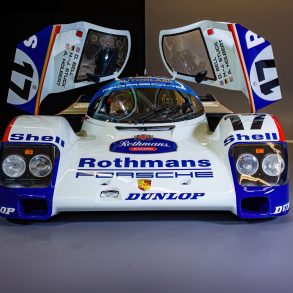
Starting in the early 1980s, Porsche shifted focus toward a different category of racing car entirely. Purpose-built prototypes that had nothing to do with the 911. The 956, which arrived in 1982, is remembered primarily for its aerodynamics: a shaped underbody that generated downforce through ground effect, pulling the car onto the track as it accelerated. 

Power came from a 2.65-liter twin-turbo six-cylinder making 611 horses, with fuel delivery and ignition managed by a Bosch Motronic electronic system. From 1984, Porsche also started running the dual-clutch PDK gearbox experimentally in the car. It took until 2008 before that transmission appeared in a production Porsche, but the groundwork was laid here.

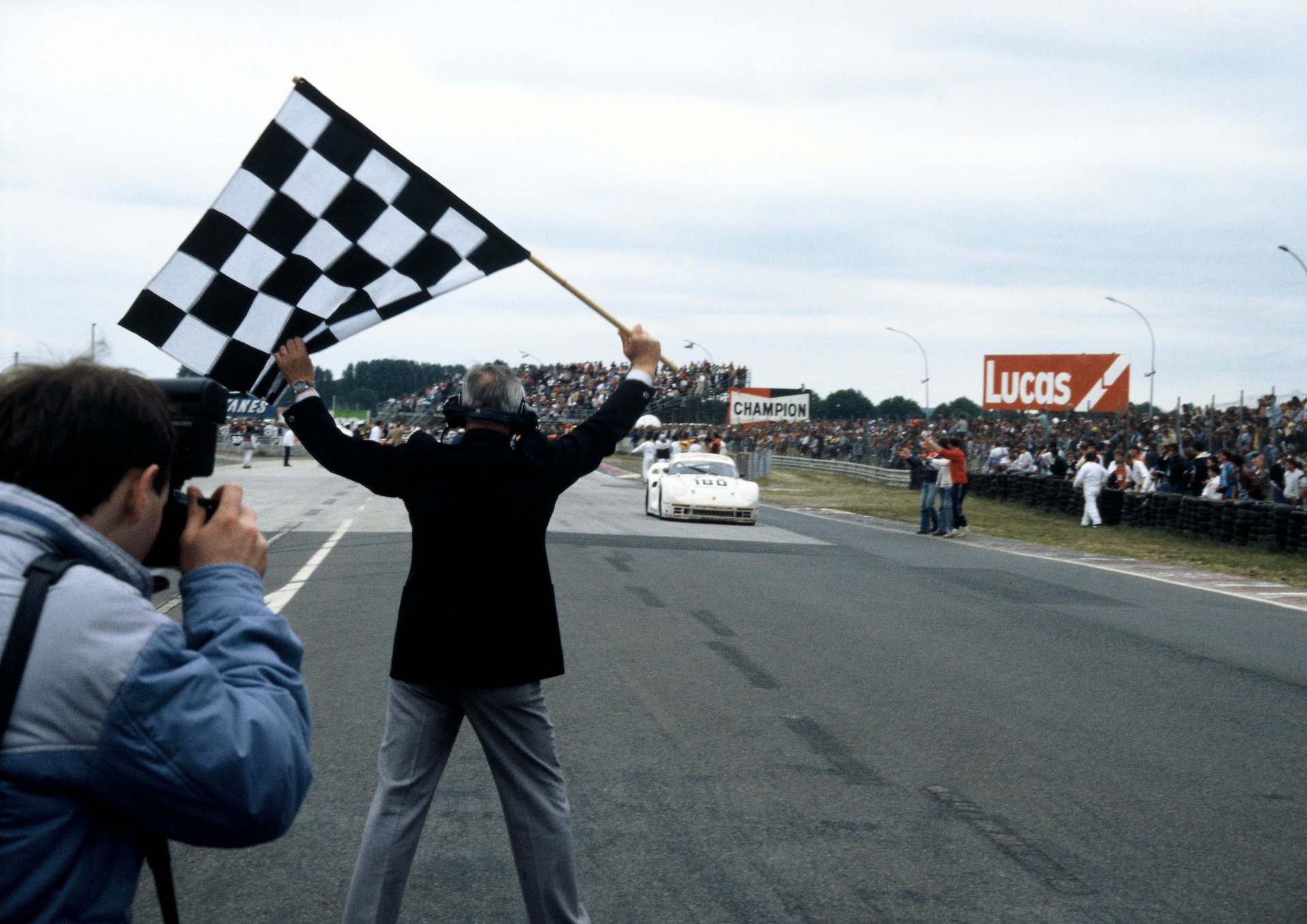
The 956 and its successor, the 962, won six consecutive runnings of the 24 Hours of Le Mans between 1982 and 1987. Customer teams ran both cars in Europe, Japan and the United States with consistent success. Porsche has 19 overall victories at Le Mans in total, and 17 of them were powered by turbocharged engines.

The F1 Engine Nobody Knew Porsche Built

TAG TTE PO1 engine
Credit: Porsche

Hans Mezger, who had designed the flat-twelve in the original 917, was back at a drawing board in the early 1980s working on something very different: a 1.5-liter twin-turbo V6 for use in Formula 1. The engine was commissioned by the McLaren team, funded through a company called Techniques d’Avant Garde, and badged as the TAG Turbo. Porsche’s name wasn’t on it anywhere. The whole unit weighed 150 kg (331 lbs).

It first ran in a Grand Prix in August 1983. In early form it produced around 710 horsepower in race configuration; by 1987, that number was up to 937 hp, with qualifying versions reaching 1,026 hp. Over the life of the program, the engine won 25 Grands Prix and three Formula 1 world championships. The people in the grandstands had no particular reason to know Porsche had anything to do with it.

Beyond the 911: Turbo Becomes a Name

First-gen Porsche 911 turbo artwork
Credit: Porsche

Even while the 935 was winning championships and the 956 was rewriting the record books at Le Mans, the word “Turbo” was quietly acquiring a different kind of weight inside Porsche’s own lineup. The production 911 Turbo, launched in 1974 with its distinctive wide fenders and rear wing, became the car that defined the nameplate for a generation of buyers. Intercooling arrived on road cars in 1977. The first 911 GT2, a track-focused rear-wheel-drive variant based on the 993-generation Turbo, came in 1995 and eventually reached 690 horsepower in its most developed racing form.

From there the name migrated to every corner of the range. Cayenne Turbo in 2002, Panamera Turbo in 2009, Macan Turbo in 2014. When Porsche launched the Taycan in 2019, the top models were called Turbo and Turbo S even though they’re fully electric and don’t have a turbocharger anywhere on them. It’s an odd situation, but it reflects what the word had come to mean inside the brand. Not a specific technology, but a specific tier.

The Turbo in the Hybrid Age

Porsche 919 Hybrid race car at a racetrack
Credit: Porsche

Porsche returned to top-level prototype racing in 2014 with the 919 Hybrid, a car that combined a 2.0-liter turbocharged V4 producing around 500 horsepower with an electric motor on the front axle. The system also included a generator driven by exhaust gas flow, effectively a second turbine in the exhaust stream harvesting energy that would otherwise go to waste. No other manufacturer in the World Endurance Championship used that approach. Combined output from the whole system was around 887 hp. The 919 won Le Mans in 2015, 2016 and 2017 before Porsche withdrew from the top class.

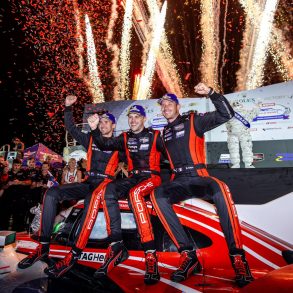
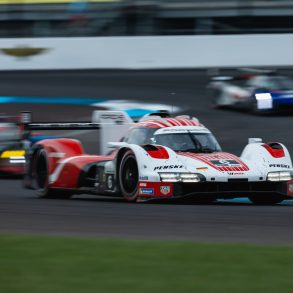
The current car, the 963, takes a more conventional hybrid approach. Its 4.6-liter twin-turbo V8 comes from the 918 Spyder road car, paired with a standardized hybrid system to keep costs in check. Total output is over 690 hp. The 963 won the 24 Hours of Daytona in its second season of racing.

Fifty years on from those first turbo test laps at Weissach, the basic physics haven’t changed. Force more air into the combustion chamber, extract more energy from the fuel. What’s different is everything else. The electronics, the materials, the hybrid systems layered on top. The turbo is still in there, doing its job.