

Current Porsche 911 Turbo S Cabriolet (992.2) – Reviews, Pricing, Specs & Buyers Guide
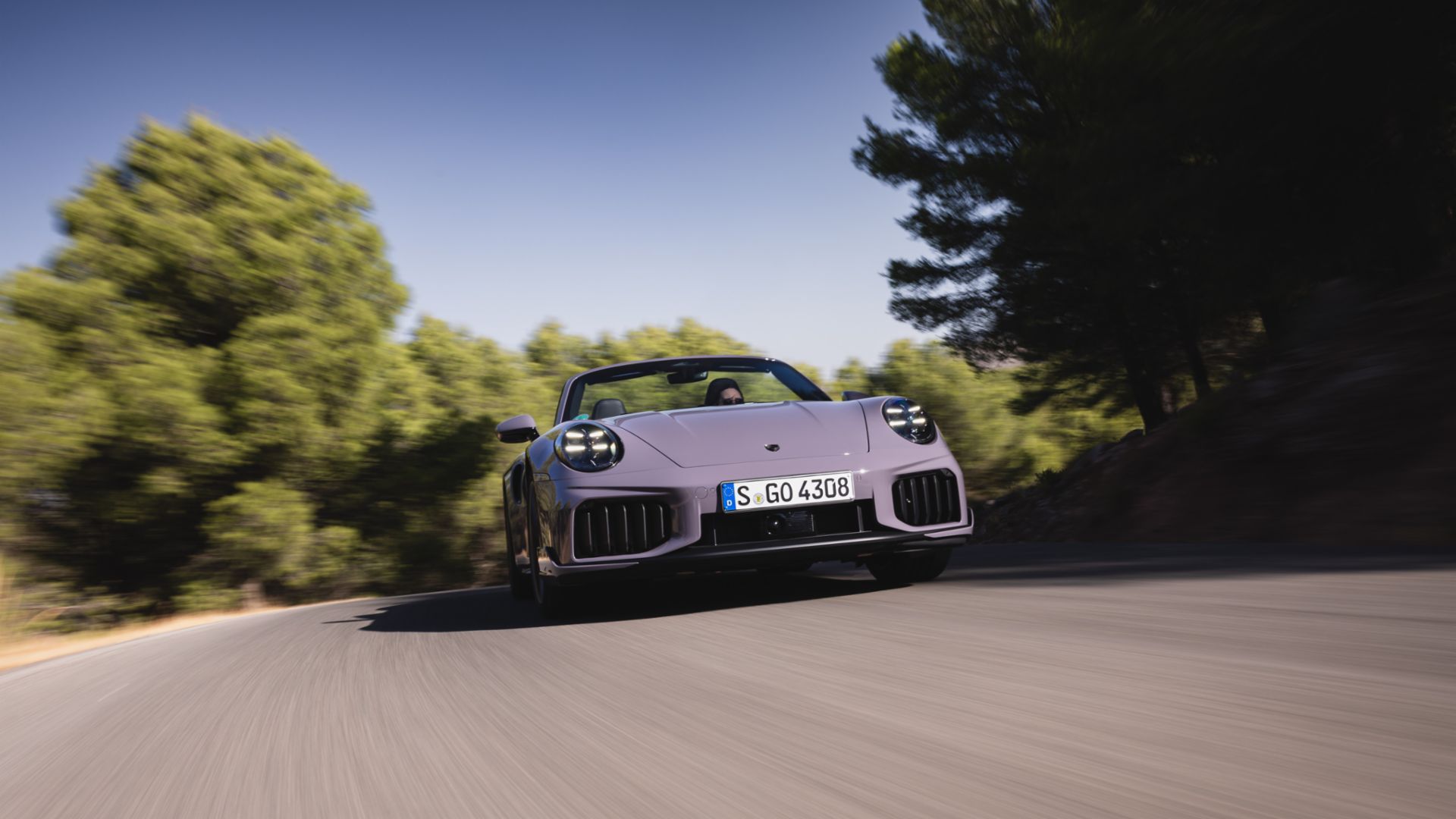
The Porsche 911 Turbo S Cabriolet (992.2) is the new high-water mark for open-top 911s. For this generation, Porsche has given its flagship cabriolet a T-Hybrid powertrain, twin electric-assist turbos, a gearbox with an integrated e-motor, and chassis hardware that reads like a motorsport wish list. The result is the most powerful and fastest 911 Cabriolet Porsche has ever put into series production, but one that still wants to be driven every day.
This guide walks through the story, specs, tech, reception, model-year changes, and buying advice for the 992.2 Turbo S Cabriolet.
Story: The Turbo S Goes Hybrid – With the Roof Down
The Turbo name has been attached to wild 911s since the 930 of the 1970s, but over the last two decades the Turbo S has settled into a clear role: the ultimate all-weather, all-rounder 911. Enormous power, all-wheel drive, dual-clutch gearbox, yet quiet enough and comfortable enough to commute in.
With the second-phase 992 update (992.2), Porsche decided this was the perfect place to make a big leap:
- In 2025 the company unveiled the new 911 Turbo S with T-Hybrid tech at the Munich show, in both Coupe and Cabriolet forms.
- It’s the second hybrid 911 after the 992.2 Carrera GTS, but here the tech is tuned explicitly for performance, not EV-style efficiency.
- Porsche’s own press kit calls it “the most powerful production 911 of all time”, with a system output of 711 PS / 701 hp and 800 Nm (590 lb-ft).
Importantly, Porsche never pitched this as a plug-in. The hybrid system is self-charging and relatively compact, borrowing ideas from the 919 Hybrid LMP1 car: electric turbochargers, brake-energy recovery, and a small high-voltage battery primarily there to make the car faster and more responsive. The Cabriolet version takes all of that and adds open-air theatre. You get the same system power and top speed as the Coupe, with only the smallest penalty in acceleration times.
Powertrain: Twin eTurbos and a Compact Performance Hybrid
At the heart of the Turbo S Cabriolet lies an all-new 3.6-litre twin-turbo flat-six backed up by an advanced T-Hybrid system.
From Porsche’s press kit and model pages:
- Engine: 3.6-litre horizontally opposed six-cylinder, twin turbocharged
- Hybrid system: 400-V T-Hybrid with
- two electric exhaust-gas turbochargers (eTurbos)
- a 1.9 kWh high-voltage battery
- an electric motor integrated into the 8-speed PDK gearbox
- System output: 701 hp (523 kW / 711 PS)
- System torque: 590 lb-ft (800 Nm) from about 2,300–6,000 rpm
- Power plateau: full 711 PS available between 6,500 and 7,000 rpm
The eTurbos can spool their compressors electrically, independent of exhaust flow, killing traditional turbo lag and allowing very aggressive boost strategies. The gearbox-mounted e-motor then fills in any gaps in torque, assists at low rpm, and recovers energy under braking.
This isn’t about silent EV driving—there is no plug-in mode—but about giving the Turbo S instant, repeatable response that simply wasn’t possible with a combustion-only setup.
Transmission & Drivetrain
As ever, the Turbo S Cabriolet is automatic and all-wheel drive only:
- Gearbox: 8-speed PDK dual-clutch with integrated e-motor
- Drivetrain: Porsche Traction Management (PTM) all-wheel drive, routing big torque to whichever axle can use it best
There’s no manual option here, but that’s consistent with the Turbo S’ remit: maximum performance with minimal effort.
Performance: Open-Top Hypercar Pace
On paper, the Turbo S Cabriolet is only a fraction behind the Coupe—and still firmly in hypercar territory.
From Porsche USA, Porsche press materials, and early test coverage:
- 0–60 mph: 2.5 seconds (Cabriolet, Sport Chrono)
- Top speed: 200 mph (322 km/h)
- 0–100 km/h (0–62 mph): Porsche quotes 2.5 seconds for the range; real-world tests often do slightly better
- 0–124 mph (0–200 km/h): about 8.4 seconds
- Nürburgring Nordschleife: the Turbo S platform has achieved 7:03.9 in Coupe form, around 14 seconds quicker than the old 992.1; the Cabriolet shares the same powertrain and chassis DNA.
Despite the added weight of the power-soft-top mechanism and hybrid system, the new Turbo S weighs only about 85 kg more than its predecessor. In practice that means a Cabriolet that still sits somewhere in the high-3800 lb range with fluids, but feels significantly more explosive than the previous non-hybrid car thanks to the hybrid torque fill and eTurbos.
The key takeaway from MotorTrend’s first drive and Edmunds’ review: the car feels immediately and violently fast from almost any speed, yet utterly unflustered when you’re just cruising.
Chassis, Suspension & Brakes
The Turbo S Cabriolet gets the same hardware as the Coupe, tuned to cope with the open-top body and added weight.
From Porsche’s press kit and MotorWeek’s first drive: PASM (Porsche Active Suspension Management) with re-tuned adaptive dampers
- New electrohydraulic Porsche Dynamic Chassis Control (ehPDCC) powered by the hybrid’s 400-V system
- Actively fights body roll and pitch
- Makes the car more predictable and easier to drive quickly
- Rear-axle steering standard
- Wider rear tyres than before: 325/30 ZR 21 (fronts remain 255/35 ZR 20) for extra traction.
Brakes are serious:
-
PCCB (Porsche Ceramic Composite Brakes) with 420 mm front discs and 410 mm rears—the largest ceramics ever fitted to a two-door Porsche.
CarThrottle and Autoweek both note that, combined with the improved tyres, these brakes allow the Turbo S to shed speed repeatedly without complaint, which is vital given how quickly it gathers pace.
Aero
Active aero also gets a major upgrade:
- Active vertical cooling flaps in the nose
- A new active front diffuser
- Adaptive front spoiler and re-profiled rear wing
- In their most efficient positions, drag is reduced by about 10% vs the 992.1; in performance modes they increase downforce and improve cooling and wet-weather braking.
Even with the roof mechanism and slightly different rear deck, the Cabriolet benefits from this whole aero package, making it stable at very high speeds—roof up or down.
Exterior & Roof: Widebody Drama, Open-Air Theatre
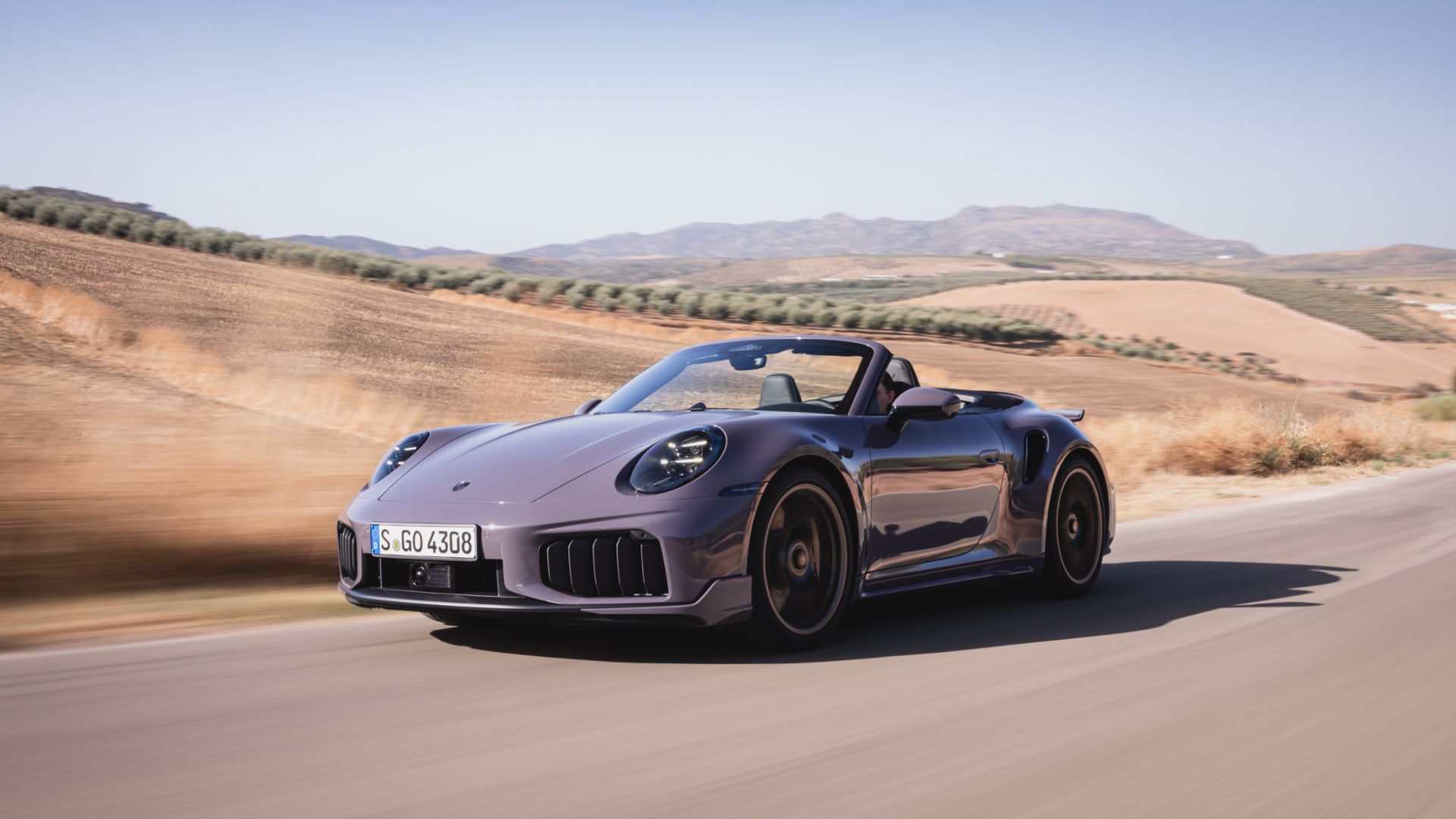
Visually, the 992.2 Turbo S Cabriolet stays recognisably 911 but is full of detail changes.
From Porsche imagery and Car and Driver’s walk-around:
- Wide Turbo body with big side intakes and flared rear arches
- New HD-Matrix LED headlights that house all light functions in a single unit, allowing larger, cleaner front intakes
- Revised front bumper with more vertical strakes in the intakes
- Re-shaped rear bumper with additional vents under a redesigned rear wing
- Titanium-finished sports exhaust outlets unique to this generation
A new trim colour, Turbonite, appears on badges, wheel centres, and trim elements, visually separating Turbo/Turbo S models from lesser 911s.
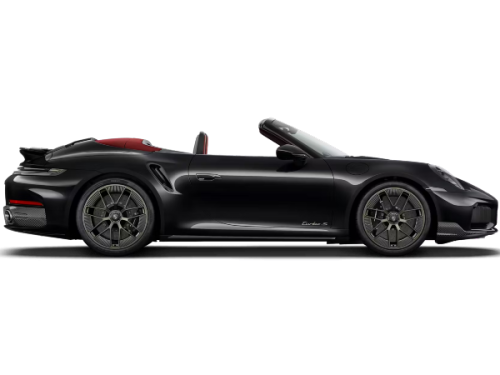
The fabric roof:
- Fully electric soft top with an integrated glass rear window
- Opens or closes in around 12 seconds at up to roughly 30–31 mph, in line with other 992 Cabriolets.
- Retains the classic 911 Cabriolet silhouette and allows you to use the rear seats, so it’s still a genuine 2+2 convertible.
Interior & Tech: Digital Flagship, Turbo S Flair
Inside, the Turbo S Cabriolet gets the updated 992.2 cabin architecture:
- 12.6-inch fully digital instrument cluster with multiple views (classic five-dial, track displays, etc.).
- 10.9-inch PCM central touchscreen with revised UI, enhanced Apple CarPlay and app integration.
Turbo-specific cues include:
- Turbonite accents on the steering wheel, dashboard, centre console surrounds, stitching, seatbelts and instrument graphics
- Unique carbon-weave trim with Neodyme inlays and optional perforated microfibre headliner
- Standard Sports Seats Plus with various leather combinations; adaptive or lightweight bucket seats optional
- Choice of two-seat configuration or 2+2, with the Cabriolet able to accommodate rear passengers by default
The net effect, as MotorWeek and Car and Driver both note when talking about the new Turbo S range, is a cabin that feels luxurious and tech-forward, but still recognisably 911 in layout and driving position.
Model-Year Updates: 992.1 Turbo S vs 992.2 Turbo S Cabriolet
The switch from 992.1 to 992.2 is a major generational step rather than a mild facelift.
Key changes for the Turbo S Cabriolet:
- Engine & powertrain
- 3.7-litre twin-turbo flat-six → 3.6-litre twin-eTurbo T-Hybrid
- Power: 640 hp → 701 hp (+61 hp)
- Torque: stays at 590 lb-ft but spreads across a much broader rev band
- New 1.9 kWh 400-V battery, twin eTurbos, and e-motor in the PDK housing
- Performance
- 0–60 mph drops by around 0.2 seconds; Porsche quotes 2.5 s for the Cabriolet
- 0–200 km/h improves by about 0.5 seconds
- Nürburgring time improves by ~14 seconds in Coupe trim
- Chassis & aero
- New electrohydraulic PDCC, tuned via the high-voltage system
- Larger PCCB discs (420/410 mm) and wider rear tyres (325 section)
- Active front diffuser and aero package improving cooling and drag
- Design & cabin
- New HD-Matrix LED lights, bumpers, rear wing, Turbonite accents
- Fully digital instrument cluster and updated infotainment
There isn’t (yet) a separate mid-cycle update for the 992.2; the 2026 model year essentially is the new hybrid Turbo S era.
Reviews & Reception
Because the powertrain and chassis are shared, most early drives focus on the Turbo S as a whole, but several outlets explicitly mention the Cabriolet.
MotorTrend’s first drive calls the hybrid Turbo S “electrified, unhinged, and brilliant”, praising:
- The lag-free response from the eTurbos
- The way PDCC and rear-steer let the car shrink around you despite its size and weight
- The blend of everyday comfort and lunatic pace
Car and Driver’s review frames the 2026 Turbo S as “supercar adjacent”, noting that:
- The driving position, visibility and 2+2 layout still make it more usable than most rivals
- The hybridisation makes it even quicker without erasing its 911 character
- The Cabriolet delivers nearly identical straight-line performance with the added joy of top-down driving
Edmunds highlights how easy the Turbo S is to drive very fast; the AWD and electronic systems mean that any oversteer or rotation is “nearly self-correcting,” making it arguably the easiest 700-hp car in the world to drive quickly. MotorWeek’s first drive specifically calls out the Cabriolet’s widebody stance and HD-Matrix lights, and emphasises that comfort and refinement remain intact in both Coupe and Cabriolet forms.
Common complaints across reviews and commentary include the weight and complexity. Some purists lament the added hybrid hardware and the increasing distance from “classic” 911 simplicity. The other complaint is pricing. U.S. pricing starts from about $284,300–$286,650 for the Turbo S Cabriolet, depending on source and whether destination charges are included—around $60k+ more than the outgoing car.
Still, the consensus is that as a halo 911 and everyday supercar, the new Turbo S (Cabriolet included) absolutely delivers.
Buying & Ownership Guide
In the U.S the base price of the 911 Turbo S Cabriolet starts at roughly $284,300–$286,650 before options. That puts it firmly in Bentley Continental GT / Ferrari Roma / McLaren Artura Spider money, which is exactly the company Porsche wants it to keep.
The Turbo S Cabriolet makes sense if you want the fastest, most capable open-top 911 that isn’t limited-run and you prefer effortless, all-weather pace over the raw, high-revving purity of a GT3. If you like the idea of hybrid tech being used purely to make a car faster and sharper, not to turn it into an eco-special then this is the car for you. If you’re obsessed with manual gearboxes and natural aspiration, you’re better off in a GT3 Touring or Carrera T Cabriolet. If you care more about cruising than cornering, a standard Carrera or Carrera S Cabriolet will be cheaper and still delightful.
Key Options to Consider
Based on Porsche’s configurator and dealer guidance:
- Seats:
- Sports Seats Plus are ideal for mixed road use.
- Adaptive Sports Seats add comfort for long trips.
- Full bucket seats (where available) make sense if you plan regular track days and want a more focused feel.
- Chassis & brakes:
- PCCB, PDCC, PASM, rear-steer are already standard—the chassis is fully loaded by default.
- A front axle lift system is a smart choice if you have steep driveways or city speed humps.
- Design & trim:
- Consider keeping the Turbonite accents and Turbo-specific wheels; they help cement the car’s identity and could matter for future collectability.
- Paint-to-Sample plus a tasteful interior spec will always be a draw on the used market.
Daily Usability
Despite the crazy numbers, the Turbo S Cabriolet remains a thoroughly usable car:
- AWD traction and PDK make it easy in bad weather and traffic.
- The roof is quick and well-insulated; with it up, refinement is close to the Coupe.
- Rear seats are small but useful for kids or luggage.
- Servicing and consumables (tyres, ceramics) will be expensive, but you’re in supercar territory anyway.
Final Verdict
The Porsche 911 Turbo S Cabriolet (992.2) is a landmark car: the first open-top Turbo S to deploy a full-on performance hybrid system. It’s heavier and more complex than any 911 Cabrio before it, yet also far faster, sharper and more capable, while remaining as friendly to drive as ever. If you want a convertible that can run with serious supercars on a circuit, cross continents in comfort, take the kids to dinner, and do it all with the roof down and 701 hp on tap, there’s really nothing else quite like it on sale today.
Videos & Reviews
Pictures & Gallery

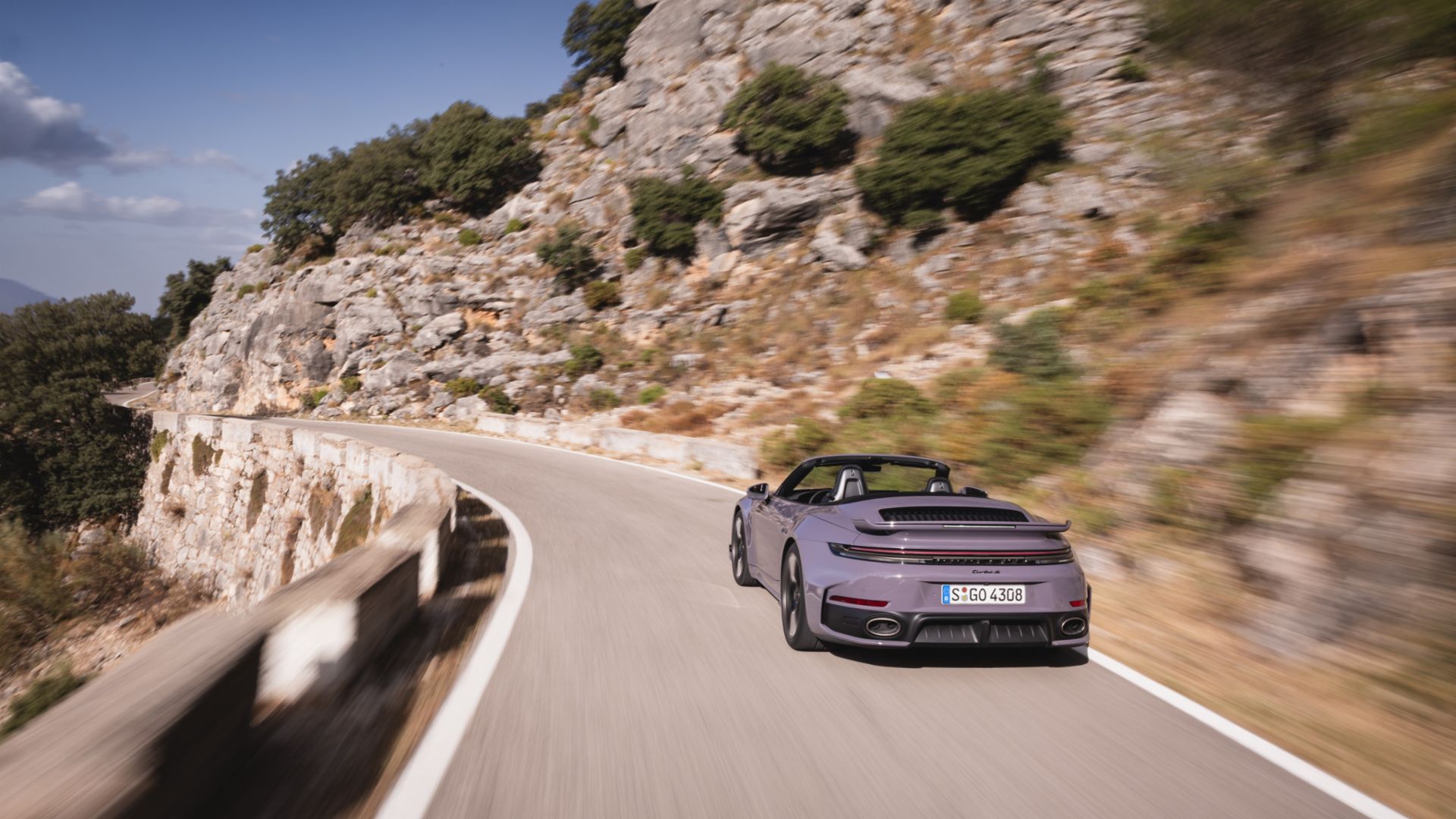
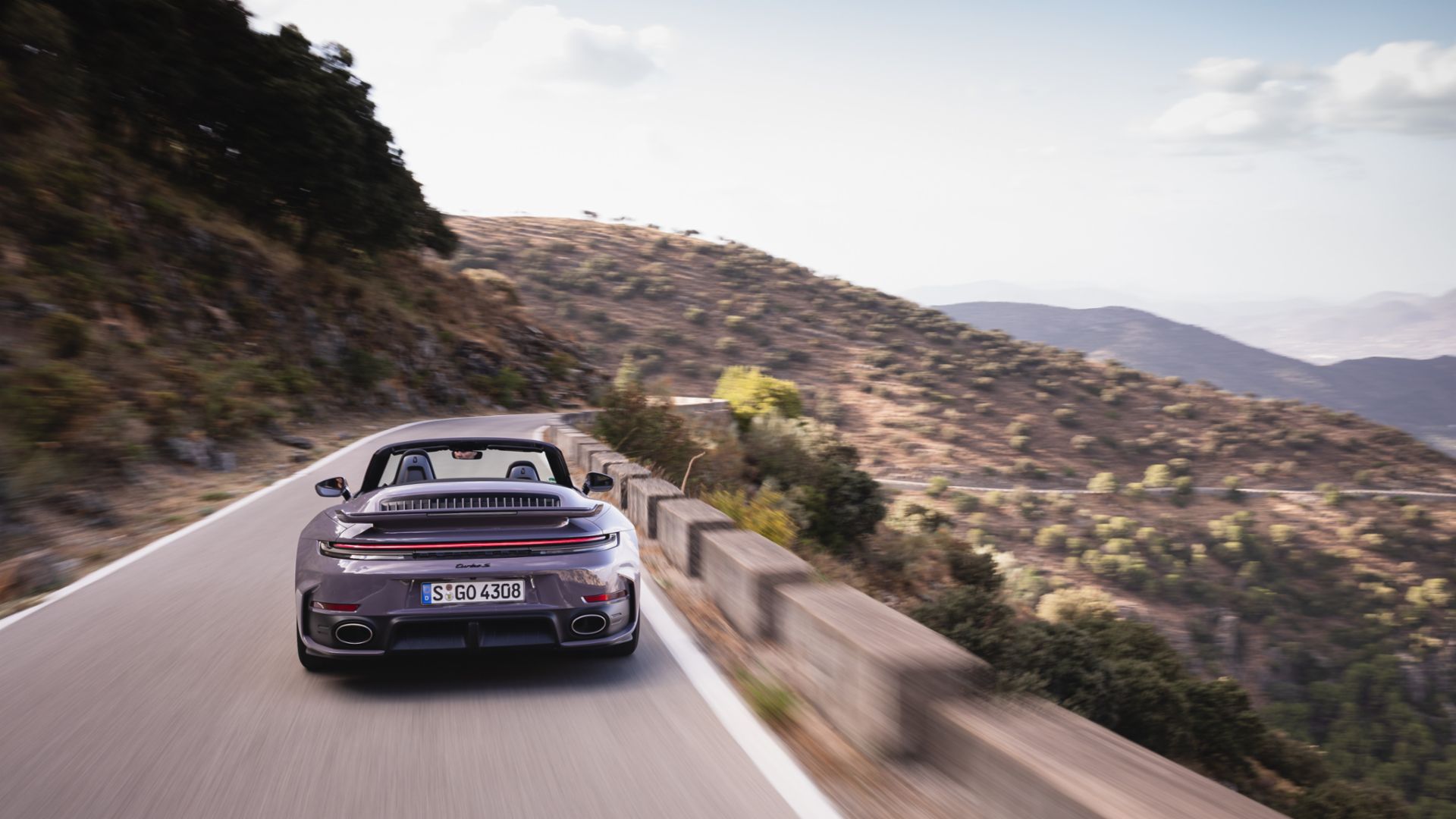
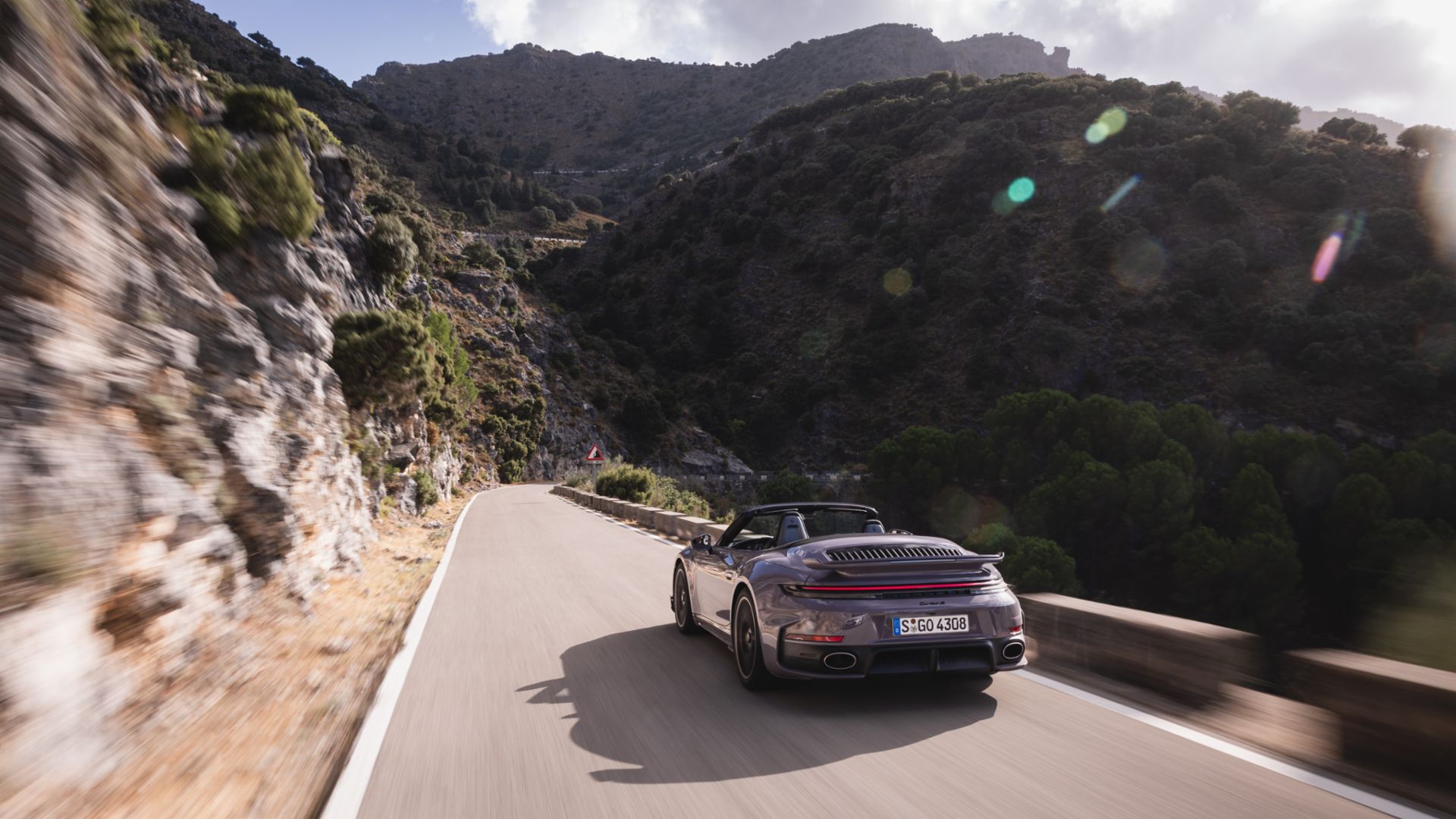

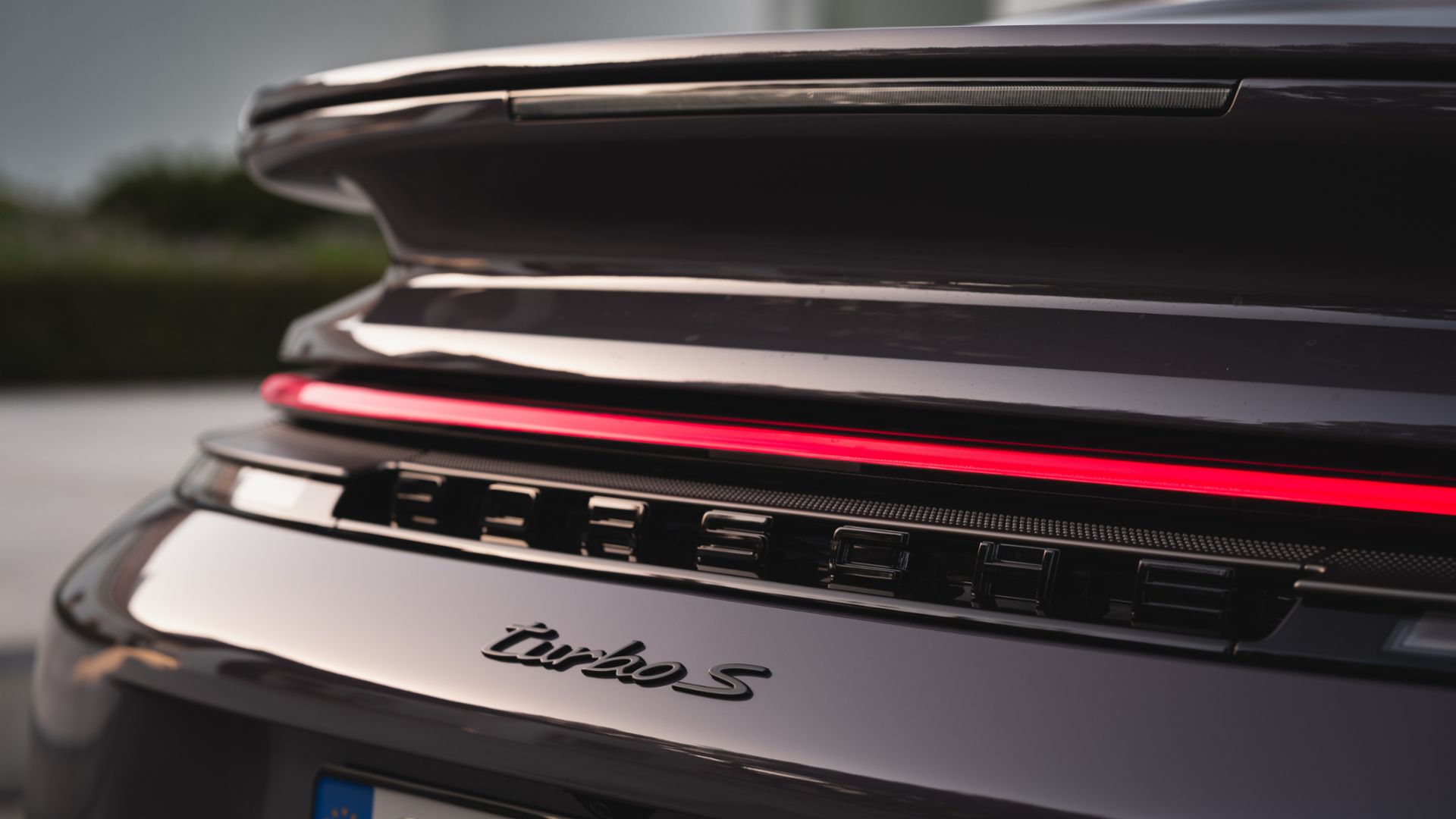

Press Release
September 7, 2025
New Porsche 911 Turbo S Celebrates World Premiere in Munich
Range-topping 911 adopts T-Hybrid tech to make major advances in street and track performance
- Most powerful production 911 with 701 hp (523 kW) system output
- 0 to 60 mph in 2.4 s. (-0.2 s. vs. previous Coupe using Launch Control)
- Circa 14 seconds quicker around the Nürburgring than the predecessor
- Unique combination of performance, comfort, exclusivity, and daily usability
- First 911 Turbo using innovative T-Hybrid drivetrain with two electric exhaust gas turbochargers
Porsche is presenting the new range-topping 911 at the IAA Mobility trade show in Munich: the new 2026 911 Turbo S is the most powerful production 911 to date thanks to an innovative twin-turbo powertrain with T-Hybrid technology. The 701 hp (523 kW) all-wheel drive sports car combines outstanding performance with a high degree of exclusivity, long-distance comfort and everyday usability.
Atlanta. The new Porsche 911 Turbo S has big shoes to fill. Its predecessor was already considered the benchmark for a sports car that blends performance, long-distance comfort, exclusivity and everyday usability. Now the 911 Turbo S raises the bar once again. Available as a coupe and Cabriolet, the new generation debuts with significantly improved performance, a more muscular design, refined aerodynamics, an optimized chassis and an extensive list of optional equipment for personalization.
“The 911 Turbo S is the most complete and versatile way to drive a Porsche 911. Whether in daily use, on long highway trips or on the track – we have been able to make the new 911 Turbo S even more comfortable, more customizable and at the same time significantly faster than its predecessor,” says Frank Moser, Vice President of the 911 and 718 model lines.
Innovative twin-turbo T-Hybrid powertrain
The newly developed, high-performance T-Hybrid powertrain achieves a system output of 701 hp (523 kW), a 61-hp increase over the previous model. This makes the new 911 Turbo S the most powerful production 911 to date. The maximum torque of the powertrain is 590 lb.-ft. and is available over an extremely wide range of 2,300 to 6,000 rpm. Peak horsepower is available across an especially broad powerband between 6,500 and 7,000 rpm.
The T-Hybrid technology, which first appeared last year in the current 911 Carrera GTS, has been developed further for the 911 Turbo S. While a single electric exhaust gas turbocharger (eTurbo) is integrated into the T-Hybrid system in the GTS, two eTurbos are used in the new 911 Turbo S. The turbines and compressors were specifically designed to meet the requirements of the top-of-the-range model. The two eTurbos not only contribute to the considerable increase in power, but they also improve responsiveness.
The particularly compact, 1.9-kWh high-voltage battery is the same as the energy storage unit in the 911 Carrera GTS. An eight-speed PDK with an integrated electric motor sends power to the Porsche Traction Management (PTM) all-wheel drive system. The Turbo S Coupe is capable of a 0-60 mph sprint in 2.4 seconds (-0.2 seconds compared to its predecessor). It takes 8.4 seconds to reach approximately 124 mph, which is an improvement of 0.5 seconds. The top track speed of the new 911 Turbo S is 200 mph.
Significantly quicker around the Nürburgring Nordschleife
The new 911 Turbo S has a curb weight of 3,829 lbs., which is a 180-lb. increase from its predecessor, but a modest one considering the additional components of the performance hybrid system. The additional weight is more than compensated for in all areas relevant to driving dynamics. The best proof of this is the lap time on the
Nürburgring Nordschleife. As part of the final development drives conducted in fall of 2024, a lightly camouflaged 911 Turbo S achieved a time of 7:03.92 minutes under the supervision of a notary – in the region of 14 seconds quicker than its predecessor.
“You don’t feel the weight gain. On the contrary – the car is much more agile, has more grip and is significantly faster than its predecessor in all relevant sections of the track,” says Porsche Brand Ambassador Jörg Bergmeister, who was involved in the development and testing of the new 911 Turbo S and set the official lap time.
Brakes and tires with optimized performance
The new Porsche 911 Turbo S improves in many areas to match its more potent powertrain. This includes a new generation of tires that offer significantly improved dry handling while maintaining good wet performance. The rear tires now measure 325/30 ZR 21, making them 10 mm wider than those of the previous car. Dimensions for the front tires remain the same as before at 255/35 ZR 20. The standard Porsche Ceramic Composite Brake (PCCB) system is fitted with new brake pads, the material mixture of which comes from motorsport and is designed with the increased power and associated braking demands in mind. The new pads are useful from both a performance standpoint and in offering improved brake pedal feel. The front brake rotors have a 420-mm diameter as before, while the rear rotors grow to a diameter of 410 mm, which is a 20-mm increase compared to the rear rotors of the previous 911 Turbo S. This means that the new model is equipped with the largest PCCB system that Porsche has ever installed in a two-door model.
Intelligent active aerodynamics
An updated design optimizes cooling for both the powertrain and brakes while delivering enhanced aerodynamics. Active, vertically arranged cooling air flaps in the front of the vehicle and an active front diffuser work in conjunction with an active front spoiler and an extendable, tilting rear wing to reduce drag or lift as the scenario demands. As a
result, the drag coefficient of the 911 Turbo S Coupé is reduced by up to 10 percent compared to its predecessor in the most efficient position. In addition, the active aerodynamics aim to improve wet braking behavior: In wet mode, the cooling flaps in the front close to help protect the front brake rotors from excessive water spray.
Chassis for improved agility and stability
An electro-hydraulically controlled Porsche Dynamic Chassis Control (ehPDCC) system is included as standard equipment. The system, also available as an option on the the 911 Carrera GTS T-Hybrid, uses the 400-volt electrical system and high-voltage battery to operate. It reduces body roll when changing direction and increases agility when entering and exiting corners, actuating more quickly than the hydraulic PDCC system used in the previous 911 Turbo S. The system works with cross-connected active coupling rods, in which pressure is built up by oil volume flow depending on the driving situation. This improves comfort and agility at the same time. For enhanced everyday usability, an optional front axle lift is available as an option. Because it uses the same 400-volt system as the ehPDCC system it can lift the front end faster than the system associated with prior models. Continuing in the footsteps of previous 911 Turbo models, front and rear track widths are greater for the Turbo S than the contemporary 911 Carrera models.
A new Sport Exhaust System is included as standard equipment and features a muffler and exhaust tips made of titanium, which save weight while enhancing both aesthetics and sound of the car. Changes to the 3.6-liter boxer engine, which uses asymmetrical timing, result in a sharp, throaty sound.
Exclusive appearance and high-quality materials
With the new 911 Turbo S, Porsche continues the styling strategy already in place on Turbo models from other product lines. Numerous contrasting elements are designed in
Turbonite, a color reserved for Turbo variants. These include the Porsche crest and the “turbo S” lettering at the rear. In addition, Turbonite accents in the slats of the engine grille and around the windows differentiate the range-topping model. The selection of wheels for the 911 Turbo S also includes new center lock designs in Turbonite.
As is typical for a 911 Turbo model, the body is wider than on the current 911 Carrera models. The rear quarter panels also feature intakes that channel process air to the engine. On the redesigned rear fascia, striking ventilation openings additionally emphasize the width. Oval shaped titanium exhaust openings are available as an option.
The interior also features many accents in Turbonite including the door panels, steering wheel, dashboard and center console surrounds. The instrument cluster, and Sport Chrono stopwatch get the same treatment, along with deviated stitching in Turbonite. The seat belts and several buttons in the center console are also finished in this color. Carbon fiber trim inserts with integrated Neodyme accents create a sporty and especially premium looking interior along with a perforated black Race-Tex headliner.
The 911 Turbo S coupe is delivered as a two-seater as standard, but rear seats are optionally available at no additional charge. The Cabriolet is only offered in a 2+2 seat configuration. Porsche equips the new 911 Turbo S with HD Matrix Design LED headlights as standard. The Sport Chrono Package including tire temperature gauge, the specifically tuned Porsche Active Suspension Management (PASM) chassis, the ehPDCC system, and the titanium Sport Exhaust System are also standard equipment. In the interior, adaptive 18-way Sport Seats Plus with memory function and “Turbo S” lettering on the headrests are fitted as standard. The Turbo S-specific embossing on the seat surfaces and door panels is a reinterpretation of the design features of the original 911 Turbo.
Additional customization is possible through Porsche Exclusive Manufaktur including Turbo Exclusive Design wheels with carbon fiber blades painted in Neodyme, a lightweight roof in visible carbon fiber, Exclusive Design rear lights and air intakes in the rear side section trimmed in carbon fiber. The attention to detail is more extensive than ever before. For example, carbon fiber windshield wiper arms are available as an option for the first time, offering 50 percent weight savings over the standard component. As in the past, customers may choose from colors beyond the standard palette through the Paint to Sample program. The interior can also be enhanced with details such as decorative stitching in contrasting colors, personalized leather embossing, and personalized painted vehicle keys.
The 911 Turbo S for the wrist
The Porsche Design watch configurator offers the possibility of designing your personal “sports car for the wrist” – tailored to your 911 Turbo S down to the last detail. The new black dial with design elements in Turbonite reflects its relationship to the car it references. In addition to Turbonite, all exterior colors (including Paint to Sample colors) are available for the color ring around the dial, while the titanium case features a black titanium carbide coating. The strap is made of original Porsche vehicle leather and stitching thread. A highlight is the hot stamping with the lettering “turbo S”. The timepiece is powered by the COSC-certified Porsche Design caliber WERK 01.200 movement, which features a flyback complication. The individually selectable winding rotor is designed to look like the wheels of the car it is matched to. Caseback engraving is also available. The 911 Turbo S chronograph is made by hand in Porsche’s own watch manufactory in Grenchen, Switzerland.
U.S. market arrival and pricing
The new 2026 Porsche 911 Turbo S is available to order and carries an MSRP of $270,300 for the coupe and $284,300 for the Cabriolet. Prices exclude a $2,350 fee for delivery, processing and handling. Arrival in U.S. Porsche Centers is expected by Spring, 2026. The Total Manufacturers Suggested Retail Price (MSRP) shown excludes taxes, title, registration, other optional or regionally required equipment, dealer charges, and any potential tariffs.